
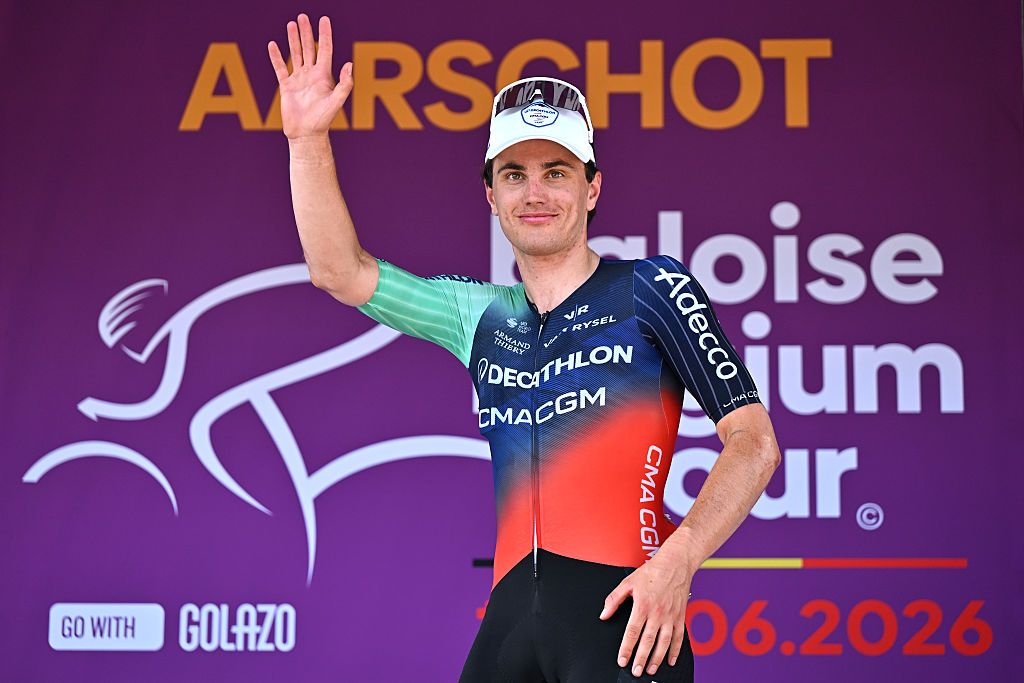
Olav Kooij, Visma's yellow fever, and the price of a singular focus
A single photo finish in Belgium exposed the great paradox of the sport's most dominant team. The price of absolute yellow, it turns out, is paid in sacrificed green.
A tyre’s width. That was the margin. When Olav Kooij (Decathlon CMA CGM Team) went wheel-to-wheel with Jasper Philipsen and Tim Merlier at the Baloise Belgium Tour 2026, the stakes were higher than a single stage win. He was racing against an entire philosophy.
That battle was more than a personal test. It was a ghost of Tour de France futures past, a referendum on the suffocating, singular vision of a team like Team Visma | Lease a Bike.
Team Visma | Lease a Bike has built a magnificent trap for itself. The team is a marvel of modern sports science, a yellow-and-black Death Star with one purpose: delivering Jonas Vingegaard to the top step of the podium in Paris.
Every rider signing, every training camp, and every mid-race tactic is calibrated to this one objective. And it works. It has created a dynasty.
But a monoculture, however successful, is a fragile thing. By dedicating every fibre of its being to the GC, Visma has engineered a talent bottleneck where there is no oxygen left for a pure sprinter.
A Tour de France team built as a seven-man mountain fortress around a single king has no room for a fast man and his leadout train. The goal is not to win stages; the goal is to not lose the Tour. They are different sports.
The Van Aert Anomaly
The conventional wisdom pushes back with a name: Wout van Aert. For years, the brilliant, confounding Van Aert has been seen as Visma’s solution to the sprint question, and the embodiment of their refusal to properly answer it.
He is a Swiss Army knife, a generational talent who can win a bunch sprint one day, a time trial the next, and pull his leader over a mountain the day after.
But Van Aert is an anomaly, not a system. He wins sprints on raw power and peerless bike handling, often freelancing with minimal support.
The team has never built a dedicated sprint project around him because his primary function has always been to be the final bodyguard for the GC leader. He is the exception that proves the rule: to win sprints for Visma at the Tour, you must first be a domestique.
This was the gilded cage a sprinter like Olav Kooij can find himself in. He was a young sprinter of immense speed who needed a team to invest in his talent, build a leadout, and give him the backing required to contest Grand Tour stages.
Kooij was a specialist in an ecosystem that only rewards the generalist. He was a racehorse stabled in a barn full of draft horses.
His move to Decathlon CMA CGM Team seemed a necessity, an admission that a sprinter's ambitions and a GC team's are often fundamentally incompatible. He could stay and become a well-paid cog in the Vingegaard machine, or he could leave and become the rider he was meant to be.
The Verdict in Belgium
And now we have the evidence. Competing against Jasper Philipsen (Alpecin-Premier Tech) and Tim Merlier (Soudal Quick-Step) in a straight-up drag race is the cycling equivalent of a young guitarist leaving a world-famous band and promptly writing a better song.
Philipsen and Merlier represent the pinnacle of modern sprinting. To beat them both is to announce your arrival at the very top table.
This is what a team like Visma can let walk out the door: not a promising junior, but a sprinter capable of winning on the biggest stage right now.
They had a potential green jersey winner in their ranks, and the all-consuming gravity of the yellow jersey forced him out.
Visma’s management will argue the trade-off is worth it. They will point to the Tour de France titles and say that nothing else matters, which is a defensible position.
But it reduces a cycling team to a single metric and a single rider. It ignores the glory that comes from fighting on all fronts—for yellow, yes, but also for green, for stages, for the joy of a perfect leadout.
When the Tour de France 2026 peloton boils into its first bunch sprint, Team Visma | Lease a Bike will be there, dutifully protecting their king at the front. But they will be spectators to the day’s real drama.
They will watch Olav Kooij, the one who forged a different path, fighting for a crown they decided they couldn't afford to chase. And that, in a flash of colour over a finish line, is the entire story.
He was a racehorse stabled in a barn full of draft horses.
They had a potential green jersey winner in their ranks, and the all-consuming gravity of the yellow jersey forced him out.
They will watch Olav Kooij, the one that got away, fighting for a crown they decided they couldn't afford to chase.