
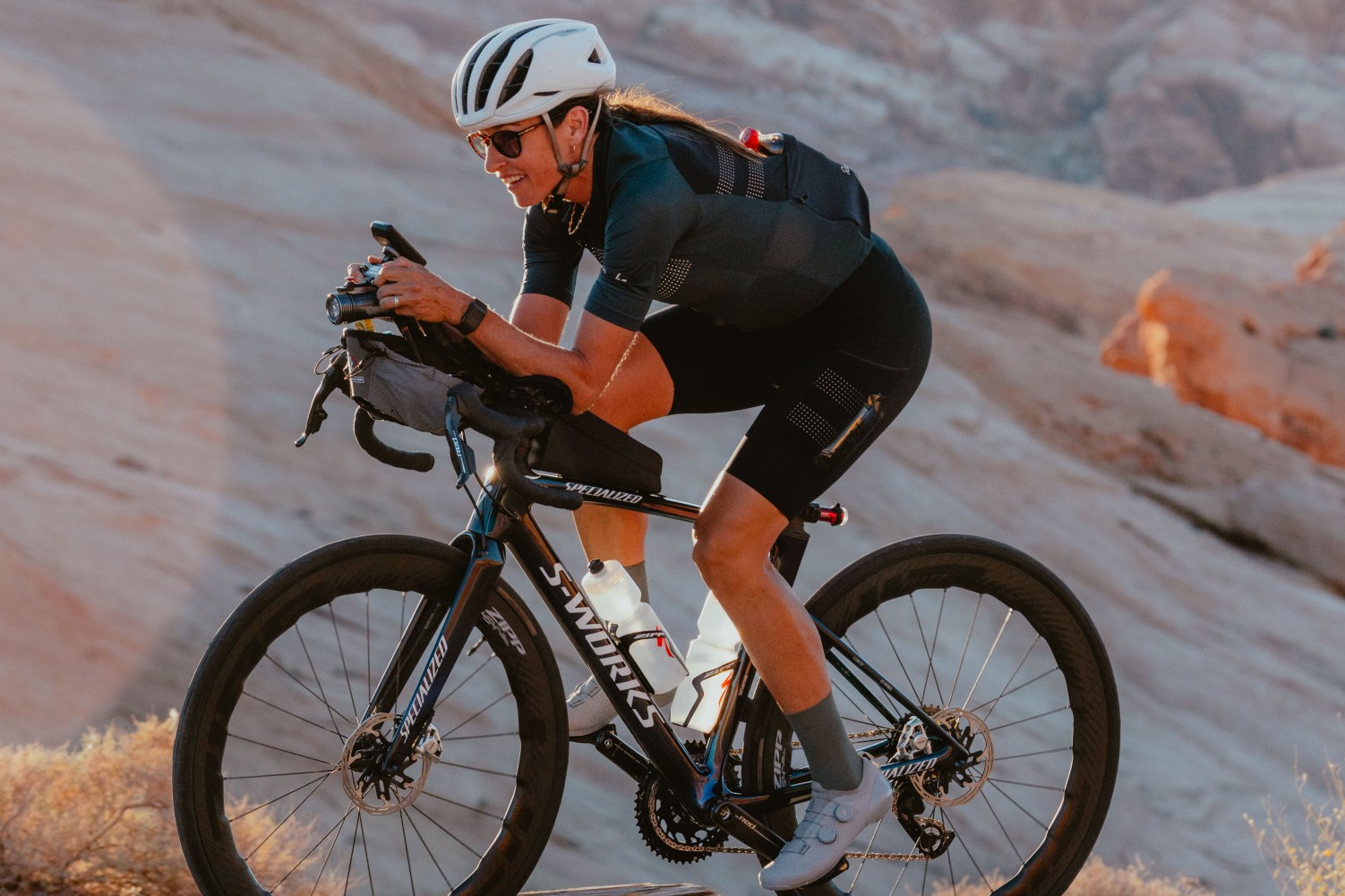
The day the planet pushed back
Lael Wilcox didn’t fail in her major endurance attempt. She was beaten by an opponent that no amount of training can overcome: a planet with a fever. Her story is a warning.
There is a unique dread for the dot-watcher, a stillness that signals not rest but ruin: a single GPS point, frozen on a map of France.
For days, Lael Wilcox’s dot had been a testament to relentless forward motion, a tiny digital emissary for an immense human effort. Then, somewhere in France, it stopped.
In that silence, a new story about the limits of endurance began.
This was supposed to be a story about the clock. Wilcox was on a record attempt, where the enemy was meant to be the distance, the fatigue, the lonely expanse of the road.
But the enemy that ended her attempt was the air itself. Extreme heat turned the French countryside into a convection oven, and her body, pushed to its absolute limit, began to cook from the inside.
The reason given was severe heat exhaustion. The real reason is bigger, and it implicates us all.
This isn't a story about one athlete hitting a wall. It is a story about the wall moving.
For decades, the narrative of ultra-endurance has been one of human will triumphing over static obstacles: the mountain, the desert, the sheer number of kilometres. But the obstacles are no longer static.
The planet, our silent arena, has started to play defence. Wilcox’s abandoned ride is a brutal reckoning, a postcard from a future where the primary challenge isn't conquering the Earth, but surviving it.
The Old Excuses Don't Work Anymore
The conventional wisdom will push back on this. It will say that suffering is the entire point of the exercise, that cyclists have always battled the elements.
The legends of the sport were forged in snow, relentless rain, and sun so blistering it was said to melt tarmac. This, the argument goes, is just the game – a particularly hard level, perhaps, but the game nonetheless.
But that argument fundamentally misunderstands the shift we are living through. This isn't just weather; it's climate. A blizzard is an event; a melting cryosphere is a systemic change.
A hot day is a challenge; a continental heat dome is a non-negotiable physiological barrier. The human body is a miraculous engine, but it operates within tight thermal tolerances.
Past a certain wet-bulb temperature, sweating no longer cools the body. The engine redlines, and then it seizes. There is no training for that, and no amount of grit can overcome the laws of thermodynamics.
Wilcox’s support team didn't advise her to stop because she was tired or sore. They did so because she was in real, physiological danger.
Think of it as a fever. When your body fights an infection, it raises its temperature to make the environment hostile to the invader. The Earth is doing the same.
We, with our grand tours and our globe-spanning record attempts, are suddenly finding the environment hostile in a new and terrifyingly active way. Wilcox wasn't just riding through France; she was riding through the planet's immune response.
A New Kind of Record
What does this mean for a sport built on pushing boundaries? It means that past records, set in a cooler, more stable climate, may soon become functionally unbreakable.
They will become artefacts of a bygone era, like a four-minute mile before modern tracks, preserved in the amber of a world that no longer exists.
It also means race organisers, from the grandest tours to the most grassroots local event, must now plan for conditions once considered hundred-year freak occurrences. Route planning is now an exercise in climatology.
And it means we, as fans and participants, must recalibrate our understanding of heroism. Maybe the heroic thing isn't always pushing through until you collapse, but being smart enough to listen when your body – and the planet – is telling you to stop.
Lael Wilcox’s dot stopped moving in France, but the story didn’t end there. It ceased to be a tale of a record lost and transformed into a warning sent.
Her body didn't fail. It sent a message, translated from the language of heat and exhaustion into a simple, undeniable truth for anyone who loves to move across a landscape under their own power.
The map is changing. The opponent is bigger than you think.
This isn't a story about one athlete hitting a wall. It is a story about the wall moving.
The planet, our silent arena, has started to play defence.