
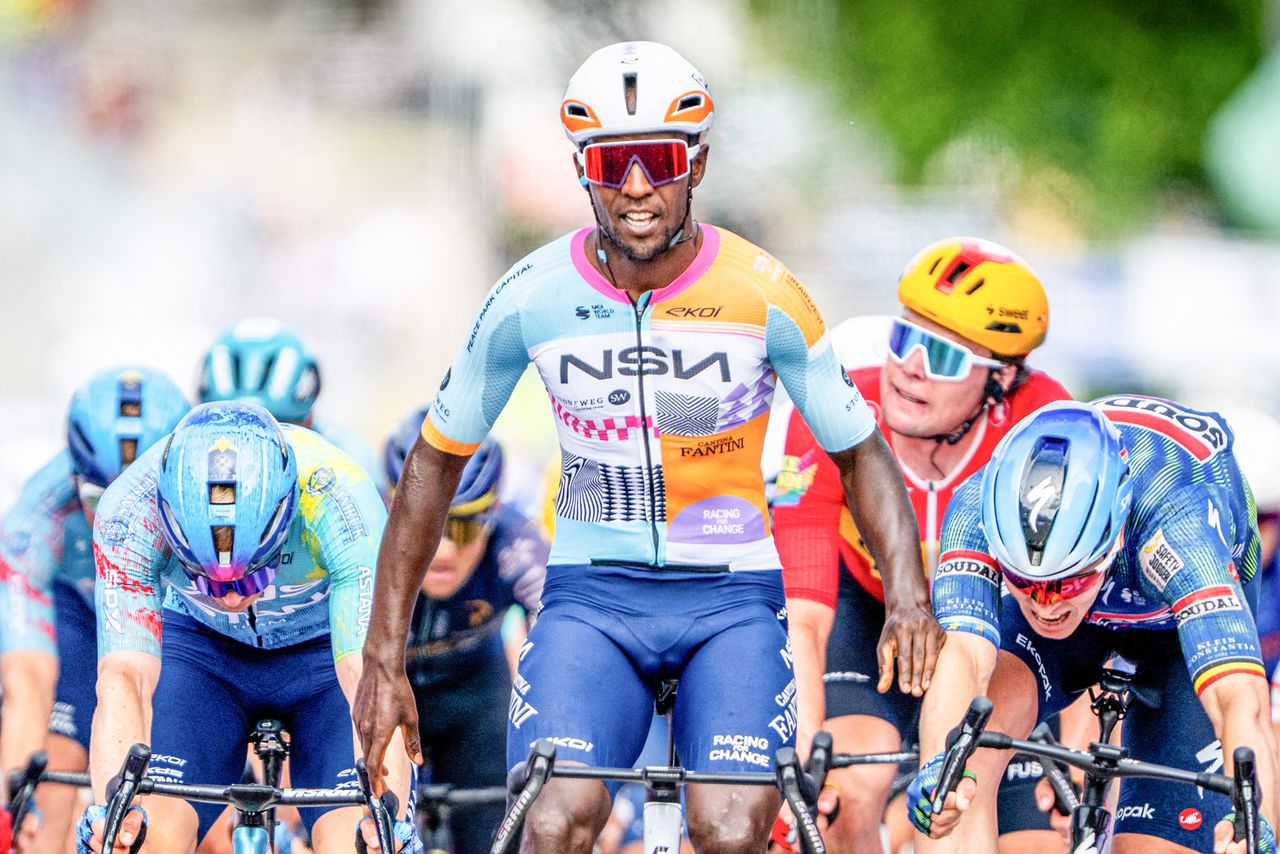
The Beautiful, Futile Gesture of the Sprint Train
NSN Cycling is betting its entire Tour de France on Biniam Girmay. It's a romantic, nostalgic, and profoundly misguided attempt to win a war that ended years ago.
There are two Tours de France. There is the one that exists in the collective memory: a swashbuckling adventure of individual raids, heroic sprints, and jerseys won through cunning and panache.
And then there is the one that actually exists now: a cold, attritional war of watts per kilo, a three-week siege conducted by monolithic super-teams whose only objective is the final yellow jersey.
NSN Cycling, it seems, has packed its bags for the wrong one.
The team’s announcement of its roster for the Tour de France 2026 is a declaration of intent, a throwback strategy made flesh. The squad is built for one purpose: to deliver Biniam Girmay (NSN Cycling) to stage victories.
With riders enlisted for lead-out duties, and climbers presumably tasked with babysitting through the Alps, the message is clear. They are not here for the general classification. They are here for the sprints.
Conventional wisdom pushes back. It says a team must play to its strengths, and Girmay is a generational one.
A stage win at the Tour is the sport’s most visible currency. A sprinter is a hero for a day, every day they win. This is a simple, legible, and glorious ambition—why complicate it?
Because the Tour has already complicated it for them. The race has evolved into a GC-obsessed organism that suffocates all other ambitions.
The teams fighting for yellow—with their nine-figure budgets and squads of interchangeable climbers—do not simply contest the mountains. They control everything, setting a suffocating pace on the flats to protect their leaders and neutralise breakaways.
The sprinter’s stages are no longer a chaotic free-for-all. They are carefully permitted events, allowed to happen only when the GC giants have finished their own business.
A Specialist in a Generalist's World
To dedicate an entire eight-rider roster to this pursuit is to accept a role as a bit-part player in the main drama. For five or six days out of 21, NSN will be at the centre of the action, a well-drilled machine fighting for a few hundred metres of road.
For the other 15 stages—the mountains, the time trials, the transition days—they will be largely invisible, their sole job to shepherd Girmay inside the time cut. They are sacrificing any chance of animating the race in its decisive moments for a handful of explosive, but ultimately secondary, conclusions.
The modern Tour de France is a three-week siege, and a sprint victory is a glorious, fleeting raid on the castle walls. It’s a moment of immense excitement, but it doesn’t change who holds the throne.
The narrative, the sponsorship value, and the soul of the event now live and die with the fight for yellow. In a race that has become an all-consuming GC war, NSN Cycling is choosing to play a different, smaller game.
The Opportunity Cost of Purity
Think of the resources committed: a full lead-out train, helpers to fetch bottles, and climbers to pace a star through the mountains. That is a massive investment of salary and strategy.
The opportunity cost is the freedom for other riders to hunt their own stage wins from a breakaway. It’s the possibility of a climber trying to salvage a top-15 on GC. It is, in essence, the chance to be relevant for more than a week of the race.
This isn't to denigrate Girmay, who is a phenomenal talent, nor is it to say stage wins don't matter. But the structure of modern cycling demands more.
A team that forgoes the GC battle entirely is like a film studio in the 2020s deciding to exclusively produce silent films. The craft is admirable, the artistry may be pure, but the audience and the industry have moved on.
They are bringing a cavalry charge to a tank battle. It’s magnificent, but the outcome is preordained.
Perhaps there is a romance in that: a refusal to bow to the homogenisation of the sport, a belief in the pure, visceral thrill of the bunch sprint. It’s a lovely thought.
But the Tour de France is not a lovely poem. It is a brutal, unforgiving machine.
NSN is banking its entire season on a strategy that requires the race to be something it simply is not anymore. And that, in three weeks, is the entire story.
In a race that has become an all-consuming GC war, NSN Cycling is choosing to play a different, smaller game.
They are bringing a cavalry charge to a tank battle. It’s magnificent, but the outcome is preordained.
The sprinter’s stages are no longer a chaotic free-for-all. They are carefully permitted events, allowed to happen only when the GC giants have finished their own business.