
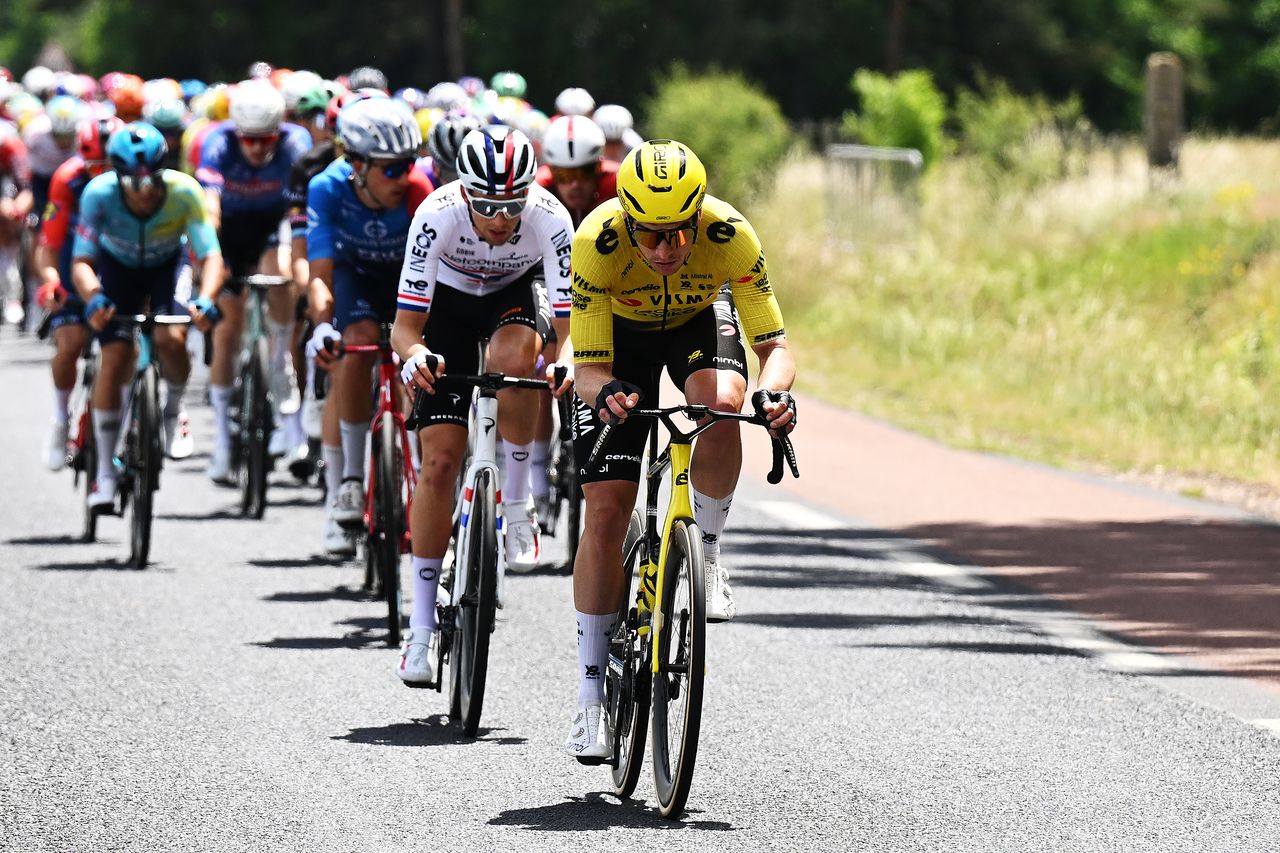
The Tour’s final dress rehearsal
The national time trial championships are a strange pre-Tour ritual. Some riders find form, others find the tarmac. But the clock is never the only story.
There is a particular quiet to the week before the Tour de France. The training is done, the bags are packed, and the noise is about to begin.
But before the caravan rolls out, there is one last, strange ritual: the national championships. For the specialists against the clock, it’s a final, high-intensity test – a dress rehearsal where the stage is real and the falls are hard.
Conventional wisdom says to ignore these races as a predictor for July. It argues that a one-hour, flat-out effort has little in common with the three-week marathon of the Tour. It’s a different sport, a different kind of suffering.
Physiologically, this isn't wrong. The power numbers are irrelevant, the stakes low, the prize a jersey you’ll barely wear.
But that misses the point. To understand why, you only need to look at two riders on the Tour de France 2026 start list.
In the final days of preparation, two narratives unfolded, both destined for the Tour de France 2026. One was of serene, metronomic confirmation; the other was of sudden, violent disruption.
On one side was Filippo Ganna. His preparation appears to have been seamless. It was a man in complete control of his form, his equipment, and his destiny, laying down a simple marker: I am ready. For a rider like Ganna, this is the quiet hum of a perfectly tuned engine.
On the other side was Edoardo Affini (Team Visma | Lease a Bike), a crucial engine whose own ambitions are secondary to pulling on the front. His final preparations were disrupted by a crash. While the team has confirmed he will start the Tour, the damage isn't always measured in fractures.
It’s measured in lost skin, yes, but also in lost confidence. It's a week of recovery when rivals are sharpening their form, and the nagging doubt that creeps in when your body has been brutally reminded of its fragility.
This is the true value of the national championships as a diagnostic tool. They are a psychological X-ray, revealing the hidden cracks or reinforced foundations of a rider's Tour campaign.
The steelman and the stage
A sceptic might argue it’s an unnecessary risk, a distraction. Why would a Tour contender put it all on the line for a national title a week before the Grand Départ?
The answer is that pressure cannot be simulated in training. The weight of expectation, the need to perform on a specific day, the focus required to nail every corner for an hour – that is a rehearsal for the suffocating pressure of the Tour itself.
And then there is the story of momentum interrupted. Affini was supposed to be a known quantity for his team, a reliable constant. The crash turns him into a variable.
Will he be fully recovered? Will there be a subconscious hesitation on the first wet descent in the Tour? His team says he’s fine and he is on the start list for the Tour, but the body and mind keep their own scorecards.
The clock tells one story. The body tells another.
The illusion of the time trial is that it's a pure test of physical strength. But it is always more than that: a test of focus, of nerve, of process. When that process breaks down, the consequences ripple outward.
For Ganna, the final build-up appears to have been a flawless execution. He will arrive at the Tour start with the quiet assurance that his plans are unfolding perfectly. He carries no new questions, only the same answer he has given many times before: on his day, he is the benchmark.
For Affini, the road to the Tour now includes an unplanned detour through pain and uncertainty. He will arrive with a question mark hanging over him, visible only to himself and his team.
The Tour de France is so demanding because it preys on such uncertainties. It finds the smallest weakness – physical or mental – and exploits it over 21 stages until it becomes a breaking point.
We watch these national championships for the spectacle and the jerseys. But if you want to know who is really ready for the Tour, don’t just look at the timesheet. Look at who crossed the line with a calm smile, and who didn’t cross it at all.
The clock tells you who was fastest. The aftermath tells you who is ready.
The clock tells you who was fastest. The aftermath tells you who is ready.