
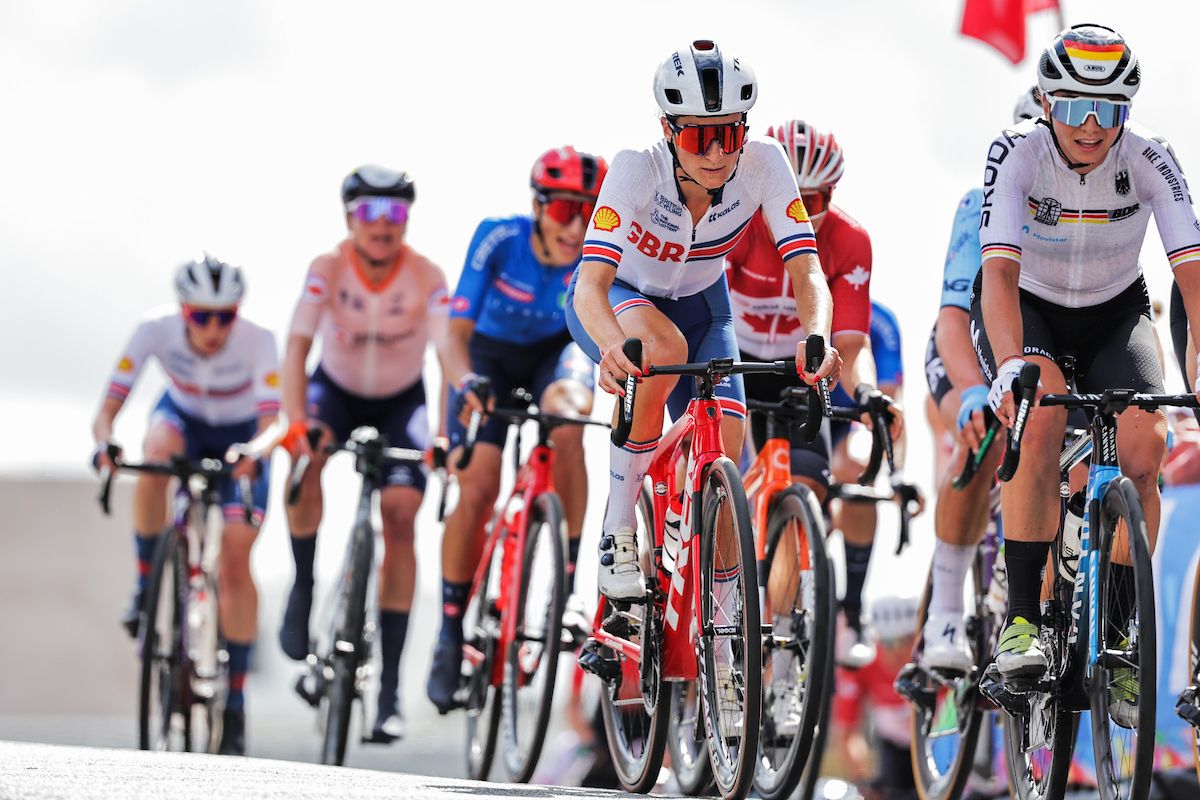
The knowledge you can't teach
The value of a figure like Lizzie Deignan to British Cycling isn't just her experience as a decorated professional. It's the map she has charted for a territory few have navigated: the life of a mother at the absolute peak of professional sport.
Picture the classic Sports Director. He’s a man, almost certainly. Lean, weathered, a former pro himself, with a face etched by a thousand grim days in the Belgian crosswinds.
He’s hunched over a steering wheel, barking tactics into a radio, his world compressed to the gap, the gradient, and the kilometre marker. He knows the playbook; he wrote parts of it.
Now, picture Lizzie Deignan in that same seat. The playbook is there, of course; a decorated former professional knows how a race is won and lost. But she holds another volume, one nobody else has.
It’s a book written not in watts and tactics, but in the quiet, unglamorous, and revolutionary work of being a mother who refused to let her career end. The prospect of her taking on a role like Sports Director for the Great Britain Cycling Team, with a focus on a future Olympics, is not just a smart idea. It’s a potential paradigm shift.
To understand why this move is so significant, we have to first dismantle the old way of thinking. The conventional wisdom says a director’s job is purely tactical, their value lying in reading a race and calling the shots.
It’s a job about logistics and strategy, not empathy. From this perspective, any decorated ex-pro will do. Deignan’s experience as a parent? A nice biographical detail, but irrelevant to the task at hand.
This is, to put it mildly, nonsense. It’s an antiquated view of what an athlete is and what a team needs. Professional cycling, particularly for women, is a career fraught with questions that extend far beyond the finish line.
When do you start a family? Can you come back? What does a contract look like when it has to account for pregnancy? How do you manage the immense physical and mental load of elite performance alongside motherhood?
For decades, the answer from the sport was a deafening silence. The road simply ran out.
Riders like Lizzie Deignan didn't just challenge that silence; they provided a new answer, written in the ink of their own comebacks. They didn't just return to the peloton; they returned to the very front.
In doing so, she charted a new course, navigating a wilderness of contractual uncertainty, physical rehabilitation, and societal expectation. She proved it was possible.
That is the knowledge she brings to the director's car. It is not something you can learn in a coaching seminar or glean from a power file. It is lived, earned, and deeply understood.
For a young female rider on the British squad contemplating her future, a leader like Deignan would not just be a boss with a race plan. She is a proof of concept, the person who can have the conversation that isn’t about the next race, but about the next decade of a life. She can talk about childcare logistics with the same authority she talks about a lead-out.
This isn't just about the women's team, either. The perspective Deignan offers is one of holistic athlete support – an understanding that the person on the bike is, in fact, a person.
A rider struggling with motivation, outside pressures, or the simple, grinding reality of being far from home will find in her a leader who sees more than just the engine. This is the new frontier of elite performance: not just stronger athletes, but more resilient and better-supported people.
A traditional DS can hand you a map of the race course. They can point out the climbs, the tricky descents, and the likely points of attack.
Deignan can do all that, but she also has the map for the rest of the terrain – the part that is far more difficult to navigate. The part that, for so many women before her, was marked ‘here be dragons’.
Appointing a director with her experience would be an admission that the old model is insufficient. It is a recognition that to build a sustainable and successful future for the sport, you need leaders whose expertise encompasses the full, complex reality of their athletes’ lives.
In this, British Cycling would not just be hiring a champion. They would be hiring a guide. And for the generation of riders heading towards Los Angeles and beyond, that might be the most valuable thing of all.
She can talk about childcare logistics with the same authority she talks about a lead-out.
British Cycling didn't just hire a champion. They hired a guide.