
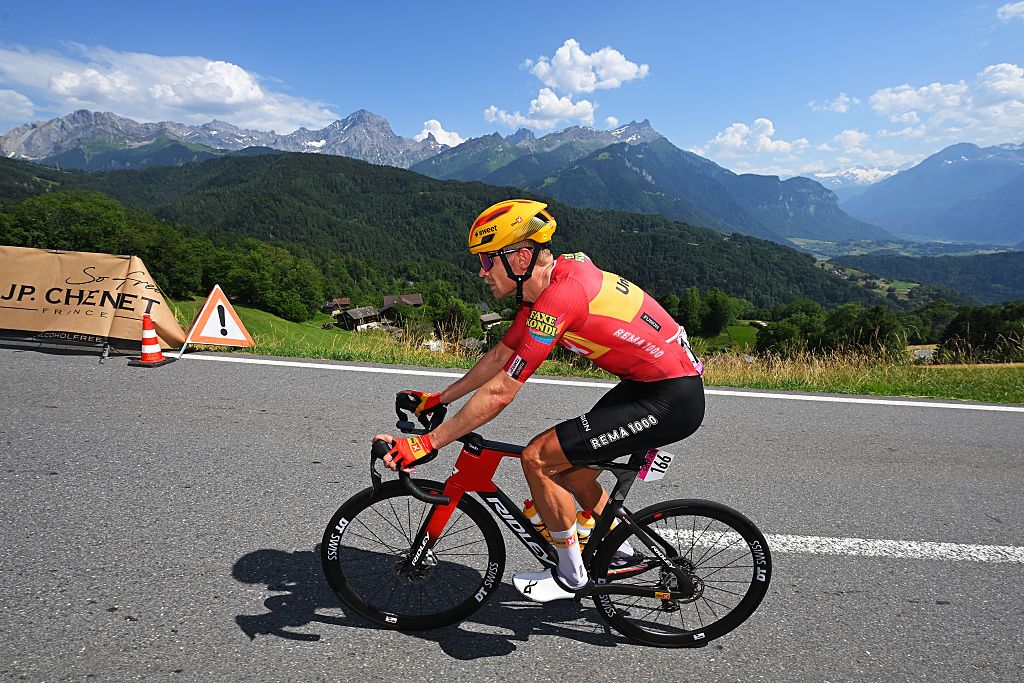
The Last Treasure Hunter
Magnus Cort is a bug in the code of modern cycling, a glorious, unpredictable glitch we may not see again.
There are two kinds of victory in a Grand Tour. There is the orchestrated, inevitable kind, the product of a thousand watts saved and a million dollars spent.
It is the GC leader, insulated from the wind by eight teammates, delivered to the final climb to execute a pre-planned attack. It is science, it is efficiency, and it is, very often, crushingly dull.
And then there is the other kind: the smash-and-grab, the improbable heist. The victory stolen from under the noses of the organised and the powerful by a single rider who saw a sliver of a chance and kicked the door down.
This is the art of the opportunist. And as Magnus Cort prepares to ride the Tour de France this July, we are witnessing the twilight of one of the last great masters of this art.
To understand what we are losing, you have to understand the ecosystem in which a rider like Cort operates. The Uno-X Mobility rider has tallied Grand Tour stage wins across his career.
None of them made him a contender for the overall, and none were the result of a multi-million-euro leadout train. They were acts of larceny, born of a particular cycling intelligence that is becoming rarer by the season.
The conventional wisdom will tell you this is a good thing. It will say that the modern peloton is a perfectly calibrated machine, where every rider has a role: protect the leader, fetch the bottles, lead out the sprinter, set a tempo that strangles the race for 180 kilometres.
In this world, the breakaway is a piece of theatre for the television cameras, a doomed enterprise whose members are given a carefully calculated leash before being mercilessly reeled in. The opportunist, the thinking goes, is an anachronism – a romantic fool.
That wisdom is wrong. It is technically correct and spiritually bankrupt.
What Cort represents is the glorious, defiant humanity that disrupts the algorithm. He is the rider who reads the race not on a power meter, but in the flicker of a rival's eyes, the momentary lull in the pace, the hesitation in the bunch as everyone waits for someone else to do the work. He is the predator who thrives on the collective inaction of the prisoner's dilemma, the one who understands that in a group where nobody wants to be the sucker, the sucker who attacks just might win everything.
His career is a map of these moments. He wins from breakaways that shouldn't have survived and wins reduced bunch sprints he had no right to contest.
He wins on days the script had already assigned to the sprinters' teams or the GC contenders. He is a scavenger, a treasure hunter in an age of industrial mining, picking through the wreckage of other teams' failed plans to find his own path to the line.
This is the kind of rider we risk losing. His style of racing is so rare that its disappearance would feel less like a single retirement and more like an extinction event.
Why? Because the sport has systematically squeezed the air out of the spaces where a rider like Cort can breathe.
The totalising influence of the GC battle means that even transitional stages, once the playground of the adventurer, are now ridden at a ferocious tempo. Teams are so singularly focused on their leader that they lack the flexibility or the ambition to let another rider off the leash.
The economics of the sport reward a safe fifth place on GC more than three swashbuckling stage wins and a DNF. We have traded chaos for control, and we are poorer for it.
When we watch Magnus Cort race the Tour de France 2026, we should not just be watching for another victory. We should be watching a style of racing, a philosophy, take its final bow.
We will see him in the break, of course. We will see him fighting for scraps on days when the big teams have declared a ceasefire. He will be there, trying to insert a moment of beautiful, unscripted anarchy into the procession.
His legacy won't be written in the record books of yellow or pink jerseys. It will be written in the memories of those who saw him turn a nothing day into something unforgettable.
He reminded us that a bike race is not a math problem to be solved, but a story to be told. And for over a decade, he was one of its very best storytellers.
When he is gone, the machine will keep running. The GC riders will trade their blows on the final climbs, and the sprinters will have their days. The race will go on.
But a little bit of its soul will have retired with him.
He is a scavenger, a treasure hunter in an age of industrial mining, picking through the wreckage of other teams' failed plans to find his own path to the line.
We have traded chaos for control, and we are poorer for it.
He reminded us that a bike race is not a math problem to be solved, but a story to be told.