
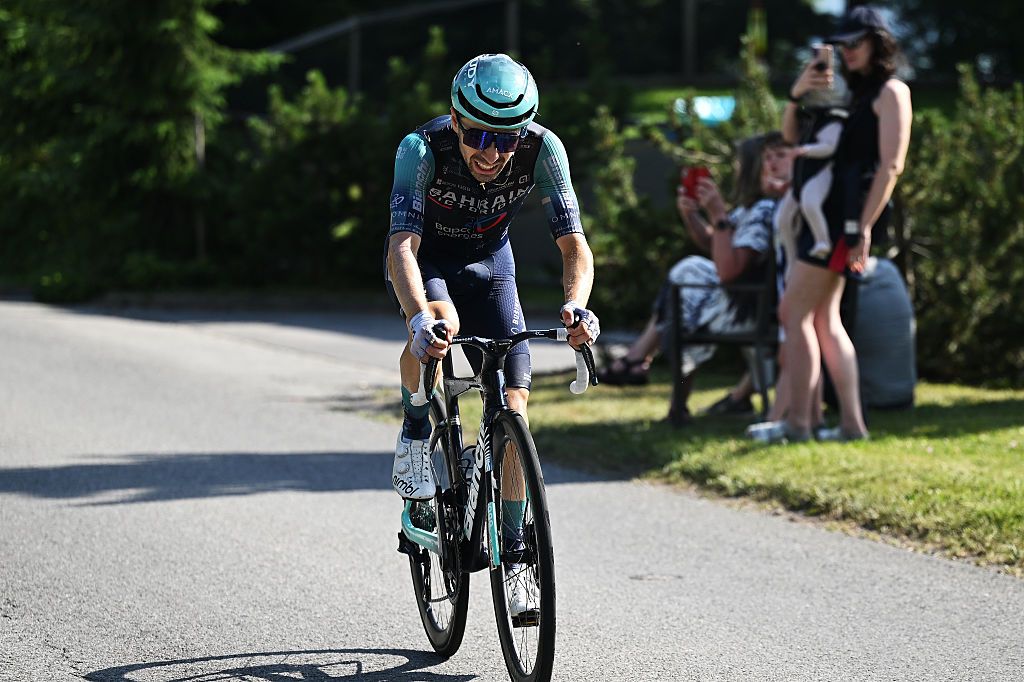
The most interesting gamble of the Tour de France
Bahrain Victorious is betting its Tour on Antonio Tiberi, a rider of immense talent and a complicated past. It's a wager not just on his legs, but on the possibility of forgiveness.
There are two kinds of stories in professional cycling. The first is written in numbers: watts, seconds, finishing positions. It is clean, objective, and unforgiving.
The second is written in whispers, in comeback arcs and cautionary tales, in the messy business of being human under immense pressure. Bahrain Victorious, in naming Antonio Tiberi its leader for the 2026 Tour de France, has chosen to write the second kind of story.
This is the most fascinating, high-stakes gamble a WorldTour team has made all season. On the surface, it’s a familiar play: anoint a prodigious young talent, give him the keys to the castle at the sport's biggest race, and see if he can turn potential into performance.
But with Tiberi, the wager runs deeper. The team isn't just betting on his talent, which is spoken of as a rare and potent thing; they are betting on his maturity. They are betting that the crucible of the Tour de France 2026 will forge a champion, not just break a young man.
Every rider faces a whirlwind at a Grand Tour. The race is a physical assault, but it’s the psychic weight that truly crushes: the suffocating media attention, the constant demand for comment, the expectation of an entire team resting on your shoulders for three weeks.
The Tour de France is a terrible place to find yourself, and an even worse place to hide. Antonio Tiberi arrives at the Tour de France 2026 with more to carry than just the hopes of his team. He arrives with baggage.
His controversial past casts a long shadow, and that story will follow him from the Grand Départ to the Champs-Élysées. Every press conference will contain a question, veiled or not, about character and redemption.
Every good day will be framed as a step toward vindication; every bad day will be seen as proof that the doubters were right. The court of public opinion holds its most raucous sessions on the slopes of the great Alpine climbs.
For Tiberi, the race will be run on two fronts: one against the peloton, and one against the narrative that precedes him.
This is why the presence of Damiano Caruso on the squad list is not just a detail; it is the entire sub-plot. Caruso is the team’s designated adult, the steady hand on the tiller, a rider who has seen many Grand Tours unfold and understands their cruel rhythms.
His job is not merely to be a super-domestique, pacing Tiberi on a key climb or delivering him to the safety of the final 3 km. His role is to be a buffer, a translator, and a mentor.
When the pressure cooker hisses, Caruso is the release valve. He is the man tasked with reminding a young leader that a bike race, even this one, is still just a bike race.
Conventional wisdom suggests this is just a team giving a young rider a free role, that a top-10 GC finish is the stated goal, and that anything more is a bonus. It will be called a learning experience.
But the Tour de France is never just a learning experience when you are the named leader. The hierarchy is absolute: the team will ride for you, sacrifice for you, and look to you when the plan falls apart.
There is no hiding in the bunch when other riders are wearing the same jersey and looking for your wheel. This is not a dress rehearsal; it’s the show.
And so, the gamble is laid. Bahrain Victorious is wagering that Tiberi's talent is so profound it can override the noise, and that three weeks of intense scrutiny will reveal a core of resilience.
It’s a brave bet, and perhaps a necessary one. Cycling loves a redemption story more than anything else – it is a sport built on suffering and, occasionally, on grace.
For Tiberi, the path is clear, if unenviable. He cannot outrun his own story, so he must rewrite it, one pedal stroke at a time, on the roads of France.
He must race with a composure that belies the storm around him. He must let his legs do the talking, because they are the one part of his narrative that is unambiguous.
He must ride like none of it matters, even as it matters more than anything. The road will be the only judge that counts, and over 21 stages, that is the entire story.
For Tiberi, the race will be run on two fronts: one against the peloton, and one against the narrative that precedes him.