
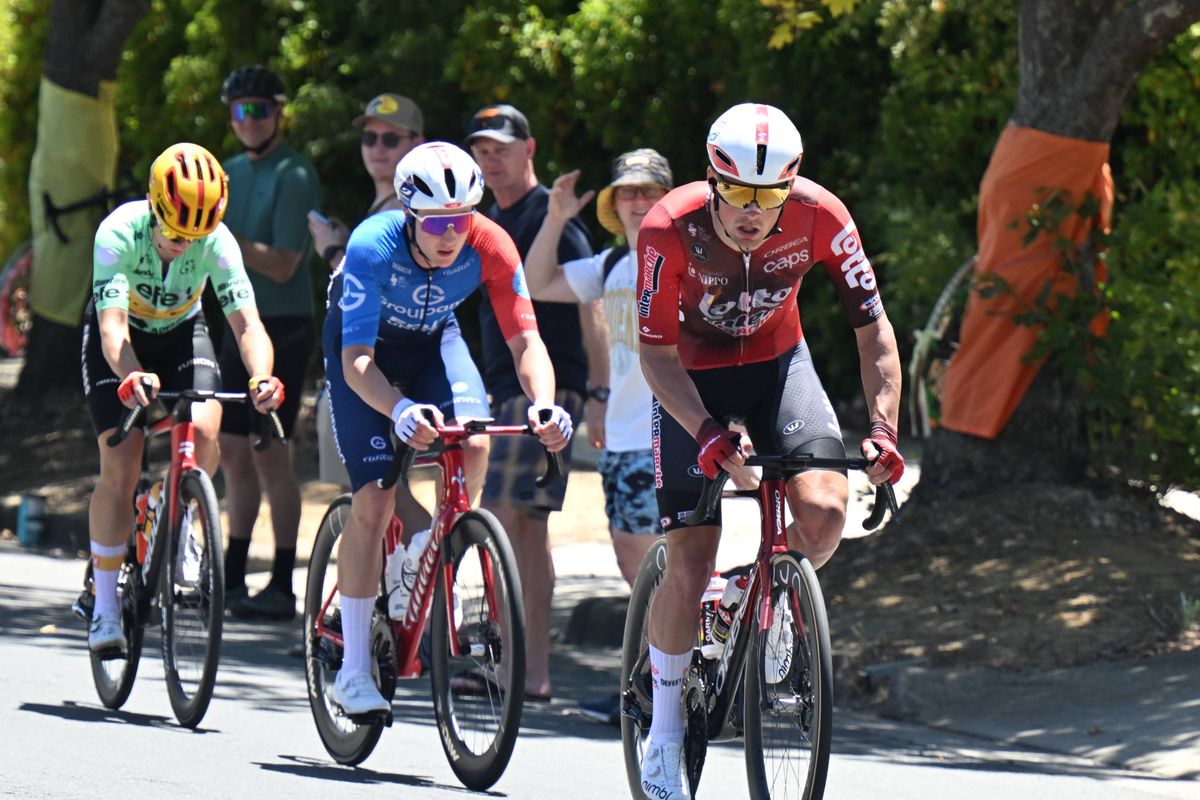
The glorious, doomed folly of Baptiste Veistroffer
A rider arrives at the Tour de France with a dream of winning from a breakaway. He is doomed to fail, and that is precisely why we must watch.
There is a particular kind of beautiful, romantic foolishness required to be a breakaway artist in modern cycling. It is a job description that reads like a paradox: you must be strong enough to leave the world’s best riders behind, and naive enough to believe they will let you stay there. It is a role for the hopeful, the audacious, and the riders who are on good terms with failure.
Enter Baptiste Veistroffer (Lotto-Intermarché). He is set to make his appearance at the Tour de France 2026.
And he has a dream. It is the oldest one in the book: to win a stage from a breakaway in the biggest race on earth.
To understand why this is the most romantic and most futile ambition in the sport, you have to understand the modern peloton. It is not a collection of individuals, but a single, hydra-headed organism with a calculator for a brain.
The breakaway is the defiant rounding error it exists to correct. Veistroffer, with his stated ambition, is volunteering to be that error.
The Audacity of Hope
The conventional wisdom will push back on this. It will say that anything is possible, pointing to the legends built on long-odds attacks.
It will argue that this is what cycling is about — the lone hero against the odds. And it has a point. Without the breakaway, cycling is just a long, rolling countdown to a sprint.
Veistroffer has earned his ticket to this particular lottery. This is not a man who waits for the race to happen to him.
He is a protagonist, an instigator.
And so he will arrive in July, full of that hope, buoyed by the home crowds who have a bottomless appetite for this specific brand of doomed gallantry. He will attack. He will get in the move.
For a few hours, he and a handful of other hopefuls will hang out there, a few minutes ahead of the inevitable. They will share the work, build a lead, and for a while, it will look like the dream is alive.
The Brutal Mathematics of the Chase
But the dream is on a leash. Back in the cars, the sports directors are doing the maths. They know the power output of their sprinters’ domestiques, they know the gradients of the road ahead, and they can calculate the exact moment to begin reeling the escapees back in.
The peloton is a patient predator. It is a problem of physics, fluid dynamics, and brutal, collective self-interest. A few riders, however committed, cannot defy that gravity forever.
Think of it as a casino. Veistroffer is walking in and putting all his chips on a single number.
The casino — the combined force of the sprinters’ teams and the GC contenders’ squads — doesn't even have to try very hard to win. It just has to follow the rules. It lets him have his moment of excitement before it calmly, methodically, takes his chips away.
We will watch it happen in real time. We will see the time gap, once a promising five minutes, begin to shrink. Four minutes. Three.
The television graphics will show the peloton moving visibly faster than the exhausted men out front. The camera will pan to Veistroffer’s face, a mask of pain, salt-caked and hollowed out.
He will be caught, very likely inside the final 15 km. The commentators will praise his courage, the peloton will swallow him up, and that will be that.
So why do it? If the outcome is so predictable, what is the point of the gesture?
Because the attempt is the point. His job is not to win, not really. His job is to dream on our behalf, in public, where the cameras can see him.
It’s to get the Lotto-Intermarché jersey on television for hours. It’s to show his team, and others, that he has the engine and the heart to try. It is a three-week-long job interview conducted at 45 kilometres an hour.
And it’s for the tiny sliver of a chance that the casino’s maths is wrong. The day the chase is disorganised, the day the peloton’s alpha teams all look at each other, the day the rain falls and breaks the collective will.
That is the day Veistroffer is riding for. He is not just racing against the 177 other riders in the Tour de France 2026; he is racing against probability itself.
He will likely fail. But his failure will be more compelling than most riders’ quiet successes.
We don’t watch for the certainty of the sprint finish. We watch for the possibility, however slim, that the romantic fool gets it right.
And that, in 200 km, is the entire story.
His job is not to win, not really. His job is to dream on our behalf, in public, where the cameras can see him.