
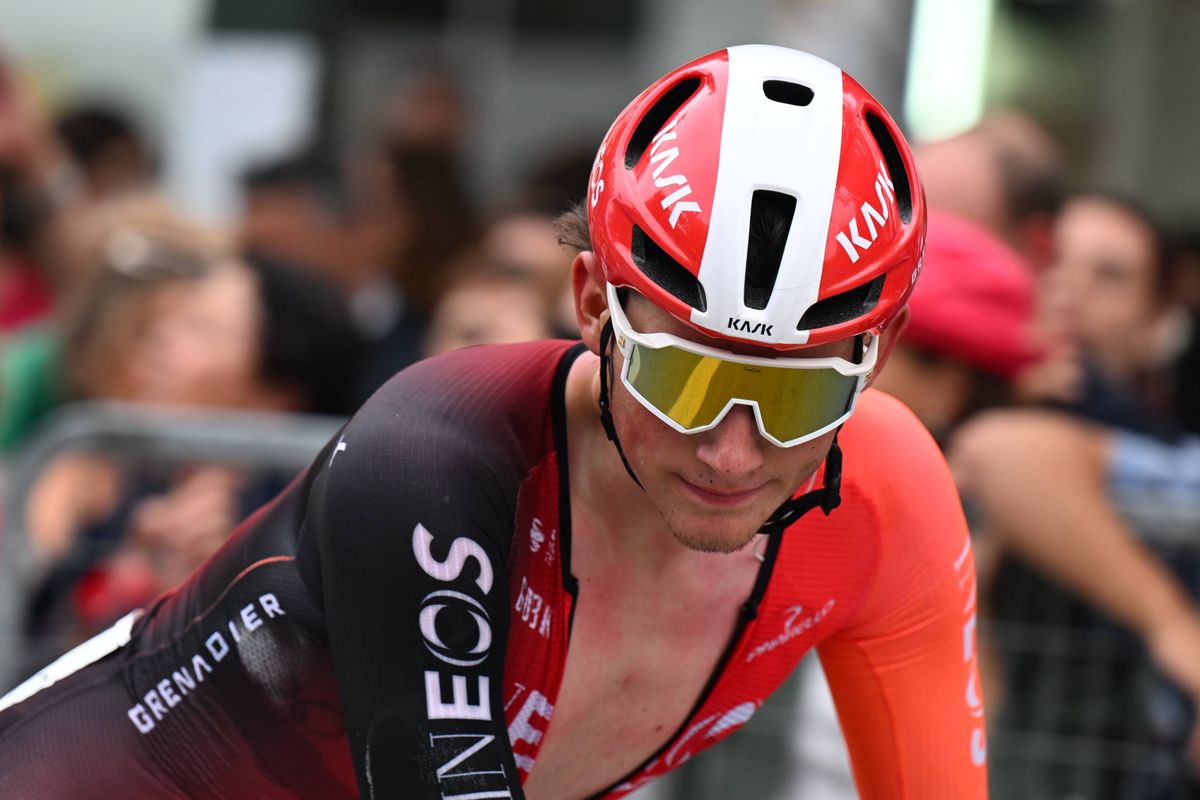
The beautiful, necessary death of the Ineos blueprint
Losing their leader before the Tour de France was the worst thing to happen to Netcompany-INEOS. It might also be the best. Disaster has a funny way of looking like liberation.
The sound of a plan disintegrating is often just the crunch of carbon fibre on tarmac. For a decade, Team Sky and its various iterations have arrived at the Tour de France with a single, meticulously crafted blueprint.
It was a holy text, a GC bible bound in data and watts-per-kilo, and its gospel was control. This year, somewhere on a road during the Tour Auvergne - Rhône-Alpes 2026, that bible was tossed into a ditch.
The catalyst was an incident that ended Oscar Onley’s Tour de France before it began. With their prospective leader out, the old plan was rendered instantly obsolete.
The team announced a pivot: abandoning general classification ambitions to hunt for stages. In that moment of crisis, Netcompany-INEOS was accidentally handed the keys to its own prison cell.
Losing their leader has liberated this team. It has forced them, against every instinct honed over years of dominance, into a strategy of aggressive, unpredictable chaos. This will make them a more exciting, and ultimately more successful, team at the Tour de France 2026 than their conservative GC approach ever would have.
The Prison of the Plan
To understand why this is a release, you have to remember the old way. The Sky/INEOS train was a marvel of engineering, a rolling fortress designed to suffocate a bike race.
It was brutally effective. It could also, let's be honest, be brutally dull. The team’s mission was not to animate a race but to nullify it: to set a tempo so crushing no one could attack, to protect one rider at the expense of seven others, and to turn the beautiful anarchy of the Tour into a three-week maths problem.
Riding for fifth on GC, or even for a podium, involves a thousand negative obligations. You police breakaways, ride defensively, and measure every effort against a single, overarching goal.
Your riders become bodyguards, servants to the singular ambition of one man. It’s a strategy that can win, but it rarely inspires.
Conventional wisdom will say this is just putting a brave face on failure. It will argue that a team with the budget of INEOS hunting for stages is like an aircraft carrier used as a fishing trawler – a catastrophic failure of ambition.
The argument is that stage wins are mere consolation prizes for teams that can’t contest the yellow jersey. It’s a powerful point, because it’s rooted in the very logic the team itself has championed for years.
But that logic is a trap. And the riders they’ve brought to France this year are the wrong men to keep in a cage.
Unleash the Wolves
Look at the squad that will start the Tour de France 2026. This isn't a collection of domestiques suddenly left without a master; it's a pack of wolves who have just been told the hunt is on.
You have Filippo Ganna (Netcompany-INEOS) and Joshua Tarling. Two of the most powerful time trial engines on the planet are no longer shackled to the front of the peloton for 150 kilometres a day.
Imagine Ganna, a man built like a Renaissance statue, deciding with 50 km to go that he’s bored and simply riding away. Imagine Tarling, free to contest a sprint or obliterate a late-race breakaway. Their job is no longer to slowly cook the peloton; it’s to break it apart.
Then you have the climbers: Egan Bernal and Thymen Arensman, a rider of immense talent. We’ve watched Bernal work to return to the mould of a GC contender.
Now, he is free. Free to feel the race, to follow an instinct, to attack on a mountain stage not because the power meter says so, but because his legs and his heart do.
He doesn't have to worry about a bad day costing him three weeks of work; he only has to find one good day. This is the path back to the joyful, brilliant Bernal we first saw.
Instead of one monolithic strategy, INEOS now possesses five or six. They are a tactical problem for every other team.
On any given day, Ganna, Tarling, Bernal, Arensman, or the versatile Kévin Vauquelin could be the danger man. How do you plan for that? Who do you watch?
The team that was once the most predictable in the peloton has become the agent of chaos.
This isn't a desperate gamble; it's a return to the essence of bike racing. The blueprint is gone, torn to shreds along with Onley’s Tour ambitions. What’s left is a blank page.
For the first time in a long time, Netcompany-INEOS gets to write a new story every day for three weeks. They lost a leader, but they found a team. And that might be the biggest victory of all.
The team that was once the most predictable in the peloton has become the agent of chaos.
They lost a leader, but they found a team. And that might be the biggest victory of all.