
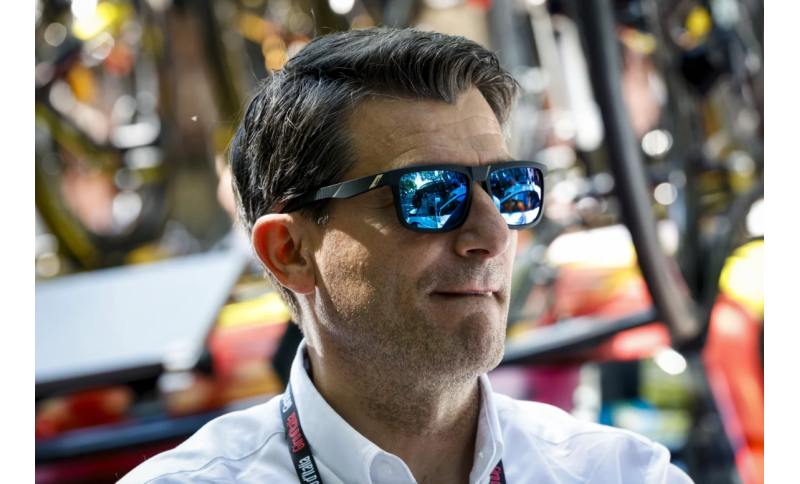
The poacher turned gamekeeper
When a team boss moves to run a major race, it represents a major power shift. It’s either a genius move for the sport, or the start of a whole new set of problems.
There are two kinds of power in professional cycling. There is the brutal, public, and measurable force a rider puts through the pedals on a 15% gradient.
And then there is the other kind: the quiet power wielded in boardrooms and backroom negotiations, the kind that determines which teams get a start, which mountains make the cut, and whose story gets told.
An influential, long-serving team manager has just been handed the keys to the latter.
His move to a major race organiser, the group behind the Giro d’Italia, isn't just a job change. It is a seismic event, a tectonic shift in the landscape of the sport.
The gamekeeper has not just been hired from the ranks of the poachers; he was their chief strategist. He doesn't just know the game; he knows the players' tells, their budgets, and the skeletons in their closets.
That knowledge could either be the salvation of Grand Tour racing or its most profound conflict of interest.
The case for revolution
The optimistic take is that this is a masterstroke. For too long, race organisers have operated in a vacuum, designing courses and setting rules with a tin ear to the realities faced by the teams.
Who better to fix this than a man who has lived those realities for years, a man who knows the teams are the entire show?
This argument has merit. A former team boss knows the brutal calculus of a team budget. He understands that a 250-kilometre transitional stage with a four-hour transfer doesn't just tire out riders; it burns money and strains logistics.
He has sat in the meetings where sponsors demand more value, riders plead for safer finales, and sporting directors curse a route that neutralises racing for five hours before a predictable bunch sprint.
In this version of the future, we get a Giro d'Italia designed with an empathy born of experience, a race that understands the delicate ecosystem it commands.
It would be a better sporting product because its architect finally knows what it’s like to be a participant, not just a proprietor. He could, in theory, build a more sustainable, more thrilling race for everyone.
The unavoidable conflict
The problem is, theory is a lovely, clean place to live. Professional cycling is not.
The knowledge such a figure brings to a race organiser is not general, high-minded wisdom. It is specific, proprietary, and weapon-grade.
He knows the inner workings of rider contracts and what a title sponsor is really willing to pay. He knows what bluff a team manager might be pulling.
When it comes to awarding wildcard invitations, he is no longer an advocate pleading his case; he is the judge, armed with an intimate understanding of the financial health and sporting merit of every team petitioning him.
He knows which squads are desperate and which are simply posturing.
And what of the race itself? Imagine a Giro d'Italia 2026 with a route tailor-made for his former team, or a time trial that perfectly negates the strengths of a key rival.
Every decision he makes, from the placement of a feed zone to the profile of the queen stage, will now be scrutinised through the lens of his past allegiances.
The perception of bias, in this game of inches and marginal gains, can be as corrosive as the real thing.
This isn't to question anyone's personal integrity. It is to question the wisdom of a system that would place someone in such a compromised position.
It's like having a former Goldman Sachs executive run the Securities and Exchange Commission. The expertise is undeniable, but the potential for seeing the world through the prism of an old firm is inescapable.
The new blueprint
For decades, the sport has operated on a tense but stable cold war between the teams and the major race organisers.
It was a balance of power, however lopsided. Such a move fundamentally alters that dynamic. He hasn't just crossed the aisle; he has taken years of state secrets with him.
Now, one of the most powerful people at the Giro knows exactly how little power the teams actually have when they are divided. He knows their pressure points and their dependencies.
He knows who to call, and what to offer, to break any nascent solidarity among them.
This is the new reality: a man who intimately understands the vulnerabilities of the teams is now in charge of the event they are all desperate to race.
It sets a precedent that could ripple through the sport. What if another major organiser decides it needs its own insider to run a race like the Tour de France? The revolving door starts to spin, and the line between organiser and participant blurs into meaninglessness.
A man like this has seen the race from the claustrophobic confines of a team car, screaming into a radio. Soon, he will see it from the serene authority of the race director's red car.
The view is very different. But the memories, the relationships, and the knowledge remain.
The great, unanswered question is not whether he can forget everything he knows, but how he could possibly be expected to.
The gamekeeper has not just been hired from the ranks of the poachers; he was their chief strategist.
The perception of bias, in this game of inches and marginal gains, can be as corrosive as the real thing.
The great, unanswered question is not whether he can forget everything he knows, but how he could possibly be expected to.