
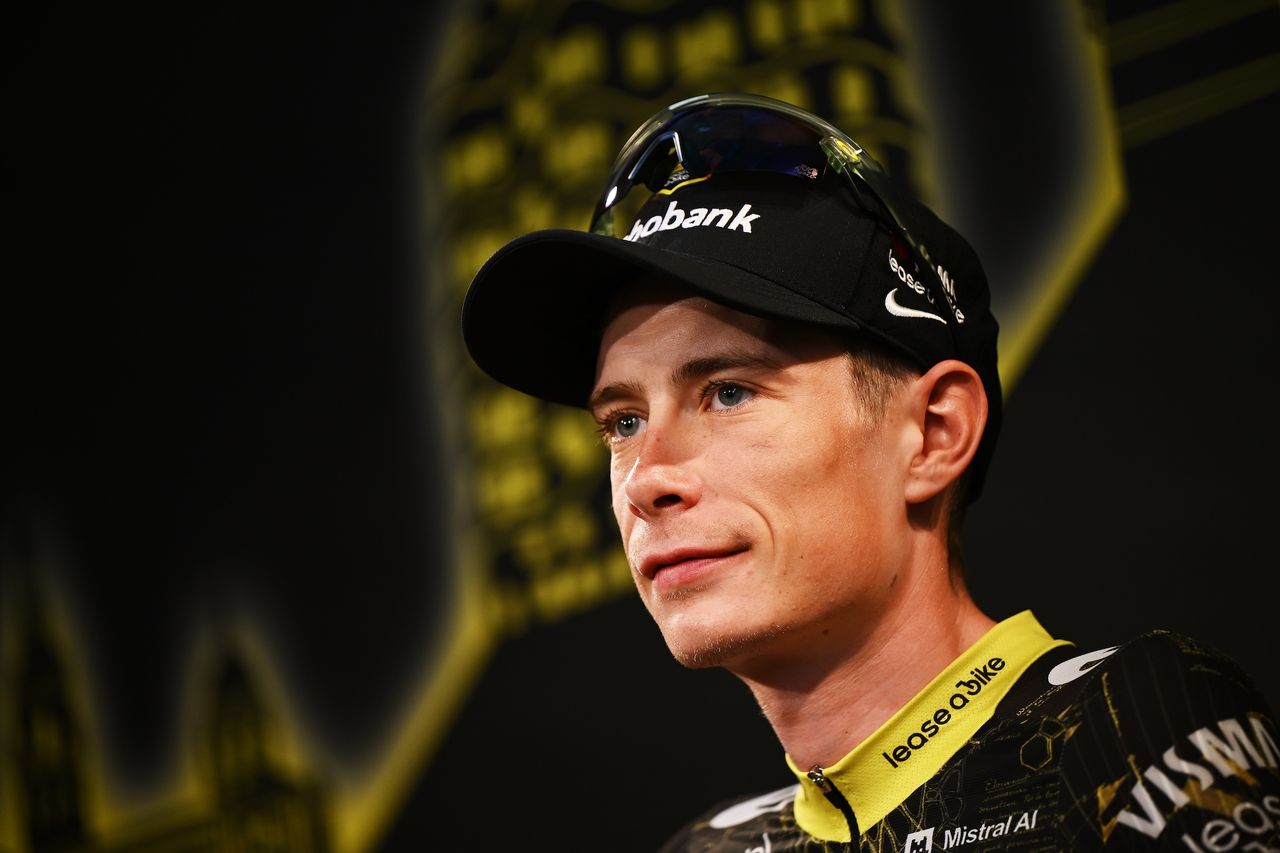
The beautiful, necessary lie of Jonas Vingegaard
A rider says he is rejuvenated. The laws of physiology say otherwise. This is either the next evolution in Grand Tour racing, or a fantasy about to meet a French mountain.
There are two kinds of truth in professional cycling. There is the truth of the power meter, the lactate test, and the stopwatch at the finish line. And then there is the truth a rider must tell himself to get out of bed in the morning.
Jonas Vingegaard (Visma | Lease a Bike), a man who seems forged from the first kind of truth, is asking us to believe in the second. Fresh off the Giro d’Italia 2026, he claims a new approach has left him “rejuvenated.” He insists he did not finish the first Grand Tour of the season “completely on my knees.”
It is a lovely thought. It is also, quite possibly, a beautiful and necessary lie.
What we are witnessing is either a quiet revolution in athletic performance or a masterpiece of public relations aimed at the most important audience of all: the man in the mirror. The stakes are not just the Giro-Tour double, that hallowed and haunted achievement, but the very belief system that underpins a team as meticulous as Visma | Lease a Bike. Is this the triumph of a new process, or the triumph of hope over experience?
The Gospel of the Spreadsheet
Conventional wisdom pushes back, of course. If any team has cracked the code of recovery, it is Visma | Lease a Bike.
This is the outfit that treats cycling not as a romantic art but as a series of problems to be solved with data, technology, and ruthless efficiency. They are architects of totalising team strategy, masters of marginal gains that have become grand canyons. Why wouldn't they be the ones to solve the double?
In this version of the story, Vingegaard’s feeling of rejuvenation isn’t a feeling at all; it’s a data point. It’s the output of an algorithm that has perfectly balanced the physiological load of the Giro d'Italia 2026 with a recovery protocol bordering on science fiction.
He didn’t have to dig as deep, the argument goes. He rode a perfect race, managed his efforts, and exited Italy with just enough fatigue to sharpen his form for July, but not enough to break it. In this telling, his body is a spreadsheet, and the numbers all balance.
To believe this is to believe that the human element – the chaotic, unpredictable toll of three weeks of racing – can finally be tamed. It suggests that deep, cellular fatigue, the kind that settles in the bones, is a bug the team has now patched.
If true, it’s groundbreaking. It changes everything we thought we knew about the limits of endurance.
The Unforgiving Grammar of the Road
But the road has a long memory, and its grammar is written in pain. The history of the Giro-Tour double is a graveyard of ambitions.
It has been a lifetime in sporting terms since the feat was last achieved. The sport is faster now, more relentlessly controlled, more profoundly draining from the first kilometre to the last.
The attempts since have been noble, brutal, and ultimately futile. They all found that the Giro takes more than it seems, and the Tour asks for more than you have left.
Think of a smartphone battery. After a year, it might still charge to 100%, but its fundamental capacity – its health – is degraded. It dies faster.
Vingegaard may feel charged to 100% after the Giro, but the race will have subtly, irrevocably lowered his ceiling. The effort of Italy isn’t a deposit that can be withdrawn and fully replaced; it is a structural cost.
His claim of not being “on his knees” is the tell. No Grand Tour winner finishes standing tall. They finish hollowed out, aged, running on fumes and fury.
To suggest otherwise is to either redefine the effort required to win a Grand Tour or to admit that you left something in the tank – something your Tour de France rivals were saving entirely.
And that is the crux of the gamble. The story of rejuvenation is powerful, but it is told in the face of immutable physiological law. It’s a narrative shield against the creeping doubt that must accompany the deep, abiding tiredness.
Perhaps the words are not for us, the media, or the fans. Perhaps they are for him: a mantra to be repeated in a quiet hotel room as the enormity of the task ahead settles in.
We will get our answer on the roads of the Tour de France 2026. We will see if the rejuvenated man is real, or if he is a ghost conjured to keep the wolves of fatigue at bay for a few weeks longer.
I am a romantic, but I am also a realist. And the history of this sport is a testament to realism.
Across 21 stages in France, that will be the entire story.
His claim of not being “on his knees” is the tell. No Grand Tour winner finishes standing tall. They finish hollowed out, aged, running on fumes and fury.