
The accidental arms fair in the Alps
The combined paddock at the La Thuile EDR wasn't just a logistical headache for teams. It was an accidental revelation, pulling back the curtain on a secret technological war fought in carbon fibre and damper fluid.
There are two kinds of innovation in professional sport. There is the kind they announce in a press release, with glossy photos and a trademarked name. And then there is the kind they hide under muddy neoprene covers and hastily applied electrical tape.
For one week at the Enduro World Cup in La Thuile, Italy, we got a rare, unfiltered look at the second kind. The decision to merge the paddocks for the Enduro, Downhill, and Cross-Country disciplines at the La Thuile EDR 2026 created a peculiar sort of high-alpine melting pot.
XC whippets, all sinew and twitching anxiety, shared space with DH riders who look like they could wrestle a bear. But more importantly, their mechanics and their closely-guarded machines had to coexist in the open.
And in doing so, they revealed the quiet arms race that defines the top level of the sport. This was about engineers trying to nonchalantly walk past a rival’s pit, their eyes scanning for the odd-looking linkage, the unbranded component, the tell-tale lump that signifies a new idea.
To understand what we saw at La Thuile is to understand that the most important races are often won months before the tape ever goes up.
The little secret that made a big noise
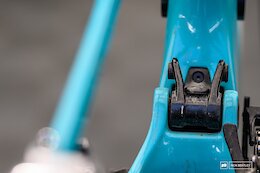
The star of this accidental tech expo was a device that is, by its very nature, designed to quell noise: the mass damper. Tucked away inside frames or forks, these little contraptions—essentially a weight on a spring, tuned to a specific frequency—are designed to counteract the high-frequency vibrations that suspension can’t handle.
Think of it as a tiny, autonomous shock absorber for your shock absorber. It’s the kind of marginal gain that sounds like science fiction until you see it bolted onto a bike.
This isn't some newfangled idea. The technology famously appeared in Formula 1, where Renault used it to devastating effect in the mid-2000s before it was swiftly banned for being a 'moveable aerodynamic device'.
That its ghost has reappeared here, in the Italian mountains, tells you everything you need to know about the level of engineering being brought to bear. Teams aren't just trying to make bikes lighter or stiffer anymore. They are battling the very physics of a wheel hitting a rock at 60 km/h, hunting for a level of control that conventional suspension cannot provide on its own.
Spotting one in the wild is one thing. Seeing multiple teams covertly testing their own versions, all within a stone's throw of each other, is another. It confirms that this isn't one team's pet project; it's a full-blown technological front in the war for seconds.
Use your prototypes on the prototype tracks
The conventional wisdom will push back on this. It will say that teams are always developing new equipment, that prototypes are part of the game. And that’s true. But the argument misses the point: the difference at La Thuile 2026 was the context and the concentration.
This wasn't just about mass dampers. A new Yeti LT bike was spotted, its revised lines and suspension kinematics being put to the ultimate test. Unmarked black-box components were everywhere, and it was all happening on a track described by riders as brutally steep and unforgiving.
This is the crucial link: the extremity of the course demands technological extremity in response. You don't bring a knife to a gunfight, and you don't bring last year's bike to La Thuile.
An open paddock transforms this process. What is normally a series of isolated experiments, conducted at secret test locations, becomes a shared laboratory. A mechanic can see a rival's idea in the morning and be sketching a version of it by the afternoon.
The development cycle is no longer measured in seasons, but in hours. It forces everyone's hand. Your secret is only safe until the mechanic from the next pit over asks to borrow a zip tie and gets a good, long look at your top tube.
The pilot has to believe
And in the middle of this tech-fest is the rider. For all the talk of sprung mass and damping circuits, someone still has to point these experimental machines down a mountain.
It takes a unique kind of trust for a rider to push to the limit on a bike that might be harbouring a brand-new, potentially unproven piece of hardware. That’s the human element of the arms race.
The engineer in the pit garage sees a data curve; the rider on the track feels a terrifying vibration, or a sublime moment of grip where none should exist. Their feedback is the currency that turns a wild theory into a race-winning advantage.
La Thuile’s combined paddock may have been a one-off, a simple quirk of event logistics. But it gave us the clearest view we’ve had in years of where the sport is truly heading. The future isn't just in stronger riders; it's in smarter bikes, managed by teams willing to chase down the most esoteric, difficult, and hidden advantages.
The real race, it turns out, is the one to build a faster future. And that, in a muddy valley in Italy, is the entire story.
This was about engineers trying to nonchalantly walk past a rival’s pit, their eyes scanning for the odd-looking linkage, the unbranded component, the tell-tale lump that signifies a new idea.
The development cycle is no longer measured in seasons, but in hours.
The engineer in the pit garage sees a data curve; the rider on the track feels a terrifying vibration, or a sublime moment of grip where none should exist.