
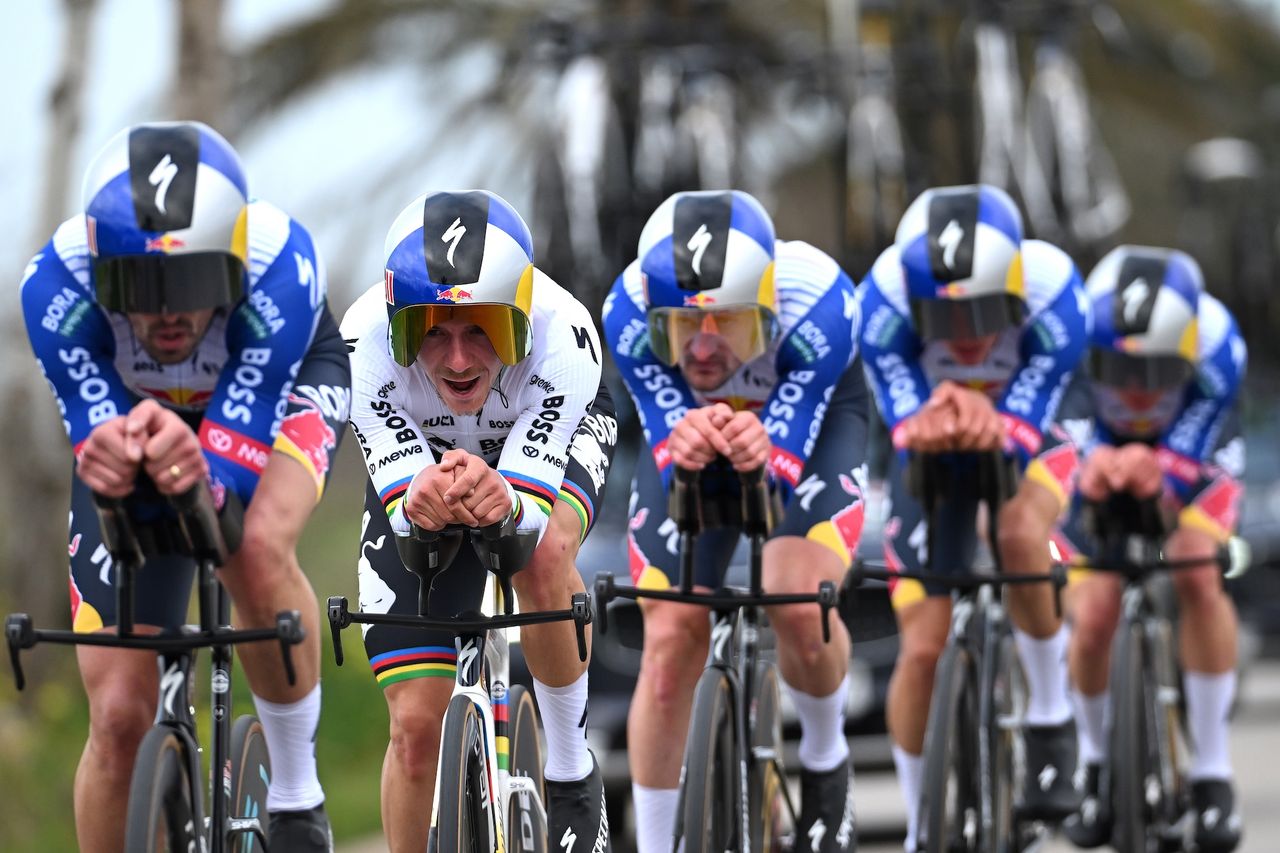
Yellow jersey by committee
The Tour de France’s first yellow jersey is its most romantic prize. If the race opens with a team time trial, it risks turning a poem into a balance sheet.
There is a certain purity to the first yellow jersey of the Tour de France. It’s a prize won in isolation: a single rider, alone against the clock in a prologue, or a sprinter finding a perfect line through the chaos of a bunch finish.
It is a moment of individual brilliance, a story with a simple, heroic protagonist. It is the overture that sets the tone for the three weeks to come.
For the Tour de France 2026, however, there is speculation that the overture will be played by an orchestra. If reports of an opening team time trial prove true, the race would begin not with a solo flourish, and in that decision, something fundamental would be altered.
The first yellow jersey would not be won by the strongest, or the bravest, or the fastest individual. It would be awarded by committee. To understand why this is the wrong argument, and not just the unromantic one, we need to look at who would stand to benefit.
The Red Bull Blueprint
The conventional wisdom will push back on this. It will say the TTT is a spectacular expression of cycling as a team sport, a beautiful display of synchronicity and collective power. And there is no clearer avatar for this paradigm than a rider like Remco Evenepoel, who would surely relish the chance for a powerful team to deliver him the race’s first maillot jaune.
This is not a criticism of a rider like Evenepoel or his ambition; it is the perfect distillation of the point. A GC contender on a lavishly funded super-team would begin the Tour with a test of that team’s sheer horsepower. It’s a stage designed for the sport's emerging powers, where budget translates directly into speed.
The ability to hire eight powerful riders who can all hold 55 km/h, to spend countless hours in the wind tunnel, to afford the fastest equipment down to the last ceramic bearing—this is what would win the day. A rider's individual talent, immense as it is, becomes secondary. They are simply the one designated to cross the line first.
It transforms the opening stage from a test of human spirit into an audit of resources. It’s a Formula 1 constructor’s championship, not a driver’s duel. The winner isn’t the protagonist; the winning system is.
A Narrative Foreclosed
What, then, is lost? The beautiful chaos. The possibility of an upset.
The TTT, by its nature, is a predictable beast. The teams with the biggest budgets and the most focused rosters of time trial specialists would rise to the top. The GC contenders on those teams would gain time, while pure climbers on less-resourced squads would lose it before they have even seen a mountain. The race would be stratified from kilometre one.
Think of the stories we would lose. There would be no unheralded prologue specialist from a ProTeam taking a surprise victory and living the dream for a few days. There would be no plucky sprinter from a team built for the breakaway timing their kick to perfection. The narrative possibilities are narrowed, foreclosed before the race truly begins.
Instead, the first week would likely be policed by a single super-team, defending a jersey they won through collective, predictable strength. This stifles the very aggression and individual flair the opening days are supposed to foster. The race becomes more controlled, more managed, more corporate.
This isn't to say team time trials have no place in a Grand Tour. A mid-race TTT can dramatically reshape the general classification and reward a well-drilled squad. But as the opening act, it feels like reading the last page of a mystery novel first, prioritising the outcome over the process, the result over the story.
The Tour de France, at its best, is a human drama played out on an impossibly grand scale. It is about individual ambition, suffering, and triumph.
To open with a team time trial would be a choice to begin their epic with a chapter on logistics and resource allocation. It would be a pragmatic choice, perhaps, but for the narrative of the race, it would feel like a failure of imagination. The jersey would be yellow, as always. But it might feel a little less golden.
It transforms the opening stage from a test of human spirit into an audit of resources. It’s a Formula 1 constructor’s championship, not a driver’s duel.
As the opening act, it feels like reading the last page of a mystery novel first, prioritising the outcome over the process, the result over the story.
The jersey will be yellow, as always. But for the first time in a long while, it will feel a little less golden.