
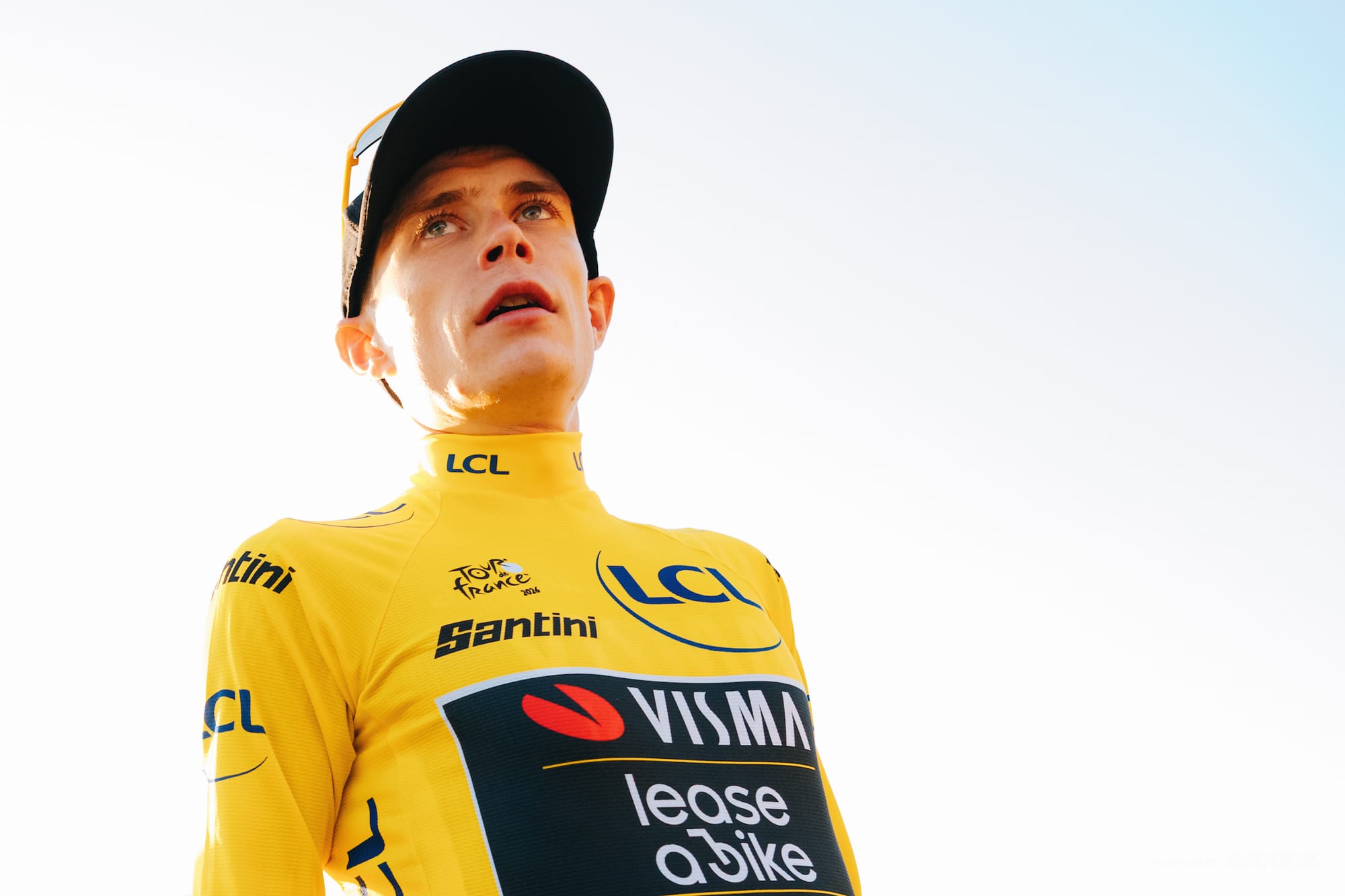
An Early Advantage
The Tour de France wasn't won on the opening stage. But the story of how it will be won may have been written there, in a handful of seconds that could change everything.
A Tour de France is not a spreadsheet of seconds; it is a three-week psychological siege. On the opening day of the 2026 edition, Jonas Vingegaard and Team Visma | Lease a Bike didn't just ride a bike race. They fired the first shot.
A small margin opened up. That was the gap between Vingegaard and Tadej Pogačar (UAE Team Emirates-XRG). In a long race, it is functionally nothing – a rounding error before the real business begins in the Pyrenees and the Alps.
That is what conventional wisdom will tell you. And conventional wisdom is wrong.
Grand Tour racing is a war of narrative. The rider who controls the story controls the race. With their perfectly synchronised performance on the opening stage, Team Visma | Lease a Bike didn't just gain an early advantage; they seized the pen and started writing this year's script.
Pogačar is now a character in their story, not the author of his own.
The Tyranny of the Chase
The easy rebuttal is that a few seconds is meaningless against a rider of Pogačar’s explosive capabilities. He can erase that deficit on a single uphill finish, or detonate a race with a trademark long-range attack. It’s a fair point, if you view bike racing as a simple equation of watts per kilo.
But that view misses the human element. It misses the shift in psychic burden.
From this moment on, the onus is on Pogačar to do something. He wakes up in arrears, with a question to answer. The pressure is his to make the race, to find an opening, and to spend the energy required to dislodge the calm, metronomic Vingegaard.
Vingegaard and his team, meanwhile, have to do nothing but react. They have an early lead and a measure of control. This is the difference between hunting and being hunted.
Vingegaard can now let Pogačar's UAE team burn matches controlling breakaways. He can sit in the wheels, forcing his rival to wonder: is today the day? Do I attack now? Every kilometre that ticks by with Vingegaard ahead is another small victory for his team, and they have turned their advantage from a target into a shield.
A Statement of Collective Strength
It’s also crucial how this gap was created. This wasn't a one-on-one duel on a mountaintop; it was a statement of organisational supremacy. Team Visma | Lease a Bike, as a unit, appeared more drilled, more powerful, and more cohesive.
For Pogačar, that has to be unsettling. He didn't just lose time to Vingegaard; he lost it to the entire Visma apparatus. He saw a team that, on day one, was simply better than his, planting a seed of doubt that individual brilliance can't always overcome.
Cycling is an individual sport played by teams. The opening stage was a stark reminder that the second half of that cliché is what wins a modern Tour de France.
This forces Pogačar, the great improvisational artist, to play a strategist’s game. He thrives in chaos and on instinct, but Vingegaard and his team have laid down a rigid plan: gain a lead, hold the lead, and force the artist to paint by numbers. They have dragged him onto their preferred terrain of cold, calculated attrition.
Of course, Pogačar can still win this Tour de France. His talent is generational, but his path to victory just became narrower and steeper. He can no longer wait for the race to come to him; he must attack it, against a team that has already proven its readiness.
The mountains will come, and the great duels will light up our screens. But the psychological landscape of this race may have already been defined, sculpted not on a high pass but on the roads of the opening stage.
A handful of seconds. It's the time it takes to draw a deep breath. And it's the time it took for Jonas Vingegaard to begin applying pressure to his rival.
Pogačar is now a character in their story, not the author of his own.