
The UCI's absurd war on the ice sock
One rider plunges his arms into a high-tech cooling device. Another is forbidden from using a frozen sock. The difference tells you everything about a governing body that has lost the plot on rider safety.
Picture the scene. It’s the start of a Grand Tour stage – say, a stage of the Vuelta a España – on asphalt baking under a 30°C August sun. The air is thick enough to chew.
A rider, already glistening with sweat, is handed a simple, life-affirming object: a women’s stocking filled with ice cubes and knotted at the top. He stuffs it down the back of his jersey, and for a few glorious minutes, the meltwater trickling down his spine offers a primal, low-tech defence against overheating.
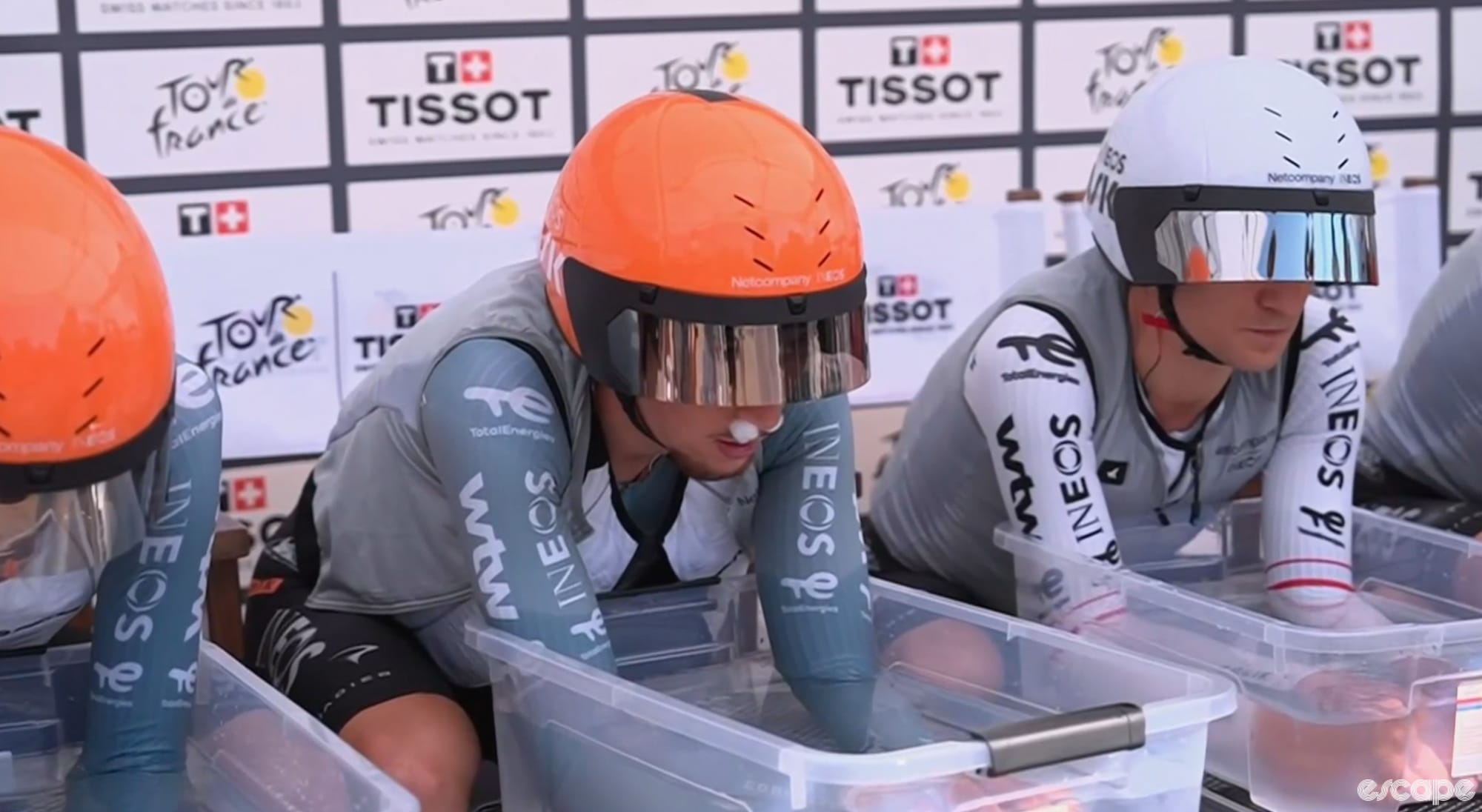
Now, picture a second scene at the Tour de France. Riders from a team whose budget could likely purchase the entire global supply of hosiery, are lined up beside the start ramp of a crucial time trial. Each one methodically plunges their forearms into a bespoke, bucket-like container of ice-cold water, a pre-cooling protocol designed to lower core body temperature.
One of these actions is a legitimate, even celebrated, performance innovation. The other is illegal. The UCI, in its infinite wisdom, has decided the melting bag of ice constitutes an illicit change to a rider's 'morphology'. In that single, baffling distinction lies the story of a governing body dangerously adrift from common sense.
What is 'morphology', anyway?
The conventional wisdom will tell you that rules are rules. The UCI must regulate equipment and the rider’s silhouette to ensure a level playing field, to stop teams from stitching aerodynamic fairings into their jerseys. On its face, this is a reasonable goal.
But to apply this principle to an ice sock is a category error so profound it borders on satire. Morphology is the study of form and structure. An ice sock is, by its nature, a temporary and degrading object. It is not a rigid structure and does not improve aerodynamics; the lump it creates likely makes a rider less slippery.
It is frozen water. It melts. To treat it as a permanent alteration of a rider's form is like fining a driver because a melting ice cream cone has temporarily changed the shape of their car's cupholder. It’s a solution to a problem that doesn’t exist, a pedantic application of a rule never intended for this purpose.
A Tale of Two Coolers
Let’s return to our two scenes. The high-tech arm-cooling method is a perfect example of sanctioned innovation. It requires equipment, a protocol, and staff to manage it – a direct, physiological intervention for a competitive advantage. And it is, rightly, perfectly legal.
The ice sock, meanwhile, achieves the exact same goal through simpler means. It is the great democratiser of thermal regulation, available to any team on any budget. One method is a folk remedy, born of necessity; the other is a lab-tested protocol, born of a massive budget. Guess which one is illegal.
The UCI's ruling doesn't create a level playing field; it tilts it dramatically. It tells teams that managing rider heat must be done through expensive, pre-approved, off-the-bike methods. The simple, on-the-bike solution available to all is forbidden, punishing the less-resourced and rewarding teams who can afford to innovate around a nonsensical restriction.
When Rules Lose the Plot
This isn't just about ice. It’s about a pattern of regulatory overreach that prioritises abstract principles over the lived reality of the athletes. While the UCI obsesses over the morphological implications of a sock, the planet gets hotter.
Grand Tours in July and August are becoming endurance tests in a way the sport’s founders never imagined. Rider strikes over extreme weather are no longer unthinkable; they’re a recurring feature of the season. In this context, banning a simple, effective cooling method is not just silly, it's irresponsible.
The governing body’s primary concern should be rider welfare. Instead, commissaires are forced to play fashion police, checking jerseys for contraband nylons while the athletes themselves are cooking.
As we look ahead to the Tour de France 2026 and the Vuelta a España 2026, heat will be a defining factor. We will see riders suffering. We will also see the world’s best-funded teams deploying ever-more-sophisticated cooling strategies, all perfectly within the rules, while a rider from a smaller team risks a penalty for trying the old-fashioned way.
This isn't about fair play. It's about a governing body creating solutions for problems that don't exist, while ignoring the real one baking the peloton alive. The greatest danger to a rider’s morphology isn’t a sock full of ice, but a core body temperature pushed beyond its limits.
To treat an ice sock as a permanent alteration of a rider's form is like fining a driver because a melting ice cream cone has temporarily changed the shape of their car's cupholder.
The greatest danger to a rider’s morphology isn’t a sock full of ice, but a core body temperature pushed beyond its limits.