
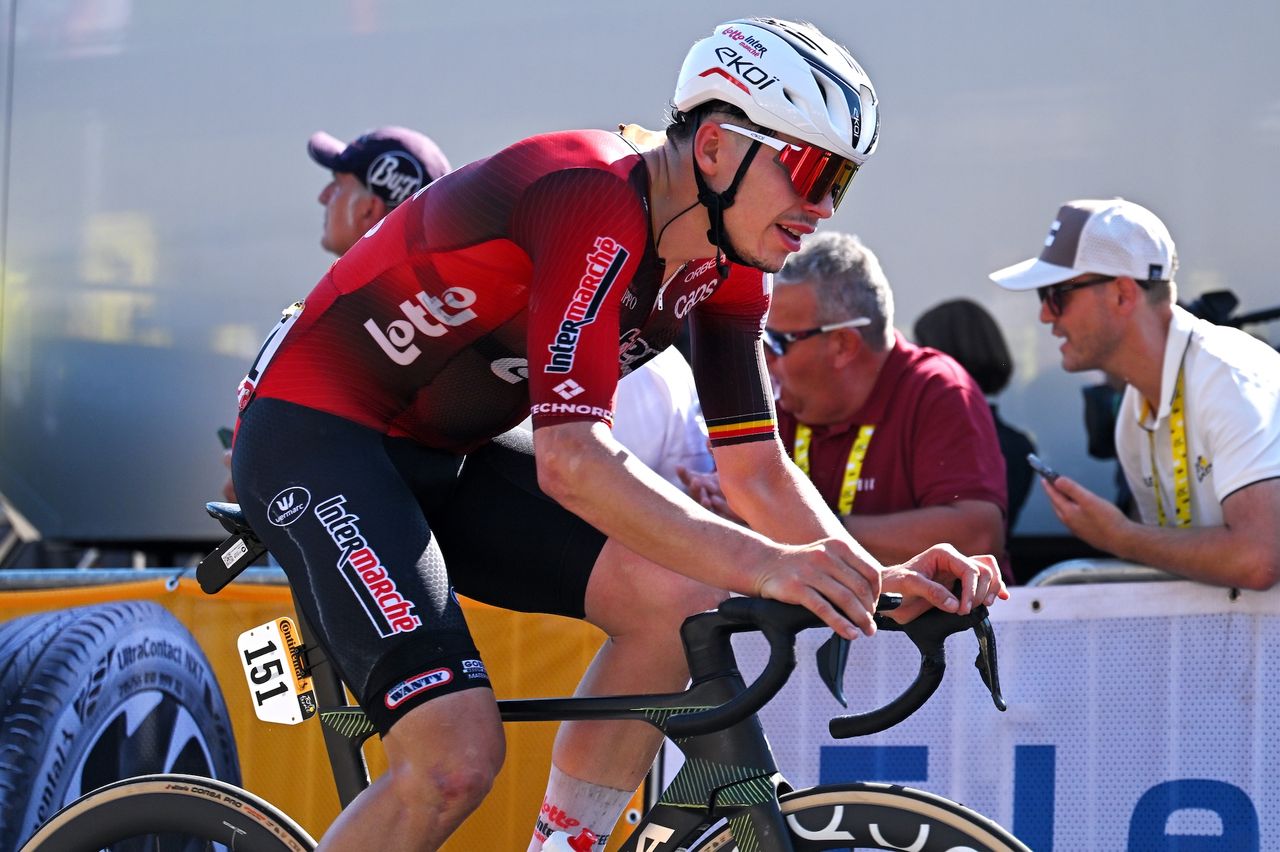
Arnaud De Lie and the art of the wise surrender
The rider's early exit from the Tour de France wasn't a failure. It was the hardest, and smartest, decision a rider can make.
There is a deep, intoxicating romance to the suffering of the Tour de France. It’s baked into the event’s mythology. We celebrate the rider who crashes, remounts, and limps to Paris with a broken bone and a thousand-yard stare.
We lionise the domestique who empties himself into a headwind for 200 kilometres, finishing an hour down but with his duty done. The entire narrative of the race is built on enduring the unendurable. To quit is to fail; to surrender is the cardinal sin.
And it is all, of course, a beautiful lie.
The wisest thing Arnaud De Lie (Lotto-Intermarché) did at the Tour de France 2026 was climb off his bike. With his body battling illness, the rider made a decision that runs counter to a century of cycling lore.
He didn't grit his teeth for the cameras or pedal himself into a state of collapse for the sake of a finish line he couldn't reach competitively. He stopped. And in doing so, he showed a maturity that promises more for his future than any grim-faced battle for the lanterne rouge ever could.
To understand why, see a rider’s career not as a single race, but as a long, fragile campaign. A rider has a finite number of matches to burn.
Each day of pushing a sick body through the most demanding athletic event on the planet doesn't just empty the tank for that day; it compromises the next day, the next week, and potentially the next month. It digs a physiological hole that can take the rest of the season to climb out of.
Conventional wisdom pushes back on this. It invokes the ghosts of heroes past, men who supposedly would have ridden on through anything. It will say that abandoning is a sign of mental weakness, a crack in the armour.
But this isn't 1974. The sport is a global, billion-dollar enterprise of marginal gains and meticulous planning. A career is an asset to be managed, not a candle to be burned at both ends for the romantic satisfaction of sportswriters.
What, exactly, would have been gained by De Lie staying in the race? The chance to be dropped at the neutral start for another week? To finish every stage in the gruppetto, his immune system in tatters, shedding form and morale with every kilometre?
To what end? To satisfy an outdated code of honour? A rider fighting an infection isn't a noble warrior; he's a liability to himself and his team. Sickness blunts reaction times and clouds judgement, making the peloton that much more treacherous.
The real courage wasn't in staying on the bike. It was in making the call. Imagine the pressure on a rider, in the biggest race of his life, to tell his team, his country, and himself that it’s over.
That is a harder moment than cresting a climb 45 minutes after the leaders. It’s a recognition that the body has limits, and that respecting them is a prerequisite for ever truly testing them when it matters.
This is the prisoner’s dilemma of professional cycling. Every rider is told to push through, but the collective result is often a peloton of walking wounded, running on fumes by the third week, susceptible to the crashes and illnesses that thrive on fatigue.
De Lie opted out. He chose to cut his losses, a cold calculation but also the sanest one. He traded a week of guaranteed misery for the chance to recover, reset, and target races later in the season where he can actually win.
We don't need another story of a rider who heroically finished the Tour and then disappeared for six months, his season a write-off. We have plenty of those.
What the sport needs is more athletes smart enough to play the long game. De Lie didn't lose the Tour de France; he simply withdrew his stake from a table where he was guaranteed to lose.
He chose the future over the finish line. And that, in the cold light of day, is its own kind of victory.
A career is an asset to be managed, not a candle to be burned at both ends for the romantic satisfaction of sportswriters.
The real courage wasn't in staying on the bike. It was in making the call.
He chose the future over the finish line. And that, in the cold light of day, is its own kind of victory.