
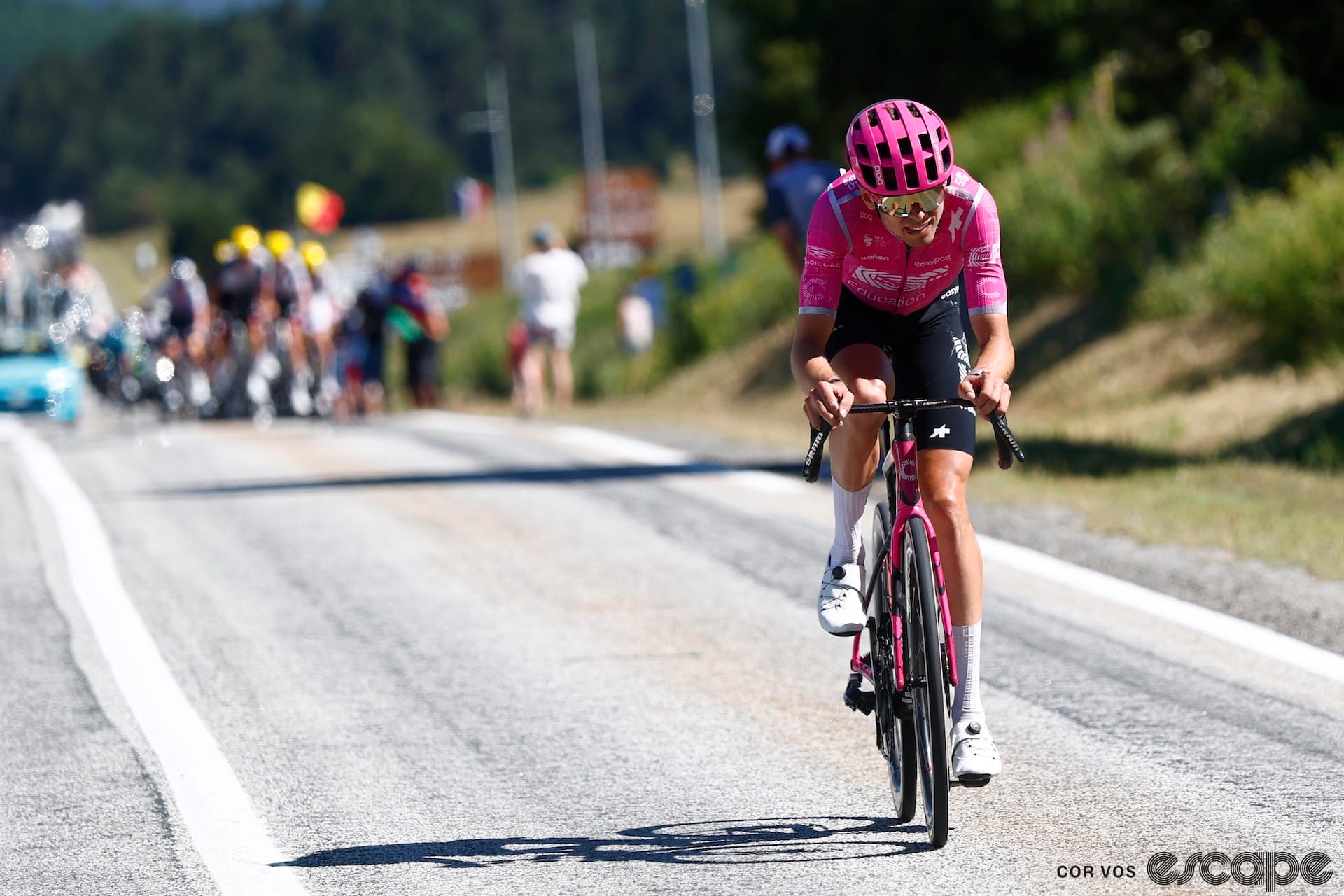
The Polka Dot Paradox: Alex Baudin and the art of losing to win
The battle for yellow is a war of attrition between titans. But the most interesting tactical battles are often fought for smaller prizes, by riders who understand that not every victory happens at the finish line.
There is a brutal, simple arithmetic to the Tour de France: one winner in yellow, 183 losers. Or so the story goes.
Every July, we fixate on the duel, the twin suns around which the whole race orbits. We measure gaps in seconds, parse post-race interviews for flickers of weakness, and elevate two men into a realm of their own.
Everyone else becomes scenery, the backdrop against which the real drama unfolds.
But that’s a lie. A convenient, simplifying lie. The truth is that the Tour is not one race but dozens of smaller, overlapping ones, each with its own logic, its own prize, and its own definition of victory.
Sometimes, the smartest rider in the race is the one who ignores the finish line entirely. For a rider like Alex Baudin at the Tour de France 2026, this is a key strategic insight.
His story on any given day might not lead the nightly news. A rider like Baudin (EF Education-EasyPost) could get into a breakaway that is, in the end, a noble failure, reeled in by a peloton with other ideas.
The conventional wisdom would file this under 'plucky rider gets TV time, ultimately achieves nothing.' The conventional wisdom would be wrong.
Such a ride can be a quiet masterclass in tactical intelligence. The rider isn't hunting the stage; he's hunting the polka dot jersey. By cresting a day’s categorised climbs ahead of his companions, he can secure it.
To understand why this is a victory, and not just a consolation prize, you have to understand the complex game theory of the breakaway.
The Sucker's Game
A breakaway is a fragile ecosystem built on a paradox: collective success depends on cooperation, but individual glory demands betrayal. To stay away, everyone must pull. But to win the stage, you must save your energy while others pull.
This tension creates the classic breakaway stalemate, the prisoner's dilemma played out at 45 km/h. Riders start looking at each other, refusing to work, each afraid of being the sucker who drags a fresher rival to the line.
And so, more often than not, they are caught. Everybody loses because nobody wants to be the one who loses most.
A rider like Alex Baudin can simply choose not to play. His objectives might be located halfway up the climbs, not on the flat run-in to the finish. Every watt he spends is an investment in the Mountains classification, a prize he could realistically target.
He isn't trying to out-sprint a faster finisher; he's collecting points. While his companions gamble on the slim chance of a stage win, he is banking a sure thing.
It’s a different kind of ambition. It’s not the explosive, all-or-nothing glory of a stage victory, but the calculated, methodical accumulation of an advantage. It’s the quiet ambition of the strategist, not the showman.
The Value of a Jersey
Of course, there will be those who scoff. The polka dot jersey in the first week, they’ll argue, is meaningless. It’s a marketing gimmick for wildcard teams, a temporary billboard before the real climbers take over in the high mountains.
And yes, it’s unlikely a rider in that position will carry it to Nice.
But that misses the point entirely. For a team like EF Education-EasyPost, a day in a leader’s jersey is a colossal success. It’s a tangible return for sponsors and a justification for the team’s place in the race.
It puts the rider and the team on the podium, in the press conferences, and in the global broadcast for hours. That visibility is currency, as real as any prize purse.
For a rider, it is a career milestone. It's a story to tell. In a sport where so many anonymous riders dedicate their lives to the service of a single leader, to have a day in the spotlight, to wear a distinctive jersey in the world’s biggest race, is a profound achievement.
It is proof that you were not just there, but that you did something. You bent the race to your will, even if only for a day.
This isn't failure. This is seizing the opportunities the road gives you. It's the recognition that in a race dominated by a handful of superstars, success must be redefined.
It lies in the intelligent pursuit of achievable goals. It’s about understanding your own strengths and the race’s peculiar rhythms, and finding the point where they intersect.
So while the cameras remain fixed on the GC titans, locked in their cold war, spare a thought for the other race. The race for the dots, the sprints, or just for the honour of being the day’s most aggressive rider. It’s in these contests that you find the heart of professional cycling: not just raw power, but cunning, foresight, and the will to make your own luck.
A rider like Alex Baudin might not win the stage. But he can win his day at the Tour de France 2026. And that, in the complex and brutal mathematics of this sport, is the entire story.
The conventional wisdom will file this under 'plucky rider gets TV time, ultimately achieves nothing.' The conventional wisdom is wrong.
Visibility is currency, as real as any prize purse.
Alex Baudin didn’t win the stage. But he won his day at the Tour de France 2026.