
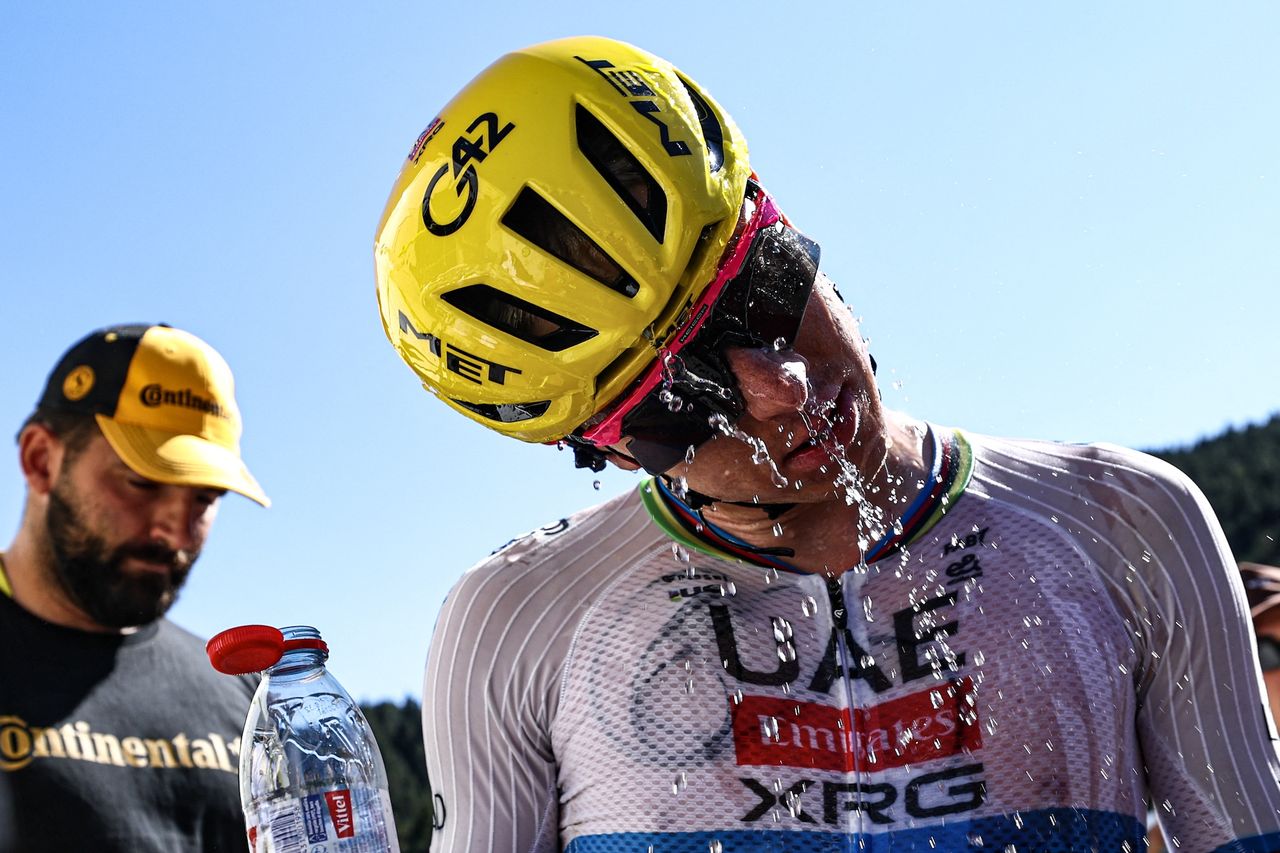
The Tour de France is melting
The race has always been an ordeal against the body's limits. Now, as the tarmac bubbles in another heatwave, it has become a desperate race against the planet's.
There’s a point where the romance of suffering curdles. It’s where shimmering tarmac is no longer a painterly backdrop for heroism, but a threat.
It’s where the frantic ballet of soigneurs with ice socks and frozen slushies stops looking like athletic preparation and starts looking like emergency triage. It’s where the air itself, thick and shimmering at 37°C, becomes the peloton’s most relentless adversary.
That point was reached during the Tour de France 2026. This isn't just another story about a hard day in a hard race; it is a klaxon horn, sounding from the Pyrenees.
Professional cycling’s grandest spectacle is simmering towards an unsustainable boiling point. When a rider as formidable as Tadej Pogačar (UAE Team Emirates-XRG) describes the conditions as a real logistical nightmare, he isn’t just talking about keeping water bottles cold. He’s describing the immense struggle to keep the show on a road that is becoming fundamentally hostile to human endurance.
The Romantic Trap
The conventional wisdom will say that the Tour has always been an ordeal. It will invoke the ghosts of pioneers on steel bikes over unpaved roads, with spare tyres slung over their shoulders.
This view argues that heat, like mountains and wind, is just another element to be conquered – another part of the race’s brutal, beautiful tapestry.
This argument is comforting. It is also a dangerous delusion.
There is a profound difference between the hardship of the past and the existential threat of the present. The pioneers faced adversity; today’s riders face an accelerating climate crisis. The heatwaves that now regularly descend on Europe in July are not the same as a few hot days of yore.
They are longer, more intense, and more frequent, supercharged by a warming planet. To equate the two is a category error, like comparing a fistfight to an artillery barrage. Both are violent, but only one signals a systemic force that changes the nature of the conflict.
The sport's entire apparatus is now geared towards battling the climate. Teams drive refrigerated trucks full of ice vests and cooling gels just to get their riders through stages that are becoming exercises in survival, not racing. This isn't a testament to modern science; it's a frantic arms race against an opponent that cannot be out-schemed or out-spent.
A Canary on the Open Road
Think of the Tour de France not as a fortress but as a canary in the coal mine. Unlike stadium sports, which can retreat into climate-controlled bubbles, cycling lives and breathes in the real world.
Its arena is the landscape itself – the Alpine passes, the sunflower fields of Provence, the forests and valleys of France. And that arena is sick.
When the road surface melts, when farmers are banned from watering crops but the race caravan sprays crowds, when riders are weighed to monitor dehydration, the sport becomes a monument to a broken relationship with the environment. It is a beautiful, fragile thing, uniquely exposed to the poison in the system.
This logistical nightmare is also an ethical one. How long can the sport justify this massive, carbon-intensive effort to race in conditions that are increasingly inimical to human health? How long can we celebrate athletes pushing their bodies to the limit when the very air they breathe is part of the danger?
An Inconvenient Truth
To understand this is a crisis, not just a challenge, is to accept an uncomfortable conclusion: the Tour de France cannot continue in its current form. Tradition is a powerful force in cycling, but it is not a suicide pact.
The July slot is iconic, tied to the French national holiday and summer vacations. It is also, increasingly, a death sentence for enthralling racing and a serious risk for rider welfare.
What would a change look like? Moving the race to May or September would detonate the existing UCI calendar, a complex Jenga tower of conflicting interests. It would be difficult, messy, and unpopular.
But the alternative is worse. It is a slow decline into a spectacle of attrition, where the winner isn't the strongest rider but the one who best manages heatstroke. It is a race defined not by daring attacks, but by desperate trips to the medical car.
This isn't about making the race easier. It's about making it possible. It’s about having the courage to admit that the world of 2026 is not the world of 1903, and that blind adherence to a century-old calendar is not honouring history, it’s ignoring reality.
The melting roads of the Tour de France 2026 are a mirror. They reflect the heat rising from the planet, but they also reflect our own complacency.
We watch, we marvel at the riders’ toughness, and we carry on. The warning signs are all there, written in the shimmering air above the asphalt.
The Tour can either change, or it can melt.
Tradition is a powerful force in cycling, but it is not a suicide pact.
The Tour can either change, or it can melt.