
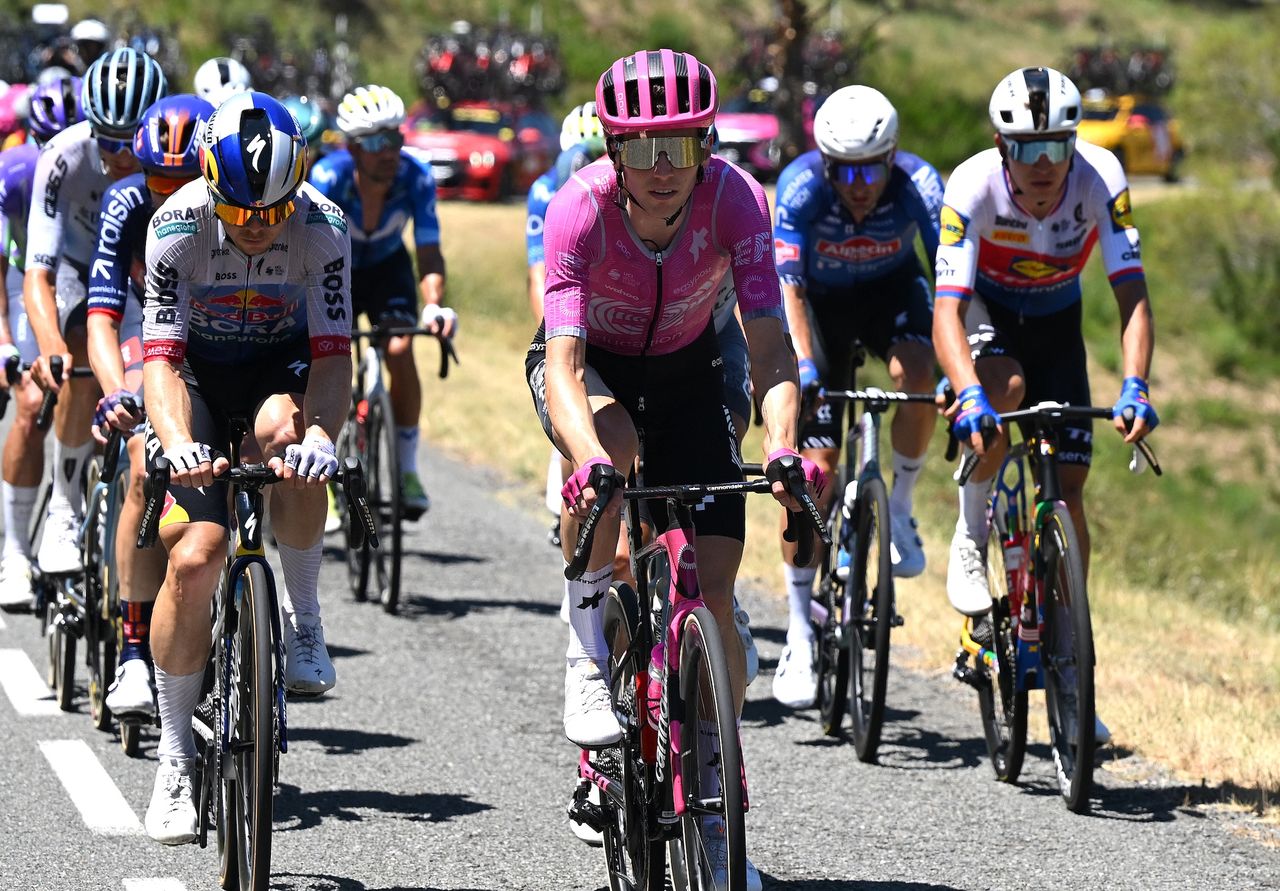
The brutal arithmetic of almost
Sean Quinn's power file from the Tour de France tells a story of immense suffering. But the stopwatch tells the only story that matters. In this sport, there is no prize for second.
There is a file on a server somewhere. A string of numbers represents a man’s soul, scraped out onto French tarmac over several hours. It is a document of profound physical suffering, a testament to an athlete pushing his body past where the warning lights explode.
By any objective measure, it is a masterpiece of endurance. And it is also a record of a failure.
This is the story of Sean Quinn’s near-miss at the Tour de France 2026. It is the story of the handful of seconds that separated the EF Education-EasyPost rider from the yellow jersey, cycling's most iconic prize.
But more than that, it is a story about the Tour’s unique cruelty: its ability to demand a historic performance only to reward it with nothing. To understand why this was not a moral victory but a perfect tragedy, you must look past the romance and into the data.
The numbers Quinn later shared are obscene. They quantify a day spent in a breakaway under brutal heat, a day of turning himself inside out while the world’s greatest bike race thundered along behind him.
We don’t need the exact figures to understand the narrative they tell. It’s a story of sustained, inhuman output, of holding a threshold that would make most mortals faint, and then pushing beyond it, again and again. The kind of performance a rider dreams of producing; the kind of performance that should be rewarded.
Conventional wisdom calls this a heroic ride, a star-making turn. It argues Quinn ‘announced himself’ on the world’s biggest stage, won hearts and minds, and that the EF team will be proud of his effort.
And all of that is true, in a way. It makes for a nice tweet. It fills the airtime for the post-race show. It gives viewers a convenient, feel-good narrative.
But it is a lie. Or, at least, a comforting fiction we tell ourselves to smooth over the jagged edges of elite sport. Moral victories are participation trophies, offering zero warmth on a cold night.
The yellow jersey is not a feeling; it is a physical garment. It is history. It is a tangible reward for being, on that day, better or luckier or cannier than 183 other riders. Quinn was not.
What makes his story so poignant is not the scale of the failure, but its intimacy. Had he been swept up with 20 km to go, legs empty and the breakaway doomed, that would be one thing. That’s just bike racing.
But to get so close? To suffer so profoundly, to empty the tank so completely, and to miss out by such a narrow margin… that’s different. That’s a haunting.
This is the brutal calculus of the Tour. It has no memory for effort, only for results. The power file, for all its staggering data points, is ultimately irrelevant to the race’s official history.
It is a personal document of pain, not a public record of achievement. The only number etched into the books is the one on the stopwatch. Quinn’s heroic numbers bought him a finish line, but another rider’s time bought them the stage, and another’s time kept them in yellow.
Think about what that must feel like. To sit on the bus, legs screaming, body caked in salt and sweat, scrolling through the data that proves you did something extraordinary. And to know, with chilling certainty, that it wasn’t enough.
It is a torment unique to professional sport. It is the gap between a career-defining day and just another hard day at the office, and that gap can be heartbreakingly narrow.
So let’s not talk about moral victories. Let’s talk about the cold, hard truth of it. Sean Quinn gave everything he had on a hot day in France. The numbers prove it.
He came closer to a life-changing moment than most riders ever will. And he failed.
That isn’t an insult. It’s a testament to the savagery of the event he was trying to conquer. The Tour de France is not a stage for heroes; it is a machine that uses them as fuel. And that, in a handful of seconds, is the entire story.
Moral victories are participation trophies, offering zero warmth on a cold night.
The Tour de France is not a stage for heroes; it is a machine that uses them as fuel.