
The smartest bike at the Tour de France has spacers
Everyone else is chasing perfection in the wind tunnel. Felix Engelhardt is chasing something far more useful: the ability to actually ride his bike for three weeks.
Every July, the bike industry wheels out its shiniest, fastest, most brutally unforgiving creations for the Tour de France 2026. Stems are slammed, tubes are shaped by supercomputers, and every component is polished to within an inch of its life. It’s a festival of marginal gains.
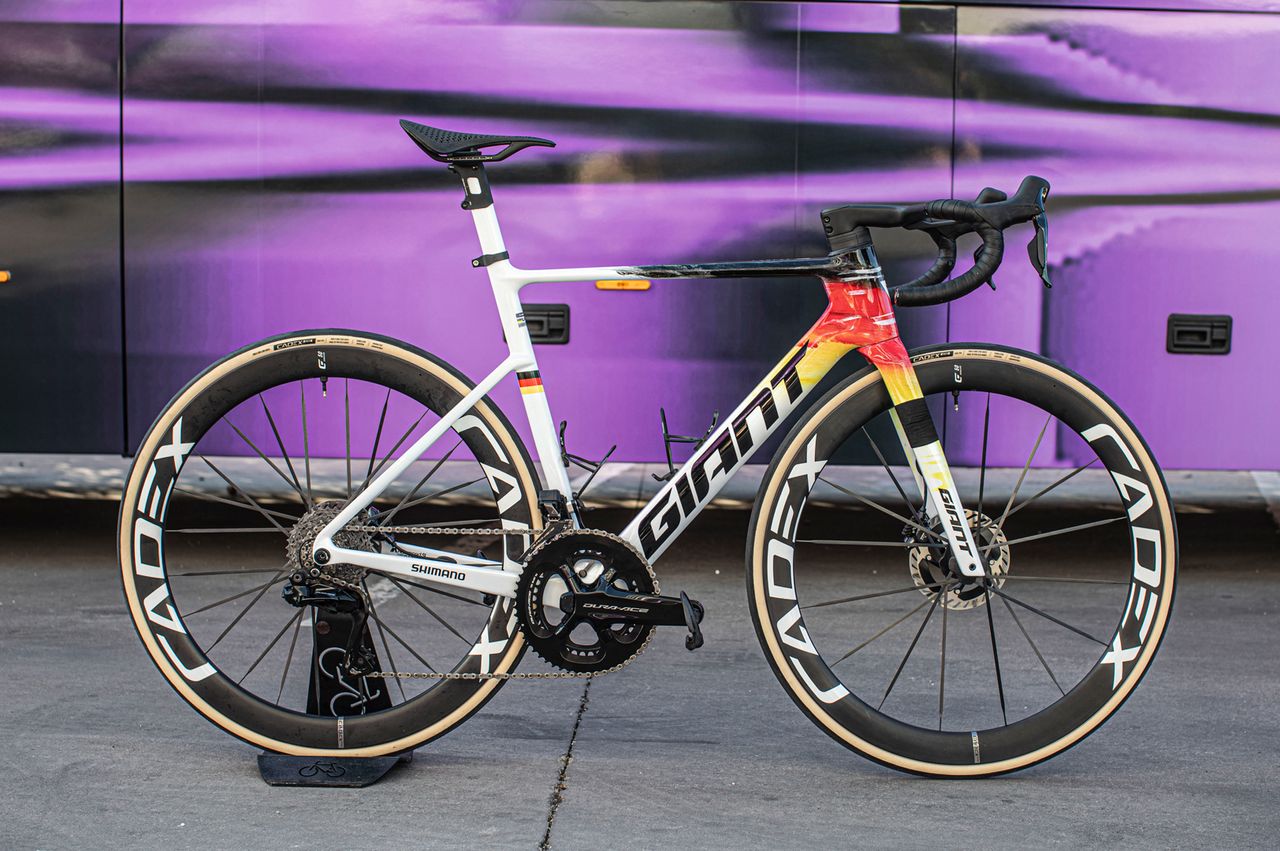
Then you get to the Team Jayco-AlUla bus and see Felix Engelhardt’s Giant Propel.
At first glance, it’s a beauty. The paint is crisp. But then your eye catches the details, and if you’re a certain kind of cycling purist, you might need to sit down.
There’s a stack of spacers under the stem. The cranks look a little... short. He’s running 30 mm tyres. It looks, to the untrained eye, a bit wrong. A bit comfortable. And in the world of professional cycling, comfort is often treated like a dirty word.
The conventional wisdom, shouted from the rooftops by every marketing department, is that aero is everything. A lower position cheats the wind, a longer crank gives you more leverage, and narrower tyres are faster. To deviate is to leave free speed on the table.
And yet, here is a rider at the biggest race in the world, committing what looks like aerodynamic heresy.
This is where you have to lean in a little closer and understand what’s really going on. Engelhardt’s setup isn’t an oversight; it’s a quiet, brilliant masterclass in pragmatism over dogma.
First, let's talk about the spacers
That little stack of carbon rings under his stem is the most honest thing you’ll see in the peloton. A slammed stem looks fantastic in the launch photos, but it forces a rider into a deep, aggressive tuck. It’s a position designed for a one-hour time trial, not for a six-hour slog through the Alps on stage 17 when your body is screaming for mercy.
Those spacers raise the handlebars, opening up Engelhardt’s hip angle and giving his diaphragm room to breathe. It’s a position that says, 'I have to do this for another 19 days, and I’d quite like my spine to be on speaking terms with my pelvis by the time we reach the finish.'
An aero position you can’t hold for the duration of an effort is, by definition, a slow position. Engelhardt is choosing a sustainable position, and in a three-week race, sustainable is fast.
And what about those tiny cranks?
The move to 165 mm cranks is even more telling. For years, the default for a rider of average height was 172.5 mm. The thinking was simple: longer lever, more torque. But the sport is getting smarter.
Shorter cranks make it easier to maintain a high cadence, which is less taxing on the muscles over a long day. They also, crucially, open up that hip angle even further at the top of the pedal stroke, reducing impingement and allowing a rider to stay in an aerodynamic tuck more comfortably.
It’s a subtle change, but it’s a choice that favours efficiency and self-preservation. It’s about being able to produce power deep into the third week, not just setting a new peak power record in a lab in December. It’s a setup for a marathon, not a sprint.
When you add in the 30 mm tyres—which offer more comfort and, on real-world tarmac, often less rolling resistance than their skinny counterparts—the picture becomes clear. Every choice on this bike is geared towards the brutal reality of the Tour de France, not the sterile environment of a velodrome or a wind tunnel.
This isn’t a rider who doesn’t know better; this is a rider who knows himself better than any spreadsheet. He’s listened to his body and figured out what it takes for him, personally, to survive the most attritional race on the planet.
While other riders contort themselves to fit the 'perfect' bike, Engelhardt has made the bike fit him.
It’s a lesson that goes beyond cycling. It’s about trusting the practitioner over the theorist, and understanding that the optimal solution on paper is rarely the optimal solution in practice.
The most advanced piece of technology in the race is still the human body, and Engelhardt is simply tuning his equipment to get the most out of his. It might not look perfect to the purists, but out there on the road, it’s a little slice of genius.
This isn’t a rider who doesn’t know better; this is a rider who knows himself better than any spreadsheet.
An aero position you can’t hold for the duration of an effort is, by definition, a slow position.
In a three-week race, sustainable is fast.