
The Sound of Silence Broken
Olav Kooij’s arrival at the Tour de France was not the loudest moment of his season. The loudest moments, the ones that truly mattered, happened in absolute silence.
There are two kinds of silence in a professional cyclist’s season. The first is the good kind, the welcome kind: the companionable quiet of a long training ride, the meditative hum of rubber on smooth tarmac, the held breath of a peloton before the flamme rouge. It is a silence pregnant with possibility.
And then there is the other kind. The bad kind. The one that hums with the fluorescent lights of a doctor’s office and echoes in the empty space on a calendar where a race should be.
It is the silence of a body that has turned state’s evidence against you, of a season that threatens to drain away into nothing before it has even begun. This is the silence Olav Kooij (Decathlon CMA CGM Team) knew intimately just a few months ago.
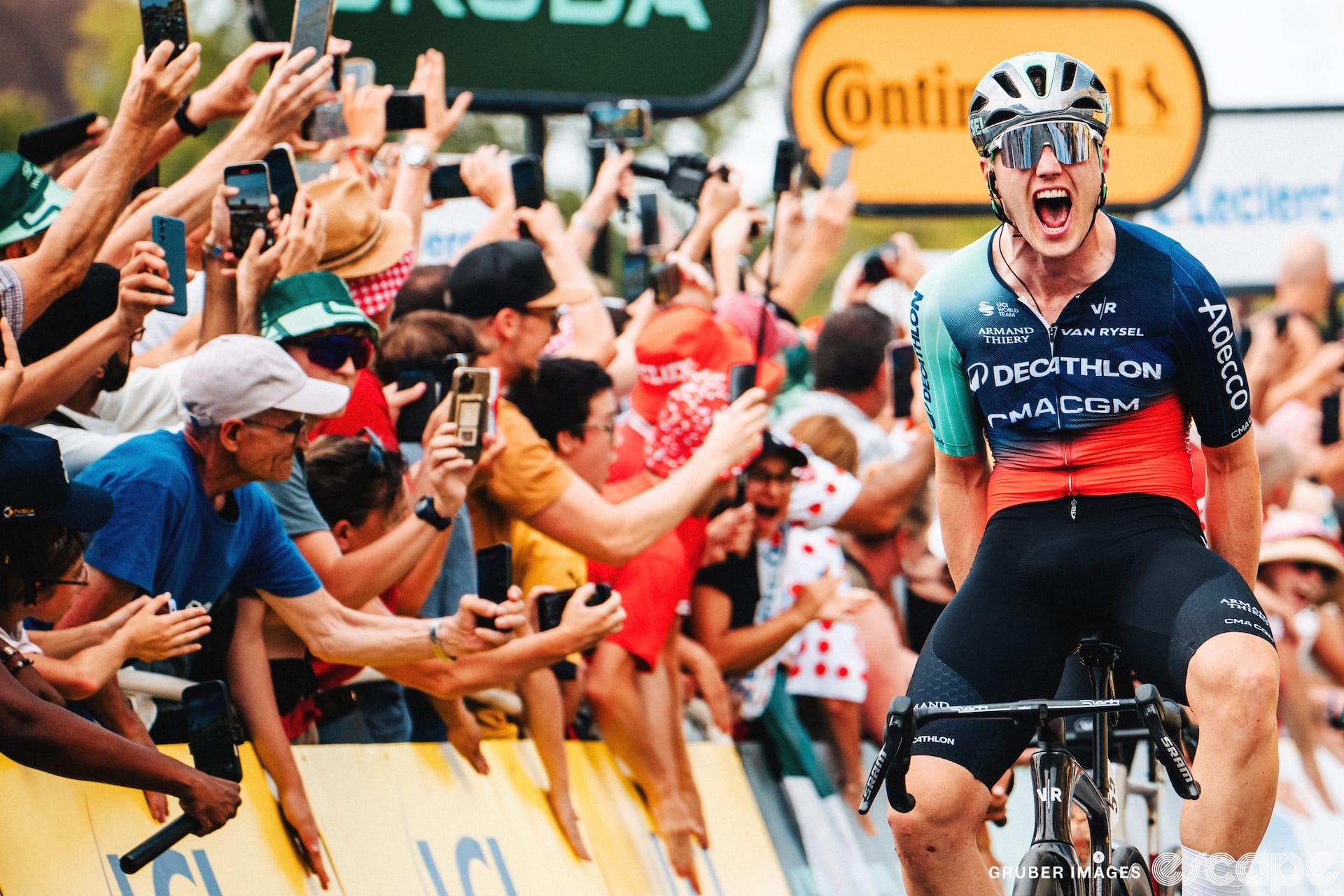
When Olav Kooij rolled to the start line of the Tour de France 2026, the noise was deafening. The roar of the crowd, the frantic commentary, the joyous shouts from his team car.
But to understand the true texture of that moment, you have to listen past the chaos. You have to listen for the echo of that other, terrible silence, now finally banished.
A Tour de France start is never just a beginning. It is an arrival. And for Kooij, this arrival was anything but guaranteed.
The conventional wisdom will look at his presence here – a sprinter at the biggest race – and file it away under ‘Expected.’ It will say that this is what he is built for, what he is paid for. It will nod sagely and move on to the next mountain stage, the next GC battle.
The conventional wisdom, as it so often is, is not wrong. It is simply incomplete.
It misses the entire point.
The hardest victory for Kooij was not won on the asphalt between two sets of barriers. It was won in the quiet rooms and on the lonely roads of a spring that threatened to unravel before it began.
A difficult spring, where a rider's body can feel like an adversary, is a uniquely cruel obstacle for an athlete. Their body is their instrument, the one thing they must trust implicitly. When it falters, it’s not just a physical setback; it’s a crisis of faith.
The questions start to creep in during those silent hours. Will I get back? Will I be the same? Has the window closed before it ever really opened?
Every pedal stroke on the home trainer is an argument against that doubt. Every cleared-to-train email from a team doctor is a minor miracle.
Just making the selection for the Tour de France 2026 was the first, and perhaps most significant, win of Kooij’s season. He had overcome the ghost of his own failing physiology. He had earned his place on the start line.
Everything else was a bonus.
This is why his presence here matters more than just another name on a start list. It is a testament to the unseen work, the lonely battles that define a career far more than the televised triumphs.
It is a story not of talent, but of resilience. The talent was always there; it was the resilience that was tested in the fire of a season almost lost.
The roar he heard as he rolled out was for a race begun. But listen closer. It sounds an awful lot like a debt being settled, a long-held breath finally released into the warm July air.
The hardest victory for Kooij was not won on the asphalt between two sets of barriers. It was won in the quiet rooms and on the lonely roads of a spring that threatened to unravel before it began.
The bike throw at the line wasn't just for victory. It was an exorcism. It was the definitive, explosive end to the silence.