
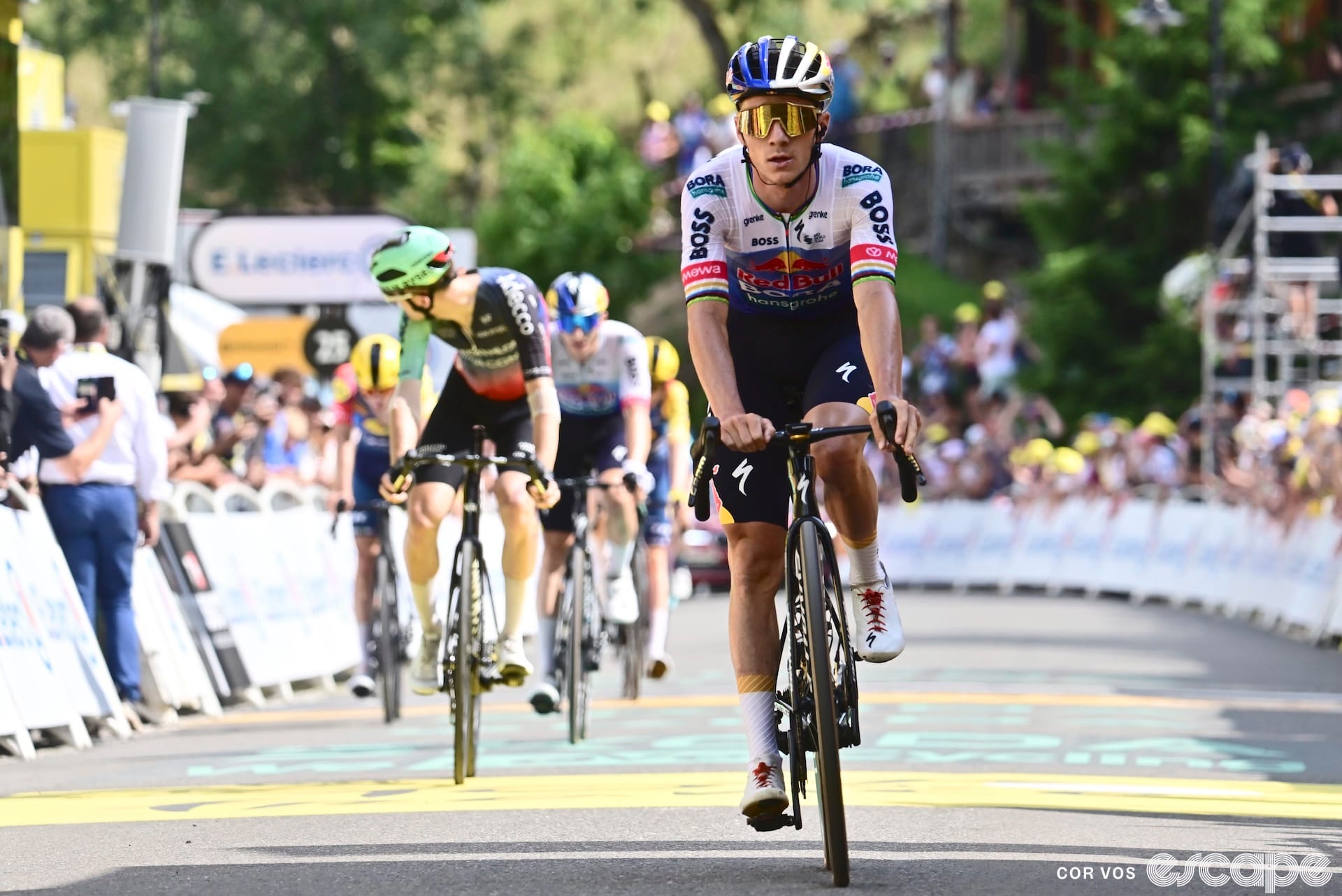
Remco’s rules of engagement
There are two races at the Tour de France: the one on the road, and the one for the microphones. Remco Evenepoel just lost a stage of the second one.
There’s a rule on the team bus, an unspoken one. You can scream, you can throw a bidon, you can have it out with a teammate behind closed doors where the only witnesses are a weary soigneur and a box of sticky rice cakes. What you don’t do is take the family argument public.
You don’t grab the nearest microphone, still panting from the finish line, and undress a teammate for the world to see.
But this is Remco Evenepoel we’re talking about. After a stage of the Tour de France 2026, he had some notes for one teammate in particular: Florian Lipowitz.
You already know the story. Evenepoel felt Lipowitz had failed to support him correctly. He said as much, his frustration boiling over into the hot French air.
Lipowitz, for his part, seemed unaware of any wrongdoing. And in that gap—between a leader’s fury and a domestique’s confusion—lies the kind of drama that can derail a three-week tour far more effectively than a poorly timed puncture.
Let’s be clear: Evenepoel’s frustration was probably justified, at least in his own head. He’s the team leader, the guy with podium ambitions and the weight of a multi-million-dollar Red Bull-BORA-hansgrohe sponsorship on his shoulders.
When you’re fighting for every second and you see a wheel you expect to be on up ahead, your blood pressure tends to rise. In the tactical heat of a Tour stage, a missed instruction can feel like a betrayal. The desire to win is a fever, and it makes you say and do things.
But turning that internal fire outward, onto your own guy, in public? That’s not leadership. It’s a gamble that almost never pays off.
The Old School vs. The Reality
The old guard will tell you this is how it’s done. A patron has to be demanding. He sets the standard, and if someone falls short, they need to be told. It’s about creating a culture of excellence, of accountability.
You can almost hear the ghosts of hardmen past nodding in approval, muttering about how riders are too soft these days.
That’s a nice, simple story. It just doesn’t work anymore. A modern WorldTour team isn’t a feudal court with a king and his serfs. It’s a highly complex organism of specialists, all of whom need to trust each other implicitly.
That trust is the currency the whole enterprise runs on. When a rider is burying himself to hold a wheel, he’s doing it on the faith that the leader will deliver at the finish, and that his effort will be valued, whether it works out or not.
When you publicly blast that rider, you torch that faith. You replace trust with fear. And fear does not make a domestique ride harder for you.
It makes him ride more cautiously. It makes him second-guess himself. It makes him wonder if the next time he makes a split-second decision that his leader disagrees with, he’ll be the one getting roasted on live television.
Lipowitz’s apparent confusion is the tell here. This wasn’t a case of open rebellion. It sounds like a miscommunication—a missed radio call, a confusing moment in a chaotic finale.
These things happen a dozen times a day in the peloton. They are supposed to be sorted out in the debrief, on the bus, with a DS acting as mediator. By making it a public execution, Evenepoel turned a tactical problem into a personal drama.
The Long Two Weeks Ahead
So what happens now? The press officer earns their salary, issuing a statement about unity and shared goals. Remco and Florian probably have an awkward handshake for the cameras at the start of the next stage. But the damage is done.
For the next two weeks, every Red Bull-BORA-hansgrohe rider will be thinking about this. Lipowitz, in particular, will be under a microscope.
Does he pull too long? Not long enough? Does he dare use his own initiative, or does he just wait for an order, terrified of getting it wrong? It’s a horrible position to be in for a rider whose job is to sacrifice himself for another.
And for Remco, he’s spent precious capital. The next time he needs a teammate to take a risk, to do something extraordinary, to empty the tank on a promise, will that rider hesitate for a fraction of a second? That fraction is the difference between a podium and fourth place.
A team leader’s greatest weapon isn’t his watts per kilo; it’s his ability to make eight other riders believe in his goal so completely that they’re willing to suffer for it.
That belief is built in quiet moments of respect, in private conversations, in a pat on the back after a hard day. It’s not built by airing your dirty laundry for the world to see.
Evenepoel is a phenomenal talent, a rider who can bend races to his will. But the Tour de France is too big, too hard, for one man to conquer alone.
He needs his team, not just their legs, but their hearts and minds too. After this, he might still have their legs. But he’s going to have to work a whole lot harder to get the rest back.
When you publicly blast that rider, you torch that faith. You replace trust with fear.
A team leader’s greatest weapon isn’t his watts per kilo; it’s his ability to make eight other riders believe in his goal so completely that they’re willing to suffer for it.