
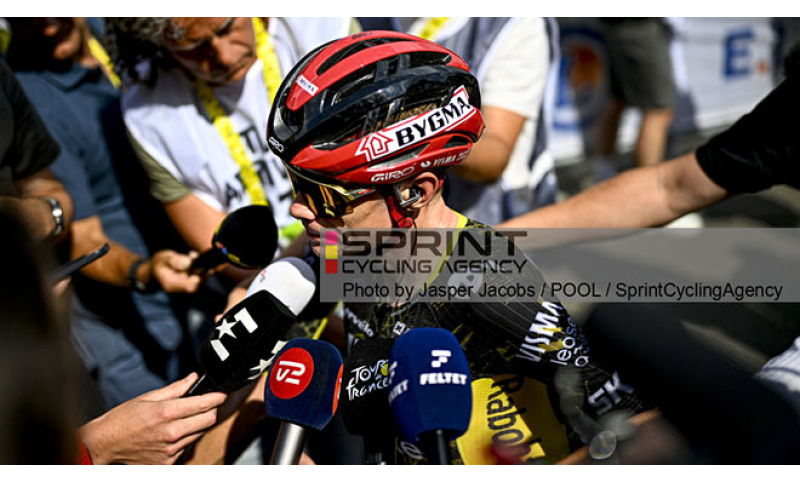
The Tour de France is over. The numbers say so.
Hope is a powerful emotion. A significant deficit on an early mountain stage is a mathematical certainty. One of these decides bike races.
A significant time gap. That is what may have decided the Tour de France 2026.
On an early mountain stage of the race, Tadej Pogačar (UAE Team Emirates-XRG) established a lead that may have dismantled the central premise of the entire event: that a competition for victory existed between him and Jonas Vingegaard (Team Visma | Lease a Bike).
That competition is now concluded. What remains is a procession to Paris for first place, and a frantic, compelling battle for second.
The debate currently raging is a denial of the facts. The Tour is not over because of a feeling or a prediction. It is over because of the irrefutable logic of the stopwatch.
Acknowledge the Objection
The conventional wisdom will push back. It will say that two weeks of racing remain. It will point to the potential for crashes, illness, or a dramatic reversal of form.
It will remind us that Vingegaard is a formidable champion, that his team is a tactical powerhouse. It will argue that anything can happen in a Grand Tour.
This is the argument from romance. It is the hope that sustains viewership. It is also, in this specific context, wrong.
Grand Tours are not decided by single moments of fluke or fortune; they are decided by physiological realities. The significant gap Pogačar opened was not the result of a lucky break or a mechanical issue.
It was the physical expression of a profound superiority. It was one rider on a level his only true rival could not approach.
For Vingegaard to reverse this, he would need to not only return to Pogačar's level, but exceed it. He would need to find a significant amount of time on a rider who has just demonstrated a major gap in class. Where, precisely, is that time supposed to come from?
Follow the Tactics
Consider the tactical position. Before that stage, the pressure was shared. Now, it rests entirely on the shoulders of Vingegaard.
UAE Team Emirates-XRG no longer has to make the race; they simply have to control it. They can set a suffocating tempo on every climb, letting their leader sit sheltered until the final kilometres.
Every stage that passes without incident is a victory for them. The clock is their greatest ally.
For Team Visma | Lease a Bike, the opposite is true. They must attack, not just once, but repeatedly. They must isolate Pogačar, they must gamble, they must throw long-range Hail Marys in the hope that one lands.
This is an exhausting, high-risk strategy that rarely succeeds against a rider of Pogačar’s calibre holding a significant buffer.
Every attack Vingegaard launches will be followed. Every move will be calculated. Pogačar doesn't need to drop Vingegaard again; he just needs to follow his wheel.
The burden of proof has shifted entirely. Pogačar has already provided his evidence. Vingegaard has none.
The Real Race Begins Now
To declare the race over is not to say the next two weeks will be boring. It is to say we should adjust our focus to the race that is actually happening.
The suspense isn't gone; it has simply moved one step down the podium. The fight for second and third place will be ferocious.
Riders who came to this Tour with podium ambitions now see an opportunity. Vingegaard, a wounded champion, will have to defend his position against challengers who no longer fear him in the same way.
This is the story now. Not a mythical comeback for yellow, but a brutal, attritional war for the minor places. Watching Visma attempt to salvage a second place from the wreckage of their ambitions will be compelling theatre.
It is just not the theatre we were promised.
The desire for a three-week, nail-biting epic is understandable, but it is not what the numbers on the road have given us. That mountain stage was not an opening salvo.
It was a verdict.
Stop waiting for a comeback. Start timing the gap to third.
The Tourmalet was not an opening salvo. It was a verdict.