
The Tyranny of the Present Second
The road doesn’t care about your backstory. It doesn’t care how long you’ve waited. It only cares what you’re doing right now.
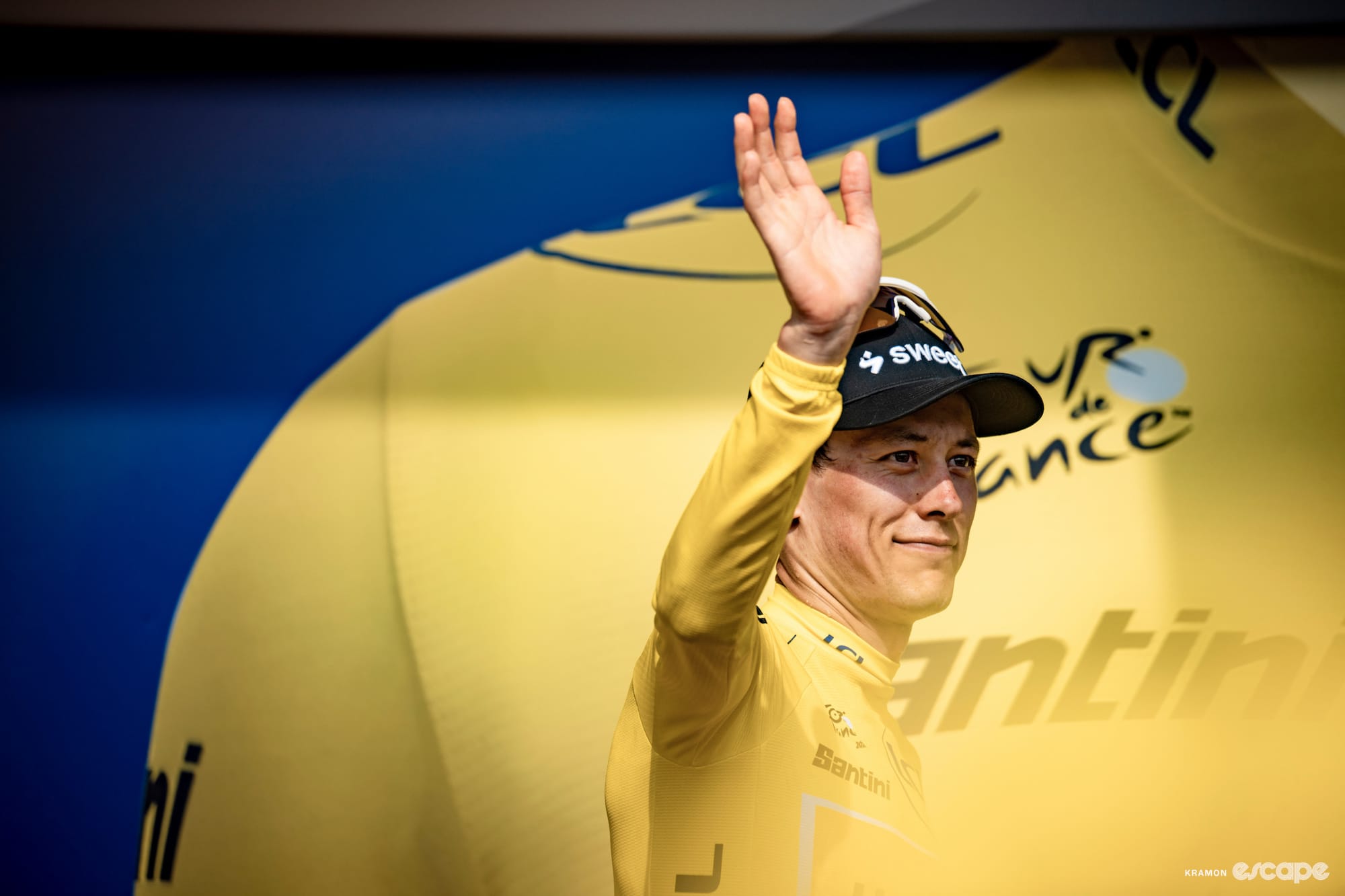
There is a particular weight to a leader’s jersey. It’s more than the sum of its high-tech, sweat-wicking fibres. It is a physical manifestation of a thousand invisible efforts: the lonely winter miles, the skipped desserts, the moments of doubt pushed through and conquered.
To pull one on for the first time is to feel the abstract dream of a career become suddenly, shockingly real. It is a story worn on the shoulders.
And sometimes, a story can be unwritten in a single, careless second.
Consider a rider who understands waiting. A journey to the top of a classification sheet measured not just in kilometres, but in overcoming significant personal adversity. To earn that jersey was to overcome not only rivals, but a fight for health that makes a bike race seem beautifully trivial.
He had waited years for a moment like this. Years. An entire Olympic cycle. A university degree. A lifetime, in bike racing years.
And then, a moment of inattention. A lapse. A brief, human flicker of distraction. And it was gone.
The specific mechanics of the loss are almost insultingly mundane. A gap opening, a missed wheel, a chase that never organises. These are the commonplace ingredients of any bike race, but for this rider, they combined into a tragedy.
The cruelty of cycling is not always found in the grand, sweeping gesture – the epic mountain collapse or the spectacular crash. More often, it lives in the tiny margins. It is a sport of punishing, relentless detail.
We ask riders for the impossible. We demand they maintain monk-like focus for five, six, seven hours, while their bodies scream and their glycogen stores plummet to zero.
Try it sometime. Try to do anything – even sit perfectly still and think about a single subject – for six hours. You can’t.
The mind wanders. It drifts to dinner, to a conversation from yesterday, to the weird noise the dishwasher is making. It is human to be distracted.
But professional cycling has no room for humanity. It is a machine that feeds on vigilance. A rider must simultaneously read the wind, the road surface, the body language of 150 other nervous athletes, the instructions crackling in their earpiece, and the frantic signals from their own protesting legs.
It is a state of sustained, high-stakes cognitive overload. To lose focus for a second is not a moral failing; it is an inevitability. It’s just that, most of the time, the price for that brief mental holiday isn’t so devastatingly high.
The conventional wisdom, shouted from sofas and typed into comment sections, will say he should have been paying attention. It is a simple, seductive logic. And it is entirely wrong.
It mistakes the symptom for the disease. The disease is that the sport demands a level of perfection that no human being possesses.
He didn’t lose his jersey because he was careless. He lost it because, for one second out of twenty thousand, he was a person and not a robot.
That is the brutal bargain of the sport. The road is the ultimate arbiter, and it is a cold one. It has no memory and no sentiment.
It did not know about his long wait. It was not aware of his victory over personal struggle. It felt nothing for his triumph, and it felt nothing for his despair.
There is no karma on the tarmac. There is only the present moment, a ceaseless and unforgiving now. Your past struggles do not earn you a protected passage through the peloton.
What are we to make of a sport so beautiful and so pitiless? Perhaps only that it is an honest reflection of things. It reminds us that nothing is permanent, that success is a temporary state, and that the distance between having and having-not is vanishingly small.
He had it. He had the weight on his shoulders, the story on his back. He had earned the right to that feeling.
And in the time it takes to glance away, the story changed. He is still the same rider. He is still the same man who stared down a terrifying personal battle and won. But the jersey is gone.
And that, in one fleeting moment, is the entire story.
He lost it because, for one second out of twenty thousand, he was a person and not a robot.
There is no karma on the tarmac. There is only the present moment, a ceaseless and unforgiving now.
The cruelty of cycling is not always found in the grand, sweeping gesture. More often, it lives in the tiny margins.