
The Invisible Current
In a Tour de France sprint, the most powerful force isn't watts. It's the invisible current of belief, and on one key stage, it pulled one man forward while another drowned.
A bunch sprint should be a simple thing. A problem of physics and physiology, solved with bike throws and bulging quads. The fastest man, delivered by the strongest train, wins.
We could write the equation on a napkin. But the finish line of a Tour de France stage is not a laboratory. It’s a cathedral of doubt, a high-speed referendum on the soul.
And on a long, flat stage of the Tour de France 2026, the elegant mathematics of the sprint fell apart, replaced by something far more human and cruel.
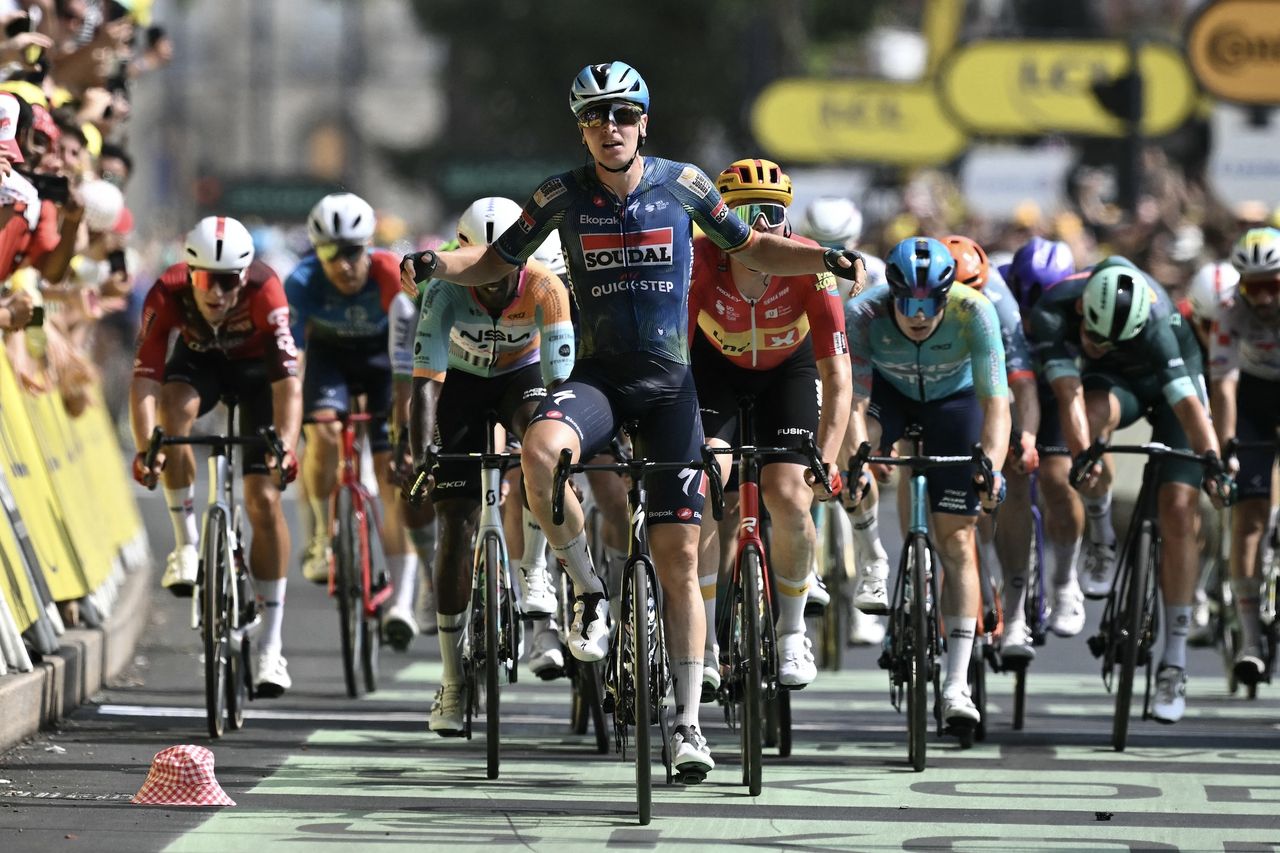
Two rivals, two teams, one road. In the end, Tim Merlier and Jasper Philipsen found themselves at the sharp end of a sprint, but moving in very different directions.
To understand Tim Merlier's sprint, you have to understand the weight he was carrying into that final kilometre. His place on the roster of a team like Soudal Quick-Step comes with the unspoken expectation of constant victory.
The pressure was immense. For Merlier, it became a tailwind.
His lead-out was not perfect. In the chaos, his Soudal Quick-Step teammate Jasper Stuyven briefly lost his wheel. But he fought his way back, found his man, and helped position him for the sprint.
It was an act of collective will. When Merlier opened his sprint, he wasn't just releasing watts into the pedals; he was releasing the anxiety of a difficult season and the pressure of his team. You could see it in the final 50 metres. That wasn't just speed. It was catharsis.
Contrast that with Jasper Philipsen. He had the perfect machine, the Alpecin-Premier Tech train that has been a dominant force on the flat stages for years. They did their job with chilling efficiency, a blue-and-red arrow aimed squarely at the finish line. They delivered their man to the front, into clean air, with the line in his sights. The equation was solved. All he had to do was provide the final, winning variable.
And yet, he seemed to falter, a king suddenly looking for his kingdom. Afterwards, he spoke of confusion, of a frustration with legs that wouldn't answer his own questions. What do you do when the engine sputters?
The Ghost in the Machine
The conventional wisdom, of course, will tell you about form. About peaks and troughs, about tired legs and mistimed efforts. It will point to Philipsen’s train and say the setup was flawless, that the failure was purely physical.
And that is the comfortable, easy answer. It is also the wrong one.
This wasn’t about the body. It was about the head. A Tour de France sprint is a game of microscopic margins decided by absolute, unshakeable conviction.
It requires a kind of arrogant faith that you are the fastest man on the road, that the gap will open, that your wheel will hold. The slightest hesitation, the smallest crack in that faith, is a sea anchor.
Philipsen, by his own admission, is searching for his top speed. But what he’s really searching for is that certainty. Momentum is a ghost. You can’t train for it, you can’t buy it, and the moment you question if you still have it, it’s already gone.
He is a man thinking his way through a process that must be pure instinct. He’s listening for an engine knock while travelling at 70 km/h.
Merlier, on the other hand, was running on pure feeling. He was powered by something beyond form, a confluence of desperation and dedication.
He found an opening near the Alpecin-Premier Tech train not just because he had the speed, but because he had the clarity of purpose to look for it. He was a man with nothing left to lose, which is, paradoxically, the most powerful position to be in.
A great river is a wide, steady force that makes its way to the sea. The peloton races alongside them for kilometres in France. On a day like this, you realise that a sprinter’s form is much the same.
It is a current. For Merlier, it was flowing powerfully, carrying him past his rivals, past his own pain. For Philipsen, it was a vicious undertow, pulling him down, leaving him stranded while the race sped away.
He will have other chances, of course. The Tour is long. But the question now hangs in the air at the Alpecin-Premier Tech bus every morning: can he find the current again? Or is he destined to spend the rest of this race fighting the water?
In that sprint, one man rode on a wave of emotion. The other was sunk by the weight of expectation. And that, in 200 metres, is the entire story.
The finish line of a Tour de France stage is not a laboratory. It’s a cathedral of doubt, a high-speed referendum on the soul.
Momentum is a ghost. You can’t train for it, you can’t buy it, and the moment you question if you still have it, it’s already gone.
He is a man thinking his way through a process that must be pure instinct. He’s listening for an engine knock while travelling at 70 km/h.