
The Beautiful, Doomed Arithmetic of the Long Solo Break
Liam Slock did not win the stage. He won something far more lasting: a place in the sport's long memory of glorious failure.
There is a particular story the Tour de France tells itself, a tale repeated across generations with the same unsparing conclusion. It is the story of the lone rider against the massed forces of the peloton, a single hopeful silhouette against an impossibly wide horizon.
It is a story that almost always ends in capture, in the heartbreaking absorption of the one by the many. And it is, very often, the most memorable story of the entire race.
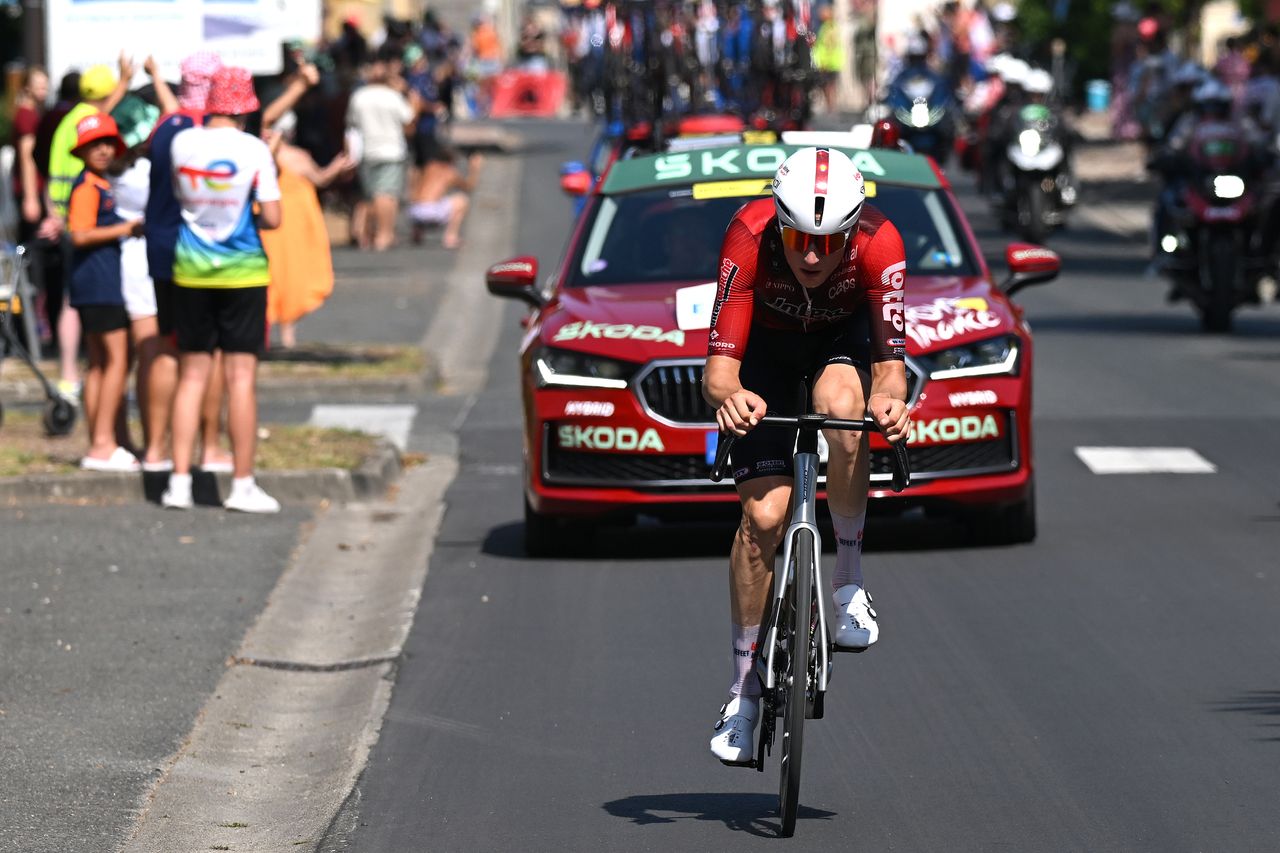
During a stage of the Tour de France 2026, a rider from Lotto-Intermarché named Liam Slock provided the latest chapter. His was a classic of the genre: a long solo flight, a desperate gamble on a day earmarked for the sprinters.
He was caught, of course. The mathematics of the modern chase are too brutal, too efficient. With the finish line approaching, the dream dissolved as the peloton swelled around him.
And yet, to see this as a failure is to fundamentally misunderstand the sport. Victory has its place; it fills the record books and pads contracts. But courage is what lodges in the collective memory.
The almanacs will record the name of the sprinter who won the stage, but those who watched will remember Slock. They will remember the grimace, the rocking shoulders, the repeated, desperate glances back at the approaching tide.
The Allure of the Hopeless Cause
The modern peloton is an exercise in applied physics and collective will. Sprint trains are assembled with the precision of engineers, components of a machine designed to deliver one rider to one point on the road at the optimal moment.
For a solo rider to defy this apparatus is an act of profound, almost irrational, optimism. It is a throwback to an era before race radios dictated tactics from the car, before power meters could tell a rider precisely when his effort would become unsustainable.
The voice of pragmatism will tell you Slock’s ride was for nothing. It was a beautiful, televised waste of energy that secured no tangible result beyond sponsor exposure.
In the cold calculus of professional cycling, it was an effort that left him at a deficit for the mountain stages to come. A match burned for a fleeting moment of glory that never even arrived.
This view is not incorrect; it is merely incomplete. It sees the race as a balance sheet, not a drama, and fails to account for why we watch in the first place.
We do not watch for the inevitable. We watch for the possibility, however slim, that the inevitable might be defied. Slock’s ride was a testament to that possibility.
He forced the sprint teams to burn their domestiques earlier than planned and chase harder than they wished. He single-handedly animated a day destined for a predictable conclusion.
A Noble Lineage
In this, Slock joins a long and noble lineage of doomed, magnificent attackers. He is a spiritual descendant of the baroudeurs who built the sport's romantic foundation, riders who raced on instinct and panache because they had little else.
These are the efforts that endure precisely because of their futility. The victory of the powerful is expected; the defiance of the underdog is what makes a legend.
We remember these moments because they reflect a fundamental human truth. We are all, at some point, the lone rider with the pack closing in; we understand giving everything to a cause that may well be lost.
The appeal of Liam Slock’s ride is not that he almost won. It is that he knew he would almost certainly lose, and he rode that hard anyway.
He did not win the stage, but he inherited a tradition. Years from now, when another young rider launches a seemingly hopeless move, commentators will reach for a name to give the action context.
They will speak of the great breakaway artists of the past, and they will speak of the rider who nearly stole a stage of the Tour de France 2026. His name will become part of the story the sport tells itself.
That is a victory of a different, and perhaps more meaningful, kind.
Victory has its place; it fills the record books and pads contracts. But courage is what lodges in the collective memory.
The appeal of Liam Slock’s ride is not that he almost won. It is that he knew he would almost certainly lose, and he rode that hard anyway.