
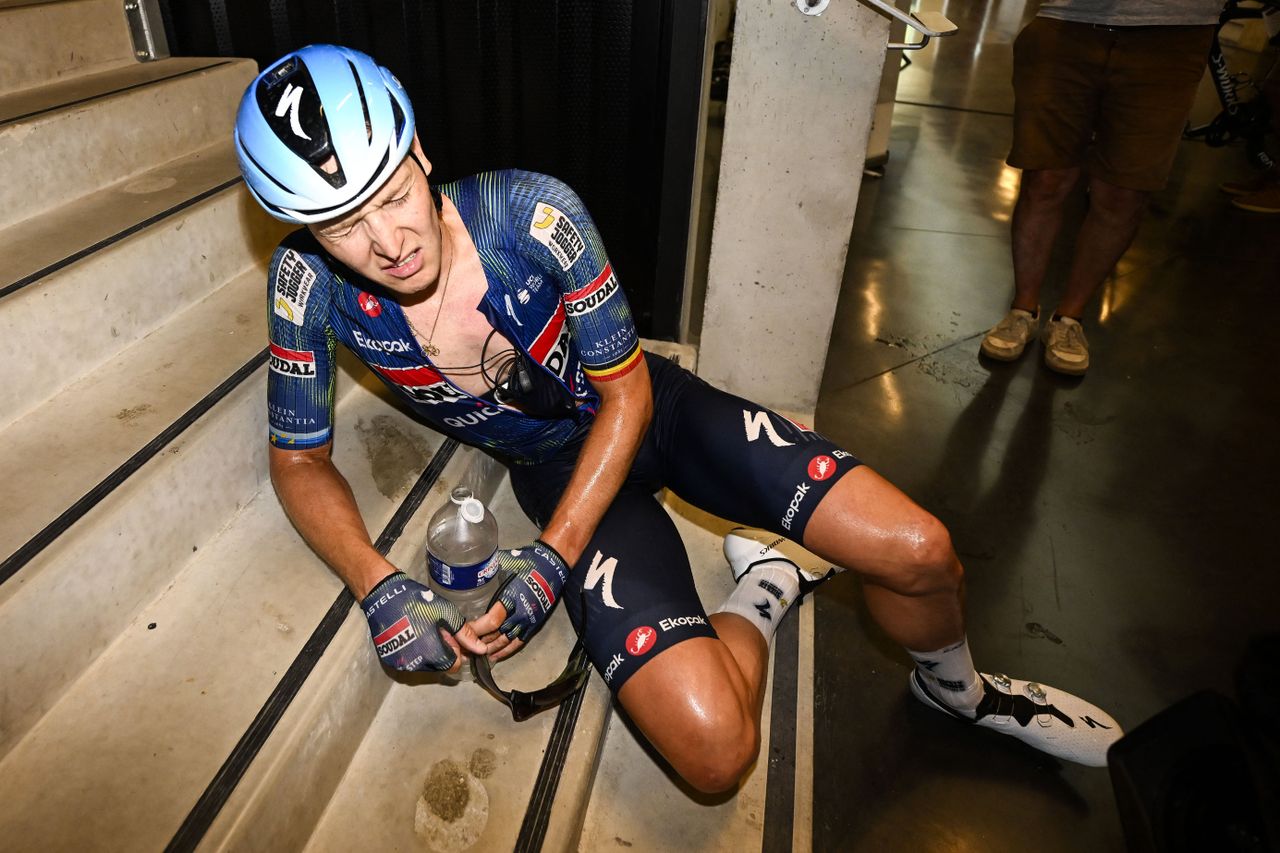
The stage that melted
They cut kilometres from a stage to save the race from the sun. But you can't shorten a season, and you can't outrun a planet's fever.
The road has a fever. You could see it in the shimmer rising from the tarmac, a heat that turned the air to liquid and the horizon into a mirage.
Extreme heat is not a number; it’s a physical presence. It’s the kind of temperature at which water bottles feel like they’re filled with tea and the simple act of turning pedals becomes a negotiation with your own biology.
And so, on one stage of the Tour de France 2026, the organisers finally blinked. They were forced to lop kilometres off the route and adjust the start time.
It was a pragmatic, necessary decision, a rare admission that the theatre of suffering has its limits. But to see it as just a sensible adjustment is to miss the story entirely.
This wasn't just a route change; it was a surrender. It was the moment the Tour de France, that great rolling monument to human endurance, conceded that a piece of its own country had become, for one afternoon, too hostile for the race to pass through.
To understand why this is the right argument, not just the dramatic one, you have to look past the ice vests and the frantic handing-up of bottles. The conventional wisdom will push back, saying that cycling has always been a sport of extremes.
It will whisper that riders are professionals, paid to suffer, and that modern science — better hydration, core temperature monitoring, advanced fabrics — has equipped them for this new reality.
Look, it will say, at how even top riders talk about improved hydration strategies making a furnace-like Tour more manageable.
That idea of manageability is the tell. It’s the sound of the ultimate professional normalising the absurd, the language of an astronaut discussing a better oxygen mix for a spacewalk on a hostile planet.
The coping mechanisms have become so sophisticated that they mask the sheer insanity of the environment itself. But a better coping mechanism is not a solution. It’s an adaptation to a problem spiralling beyond our control.
To equate this attritional war against cellular breakdown with the romantic suffering of old—a lone grimpeur wrestling with a mountain pass in the rain—is a profound category error. The mountain is an adversary you can conquer. The sun, in extreme heat, is an adversary that simply cooks you.
What happened on this stage is a symptom of a much larger sickness. Call it the Syndrome of the Shrinking Map. For years, we’ve seen the symptoms manifest at the sport’s edges: races in the Middle East rescheduled or shortened; the Vuelta a España becoming a laboratory for heat-survival technologies.
Now, the sickness has reached the heartland. The Tour de France, in July, is no longer immune. The map of where and when professional cycling can safely exist is being redrawn, not by race directors, but by the climate itself.
And what is the plan? The Extreme Weather Protocol is a reactive document, a fire extinguisher to be deployed once the blaze has already started. It’s necessary, but it is not a strategy.
A strategy would involve asking fundamental, terrifying questions. Can the Tour de France sustainably remain a July event in the decades to come? Should the grand tour calendar be fundamentally re-ordered, fleeing the peak heat of the European summer?
These are the conversations that feel too big, too radical to have. It is far easier to trim a few kilometres and hope for a cooler day tomorrow.
This isn't an attack on the organisers for making a tough call. They made the only call they could. But it is a plea to see that decision for what it represents: a temporary truce in a war the sport is losing.
We are asking athletes to perform at the absolute limit of human physiology in conditions that are becoming increasingly incompatible with it. We are celebrating their resilience while ignoring the fragility of the entire ecosystem — the roads, the mountains, the weather — that makes their feats possible.
A shortened stage will enter the roadbook as an anomaly, a footnote. But it should be remembered as a flare, fired into the sky. It was the day the greatest race in the world had to shrink itself to survive.
They cut a piece of the race away to save the riders. But the fever remains.
The mountain is an adversary you can conquer. The sun, at 41°C, is an adversary that simply cooks you.