
The Unfinished Sentence
In the heat of the Tour de France, the conversation between Tom Pidcock and Mathieu van der Poel can be ended by more than just legs. Sometimes, it's the machine that has the final, frustrating word.
Some rivalries are simple arithmetic, a cold tally of wins and losses. Others are closer to a conversation, where each attack is a question and every victory is an answer that only asks a new question in return.
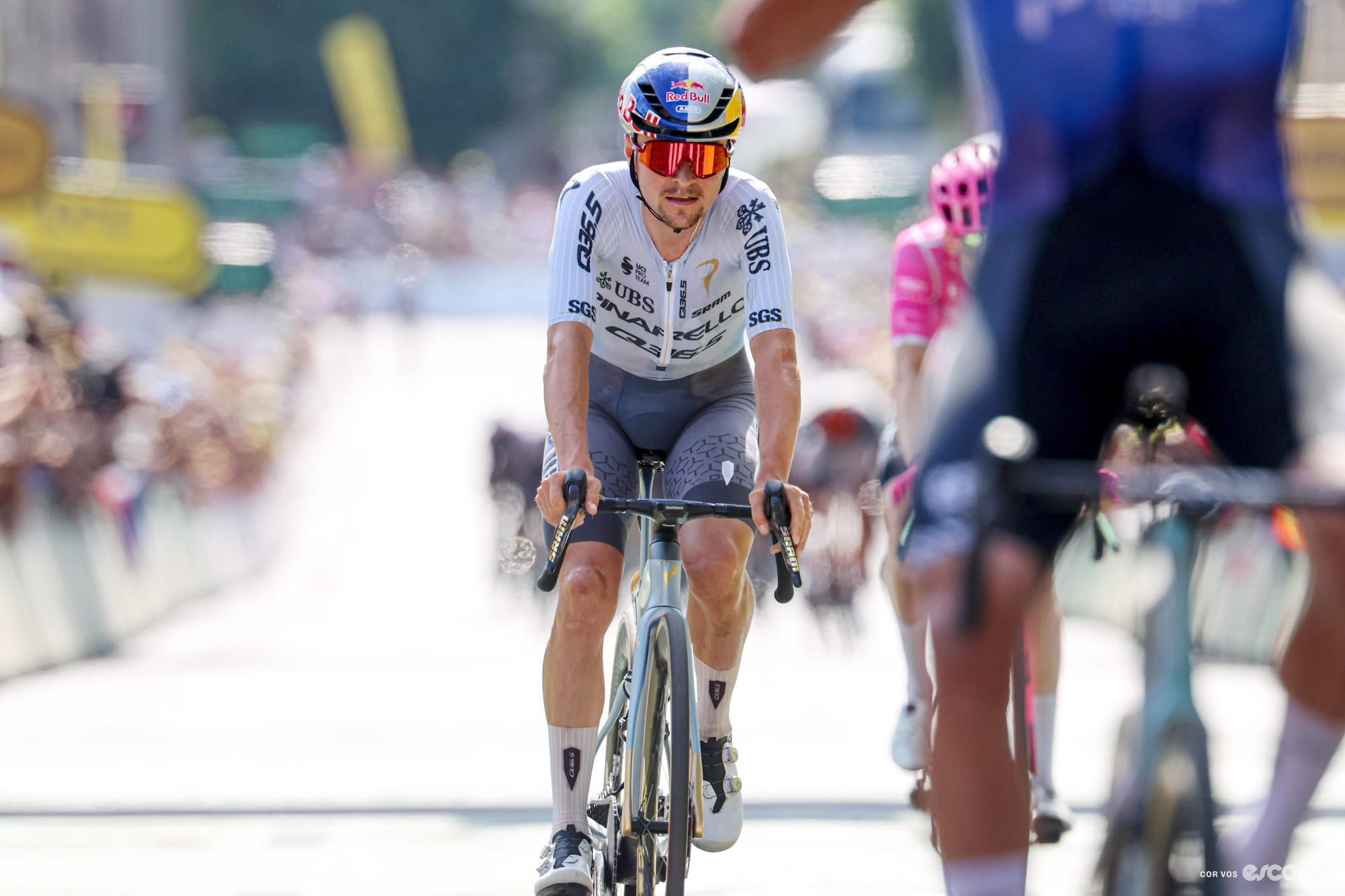
Then there is the exchange between Mathieu van der Poel (Alpecin-Premier Tech) and Tom Pidcock (Pinarello-Q36.5 Pro Cycling Team). Their racing is a dialogue conducted at 50 kilometres an hour, a thesis on the outer limits of talent argued in mud and on scorching tarmac. At the 2026 Tour de France, that conversation continues.
Any day can provide a new chapter. Picture a finale: a small group of riders hurtles towards the line, the peloton’s roar a fast-approaching promise of failure. In that group, the two men who seem to orbit each other. Van der Poel, in his singular way, produces a surge of raw, uncomplicated power. It is his statement.
Pidcock, preparing his rebuttal, reaches for the shifter to deliver his final argument. But what if, in that moment, nothing happens? What if a single, stray chip of French geology wedges itself in a derailleur? The machine goes silent.
In such a scenario, one rider powers to the line, while the other is left to coast, a man trying to shout with no voice.
The Cruelty of the Machine
The conventional wisdom would file such a moment under ‘bad luck’. It would note that a win is a win; a mechanical is a mechanical.
But that is to read only the back cover of the book. A stray piece of the world, ancient and indifferent, can lodge itself in the most delicate part of a very modern machine.
That tiny act of geological chance wouldn't invalidate the rivalry; it would throw it into sharper relief. For their conversation to flourish, for the questions and answers to be pure, a thousand components must work in perfect harmony. When one of them fails, the dialogue is cut short.
What makes the dynamic between these two so compelling is that they force each other to be more than they are. They are generational talents, polymaths of the bicycle, who find in each other the one true measure of their own abilities.
Each knows that if the other is present, a normal performance will not suffice. An entirely new gear must be found, a gear of imagination and suffering that is otherwise inaccessible. They are the architects of each other’s greatest days.
This is what can be stolen by chance. Not necessarily the victory, but the clarity of the answer. We can be denied the final sentence of the chapter.
We might see one rider's explosive declaration, but never get to see the counterargument in full flight. Would it have been enough? The point is not the certainty of the outcome, but the beauty of the attempt.
A Dialogue Without End
What would you do, if that was you? If, after more than four hours of exquisite effort, your body willing but your equipment broken, you saw your great rival ride away? The frustration must be immense, a silent scream into the indifferent sky.
Their rivalry is the sport's great gift. It is a narrative thread that weaves through entire seasons, connecting disciplines and reminding us that a cyclist is not just a climber or a sprinter, but a rider.
They are proof that the most interesting athletes are those who refuse to be placed in a box, who see any race, on any surface, as another opportunity to continue the conversation.
A single stage result is not an ending. It can be an interruption, a frustrating ellipsis. The result sheet might say one man won and another was beaten by misfortune.
But the story says two men are still asking questions only they know how to answer. One might pose his with brutalist force. And the other might be left with the silence of a mechanical, waiting for the next opportunity to reply.
The sentence is never finished. They just keep adding clauses.
Their racing is a dialogue conducted at 50 kilometres an hour, a thesis on the outer limits of talent argued in mud and on scorching tarmac.
We were denied the final sentence of the chapter.
The sentence is never finished. They just keep adding clauses.