
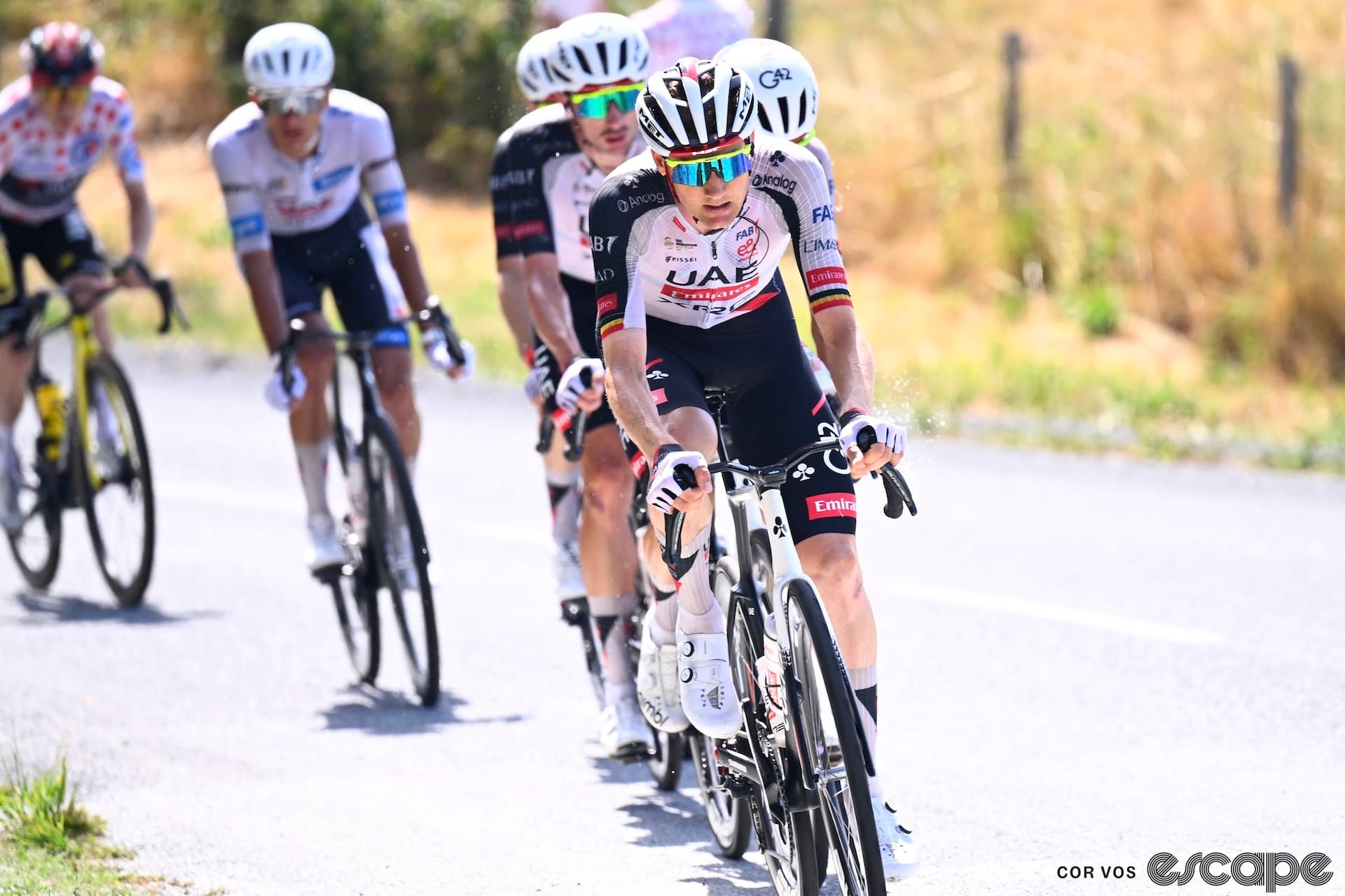
UAE's big stage 9 flex and the art of making no friends
The official line was about 'calming the race'. The reality was a chest-puffing exercise that may have bought them nothing but enemies.
There’s a certain language to the peloton, a dictionary of unspoken rules and coded messages. Then there’s the official dictionary, the one teams hand to the press.
On a stage of the Tour de France 2026, UAE Team Emirates gave us a classic entry from the latter, explaining their decision to spend all day strangling a breakaway as a desire to 'calm things down'.
You have to admire the poker face. Here was a day with 'breakaway' written all over it in big, friendly letters; a day for the wildcard hunters and baroudeurs looking for their moment of television glory.
Traditionally, this is a day for the yellow jersey’s team to put one rider on the front, let the gap balloon to ten minutes, and enjoy a relatively stress-free ride. A collective exhale before the real mountains.
But UAE Team Emirates, it seems, does not do days off. They don’t do collective exhales. Instead, they put the hammer down.
This wasn't a panicked chase because of a GC threat up the road. This was a cold, calculated suffocation. For hours, the gap to the escapees was held on a tight leash – close enough to see, too far to touch. It was a demonstration.
So let's dispense with the official explanation. This wasn't about calming the race; a calm race is one where the break is 12 minutes up the road and everyone knows the outcome. This was the opposite: a simmering, tense affair kept on a leash for no discernible GC gain.
No, this was about power. It was a message, sent from the front to every other team director, every rival, and every rider who dared to dream. The message? We are in charge. Every minute of every stage. Don't get any ideas.
The conventional wisdom (and why it's wrong)
The argument for UAE’s tactic, if you’re being generous, is that it asserts authority and discourages future attacks. It shows the team's strength and protects their leader from potential chaos. It’s the cycling equivalent of a pre-emptive strike.
By showing you have the horsepower to control everything – and they are not short on horsepower – you theoretically make rivals think twice before trying anything ambitious later on.
In a one-day race, maybe. In a three-week Grand Tour? It’s a massive gamble. The Tour de France is not won with brute force alone; it's won with alliances, favours, and a shared understanding of mutual benefit.
The peloton is an economy of energy and goodwill. On that stage, UAE spent a colossal amount of both for a very poor return.
What did they actually achieve? They tired out their own domestiques on a day they could have rested. They denied smaller teams a chance at a stage win, ensuring those teams will have long memories and no incentive to help UAE later.
They turned a routine day into a high-stress, high-wattage affair, burning matches across the entire peloton for the sake of making a point.
The unspoken cost of being the bully
There’s a reason the 'let the break go' convention exists. It’s a pressure release valve that keeps non-GC teams invested and gives them a reason to be in the race.
A stage win at the Tour can save a team's season, secure a sponsorship deal, or make a rider's career. By needlessly shutting that down, UAE isn't just flexing its muscles; it's telling half the peloton that their race doesn't matter.
And that's dangerous. When your leader has a bad day or gets a flat at a crucial moment, you might need another team to slow the chase, or a rival to share the workload.
Goodwill is a currency, and UAE just spent a truckload of it to prove a point that everyone already understood: they are very, very strong.
It’s the oldest rule in the book: don’t make enemies you don’t have to, especially not for a prize you weren't even trying to win.
This wasn't a tactical masterclass. It was a miscalculation of the social dynamics that govern a three-week bike race – a show of strength, yes, but also of political naivety.
They wanted to calm the race down. Instead, they might just have woken a few people up. And you have to wonder if, in a couple of weeks, they'll wish they'd just let the kids have their day out.
Goodwill is a currency, and UAE just spent a truckload of it to prove a point that everyone already understood: they are very, very strong.