
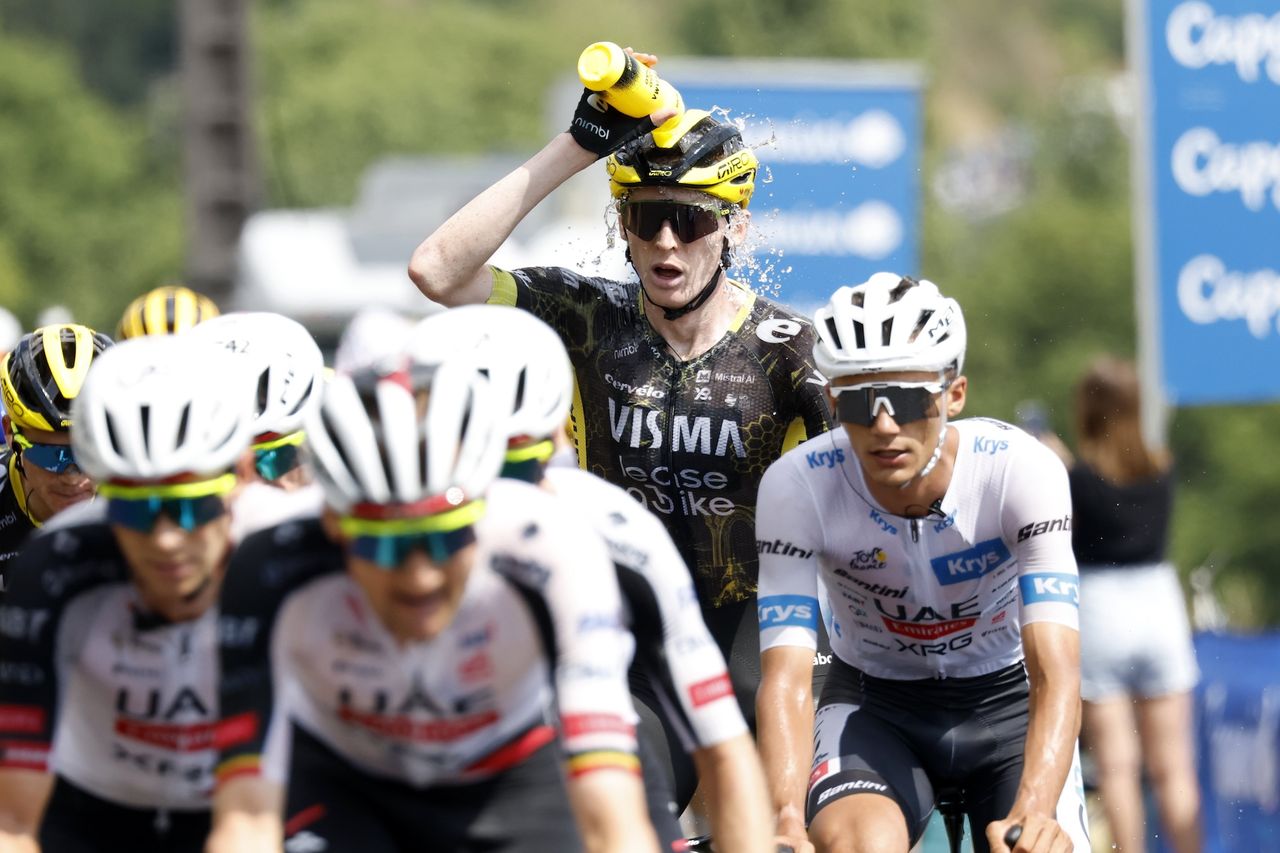
Forget the podium. The Tour’s real heroes are in the gutter.
The race is won by the strongest man, sure. But it’s held together by the ones who are falling apart.
Go on, turn on the TV. I’ll wait. You’ll see the helicopter shots, the chateaux, the pristine yellow jersey gliding through a sea of adoring fans.
You’ll hear about tactics and time gaps, about who has the legs and who’s on a bad day. The official narrative is a neat, tidy story of heroes climbing toward glory in Paris. It’s a lovely story; it’s also mostly fiction.
The real Tour de France, the one that doesn’t make the highlight reel, is happening a few hundred places back. It’s happening in the hurt locker, in the gruppetto, in the quiet moments of desperation on a lonely climb when the cameras have already passed.
You already know this, of course, but it’s worth saying again. The real story of the Tour de France 2026 isn’t who is winning, but who is surviving.
Take Matteo Jorgenson (Team Visma | Lease a Bike). On paper, he’s a high-priced, high-powered lieutenant for Jonas Vingegaard. The press release writes itself.
But what does that actually mean in the second week of a Grand Tour? It means that if you crash on a descent, you get back on. If you’re feeling ill, you don’t get to curl up in the team bus; you get to the front and you pull.
Your job title is ‘key support rider’. Your actual job description is ‘suffer so the guy in yellow doesn’t have to.’
There’s no podium for that. There’s no jersey for finishing a stage while sick, having spent five hours in the wind shielding a leader who feels fresh as a daisy because you’ve been absorbing all the punishment.
This is the hidden currency of the peloton. Every watt a leader saves is a watt a teammate has burned, often when they had precious few to spare.
The Unseen Engine Room
It’s a story playing out all over the race. Look at a team like NSN Cycling Team. All the attention funnels toward their star sprinter, the one who might throw his arms in the air at 170 kph.
But he only gets to that final 200 metres because a guy like Tom Van Asbroeck has spent the previous 199.8 kilometres fighting tooth and nail for a few inches of road space.
Van Asbroeck’s job is to be an anvil. He’s there to get battered by crosswinds, to chase down doomed breakaways, and to absorb the elbows and insults in the battle for position, all so his sprinter can be a hammer for 15 seconds.
If he does his job perfectly, he’ll be anonymous. If he makes one mistake, he’s the reason the team lost. That’s the gig.
The conventional wisdom is that this is simply the nature of the sport; a team game where the spoils go to the winner. Fair enough. But to focus only on the winner is to fundamentally misunderstand the spectacle.
It’s like watching a play and only paying attention to the lead actor, ignoring the entire supporting cast. The GC contender is just the final, visible link in a long, painful chain of human effort.
A Triage Unit on Wheels
This isn’t a race of three podium spots; it’s a rolling triage unit with 184 beds. Most are occupied by guys whose only ambition is to make it to the next town.
Their victories aren't measured in seconds, but in the simple act of finishing. It's about honouring the plan, delivering their captain to the key moment, and quietly fading back into the pack, their job for the day done.
So next time you see the man in yellow on the podium, by all means, applaud. He’s earned it. But spare a thought for the guys who got him there.
The ones who crashed and got back up. The ones who are sick but keep pulling. The ones like Jorgenson and Van Asbroeck, whose suffering is the invisible ink in which the story of the Tour is written.
That yellow jersey? It’s stitched together with the sinew of riders you’ll never see. And that, right there, is the whole story.
That yellow jersey? It’s stitched together with the sinew of riders you’ll never see.