
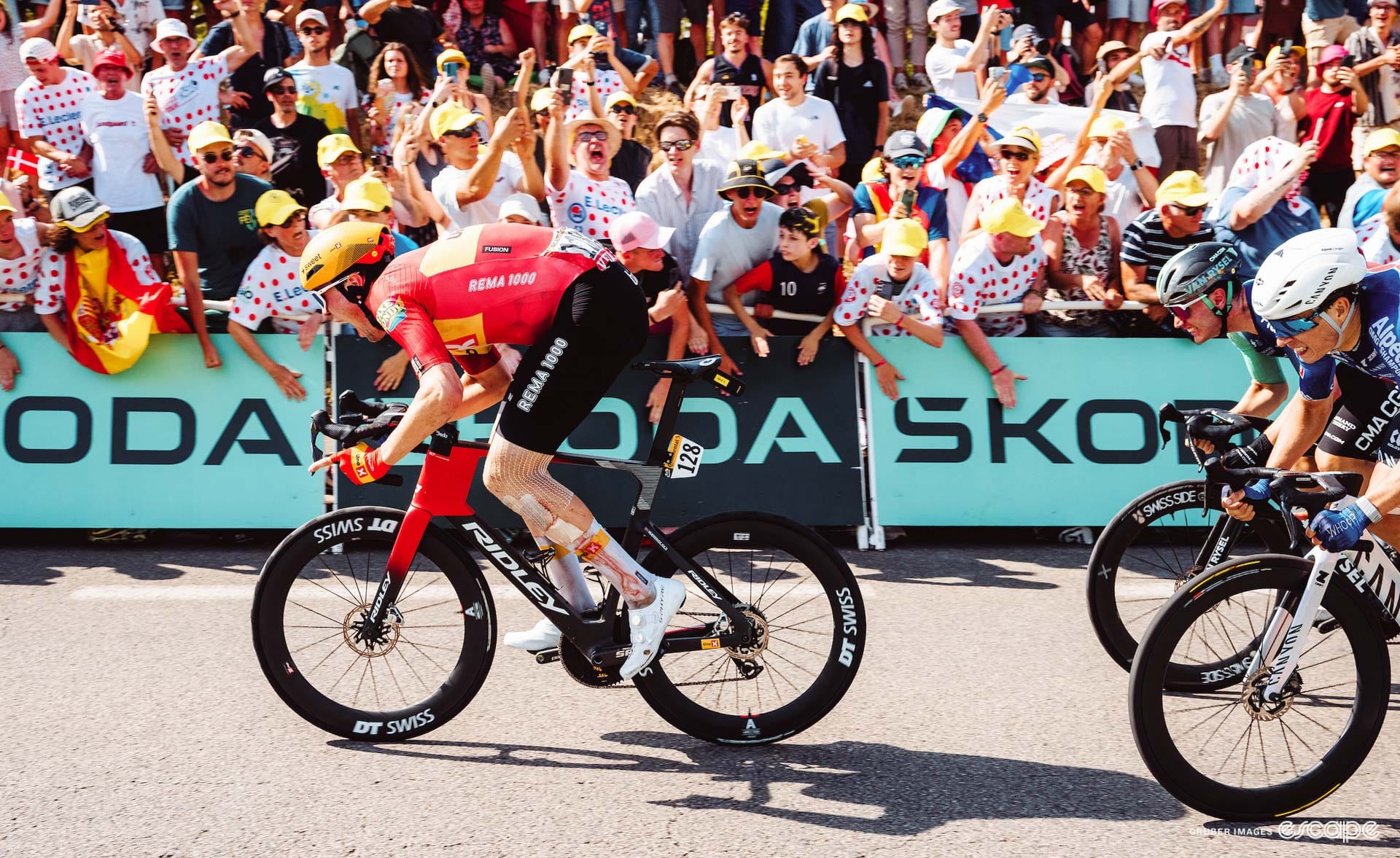
The Sound and the Fury: Cycling’s Unbearable New Speed
Modern racing is a postcard from a future that is already here, one where the peloton has forgotten how to use the brakes.
There used to be a rhythm to a Grand Tour. It was a slow, accordion-like thing; a breathing in and a breathing out over three weeks.
There were days for the GC men, days for the sprinters, and then there were the others. The transition stages, the so-called easy days, were for licking wounds, spinning the legs, and letting a doomed breakaway cook in the sun before the inevitable, gentlemanly catch.
That rhythm is gone. The song is the same, but it’s being played at double speed. The ghost of it is exorcised on seemingly every transition stage of a modern Grand Tour, like those in the Tour de France 2026.
What should be a standard-issue sprinters’ day becomes a brutalist monument to modern cycling’s obsession with velocity. A rider like Søren Wærenskjold (Uno-X Mobility) might feature, but that’s almost incidental.
The real winner, the real protagonist of these days, is the pace itself. Averages can push well over 45 km/h, on days that were once considered relative rest.
This is not a fluke. This is a symptom.
The anatomy of a record
Conventional wisdom will call this a perfect storm. It will point to a favourable wind, a relatively flat parcours, and the frantic energy of the Tour’s second week.
And it will be right, but only partly. A tailwind doesn’t account for this shift; that requires a more fundamental, tectonic shift in the sport itself.
Think about what it means to average such high speeds for hours. It’s a pace most amateur racers can only hold for a few frantic minutes. For the peloton, it is simply the cruising speed of a day that is meant to be for recovery.
When a powerful rider attacks, they aren’t launching into a lull. They are launching into a fury. The chase, featuring some of the fastest men in the world, isn’t disorganised or lazy.
It is simply pinned. It is already operating at the very limit of its capacity just to be there, and it has no answer for one more turn of the screw.
Such a ride is magnificent, a triumph of power and timing. But it is only possible because the entire ecosystem of the race has been supercharged.
The race has become a speed trap. It coerces everyone into a velocity that is barely sustainable, and then it punishes the slightest hesitation.
The end of the easy day
So, what has changed? Everything. The bikes are aerodynamic marvels, the nutrition is dialled in to the last calorie, the training a science of watts and lactate thresholds.
But the biggest change is the mentality. There is no more peloton patrol, no more patron dictating a tranquil pace. Every day is a war.
The fight to get into the breakaway is now a race within the race, often lasting for an hour at an intensity that would have been the stage-winning move a generation ago. The sprint teams, terrified of miscalculating, keep the gap on a mercilessly short leash.
There is no soft pedalling. There is no sitting up. The tension is constant, the physical cost cumulative.
This new paradigm creates a new kind of rider, or perhaps it simply elevates a type that used to be a curiosity: the engine. The rider who can sustain an inhuman output for hours, who is resistant to the attritional cost of this new speed.
They are not delicate climbers or explosive sprinters; they are diesel locomotives in human form. A rider like Wærenskjold, who can hold off the entire chasing pack, is the archetype.
The question we must ask is not how they are going so fast, but for how long they can sustain it. Are we watching a glorious evolution of human performance, or a slow-motion crash?
The sport is more spectacular than ever, a blur of colour and speed. But the riders are paying the price in flesh and bone. The peloton is stretched taut, and when it snaps, the consequences are severe.
A solo win on such a day is a moment of individual brilliance, born of a collective madness. A rider doesn’t beat the sprinters because they were slow; they beat them because the entire peloton had been driven into a red zone it could not escape.
They aren't the fastest person at the finish. They are the last one to defy the physics of a sport that is accelerating toward an unknown horizon.
And that, at speeds once thought impossible, is the entire story.
Are we watching a glorious evolution of human performance, or a slow-motion crash?