
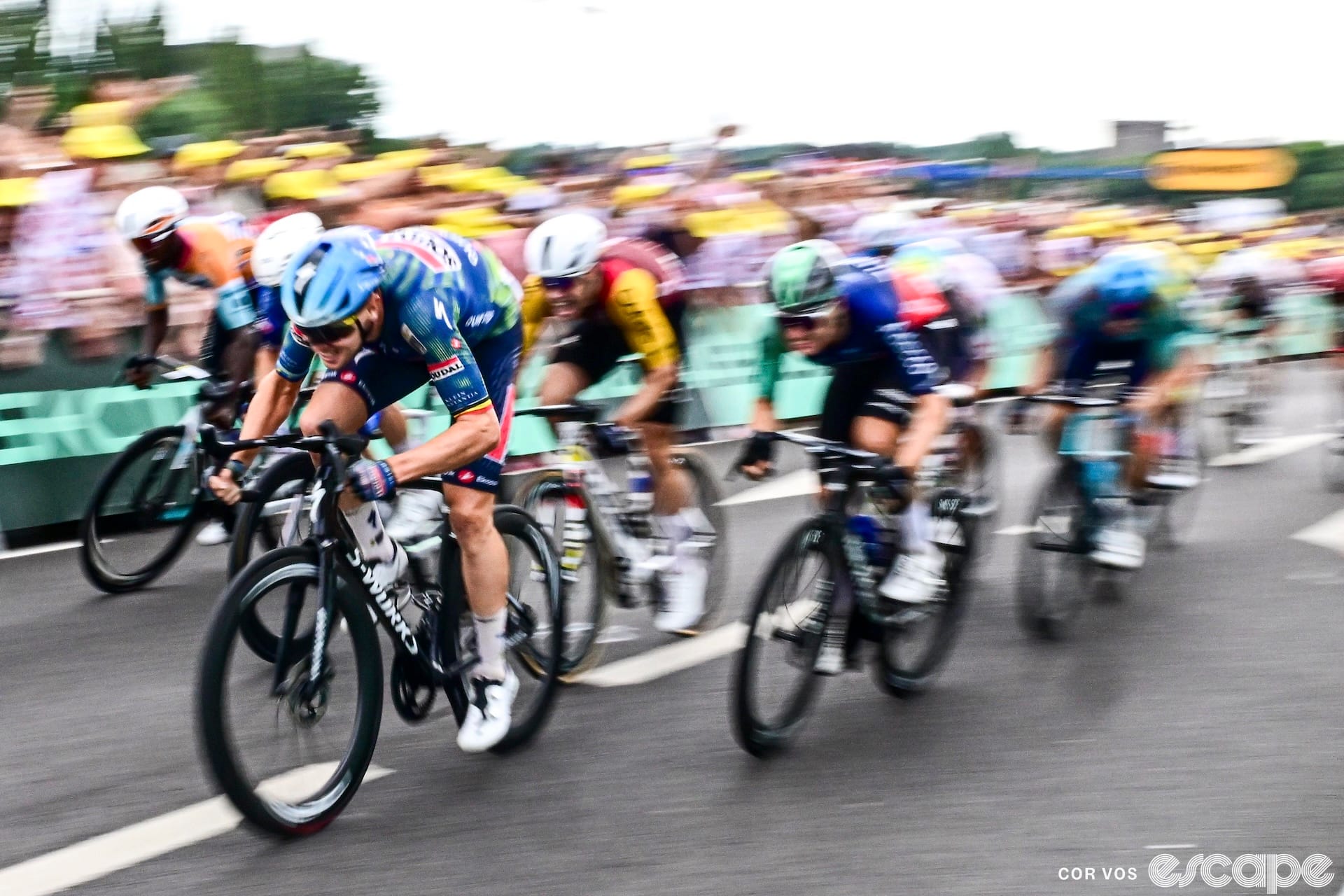
The beautiful, boring perfection of the Wolfpack
Tim Merlier was perfectly delivered to the line, but let's be honest: he was just the guy at the end of the chain. The real winner was the oldest, most reliable machine in cycling.
Look, you can read the wire report. Tim Merlier (Soudal Quick-Step) was the tip of the spear, again, at the Tour de France 2026. Olav Kooij and Jasper Philipsen were in the mix, fighting for position behind.
A big crash happened somewhere behind them. All the requisite parts of a modern bunch sprint story are there. But that’s not the story, is it?
The real story, the one that matters, is how it happened. While half the peloton was playing human pinball in the final kilometres, one team was practising a different, much older art.
Amid the chaos of flailing elbows and desperate gambles, Soudal Quick-Step were simply doing their job – a job they’ve been doing, with terrifying efficiency, for the better part of two decades.
Merlier’s performance isn’t a monument to his legs alone. Sorry, Tim. It’s a testament to the enduring, almost offensively effective power of the classic sprint train. It’s proof that in a discipline that seems to get messier every year, a perfectly executed plan still beats frantic improvisation nine times out of ten.
The gospel of chaos
The conventional wisdom from new-school pundits is that the sprint train is a relic. In the age of GPS, endless race analysis, and teams fighting for every inch of road, it’s supposedly too hard to control the front.
The theory goes that it’s better to be a freelancer, a wheel-surfer like Philipsen, using instinct to navigate the maelstrom.
And they have a point. It often looks like that. You see lead-outs get swamped at 1.5 km to go, or designated sprinters lose their last man and have to fend for themselves.
It looks like a lottery, and in a lottery, you just want a ticket, not a meticulously constructed plan that can be derailed by one wrong move.
The argument is that the collective has become too fragile, and individual genius is what now wins the day. It’s a compelling narrative. It’s just wrong.
A clinic in blue and white
Now, go back and watch the last 5 km of that stage. Filter out the noise, ignore the riders bumping shoulders in 15th place, and just watch the front.
What you’ll see is Soudal Quick-Step imposing their will on the race. They aren’t asking for permission; they are simply there. They create their own reality, a bubble of calm in the hurricane.
One by one, they peel off, each rider doing their turn with the grim satisfaction of a shift worker clocking out. They don’t panic when another team surges; they hold their line, trust the man in front, and know the man behind is right where he should be.
It’s not thrilling or dramatic. It’s methodical. It’s a process. And at the end of that process is Merlier, delivered to the 200-metre mark with more protection than a head of state.
While Kooij and Philipsen were fighting for a slipstream, Merlier was waiting for his moment in business class. That’s the difference. The others are hoping to find a path through the chaos; Quick-Step’s job is to eliminate the chaos entirely for one man.
This is the Wolfpack Way. It’s a system, a philosophy passed down through generations of riders. The name on the jersey changes, the sprinter at the tip of the spear changes, but the system endures.
It’s a finely tuned machine, and Merlier is just the latest, shiniest component. He’s a brilliant sprinter, no doubt. But you or I could probably snag a top ten with that kind of armchair ride to the line. (Probably.)
So when you see Merlier on the podium, arms in the air, remember the ghosts who put him there: the riders who emptied themselves from 3 km to 400 metres to go.
They controlled the finale. Merlier just had to finish it off.
The others are hoping to find a path through the chaos; Quick-Step’s job is to eliminate the chaos entirely for one man.
It’s not thrilling or dramatic. It’s methodical. It’s a process.
They won the stage. Merlier just did the victory salute.