
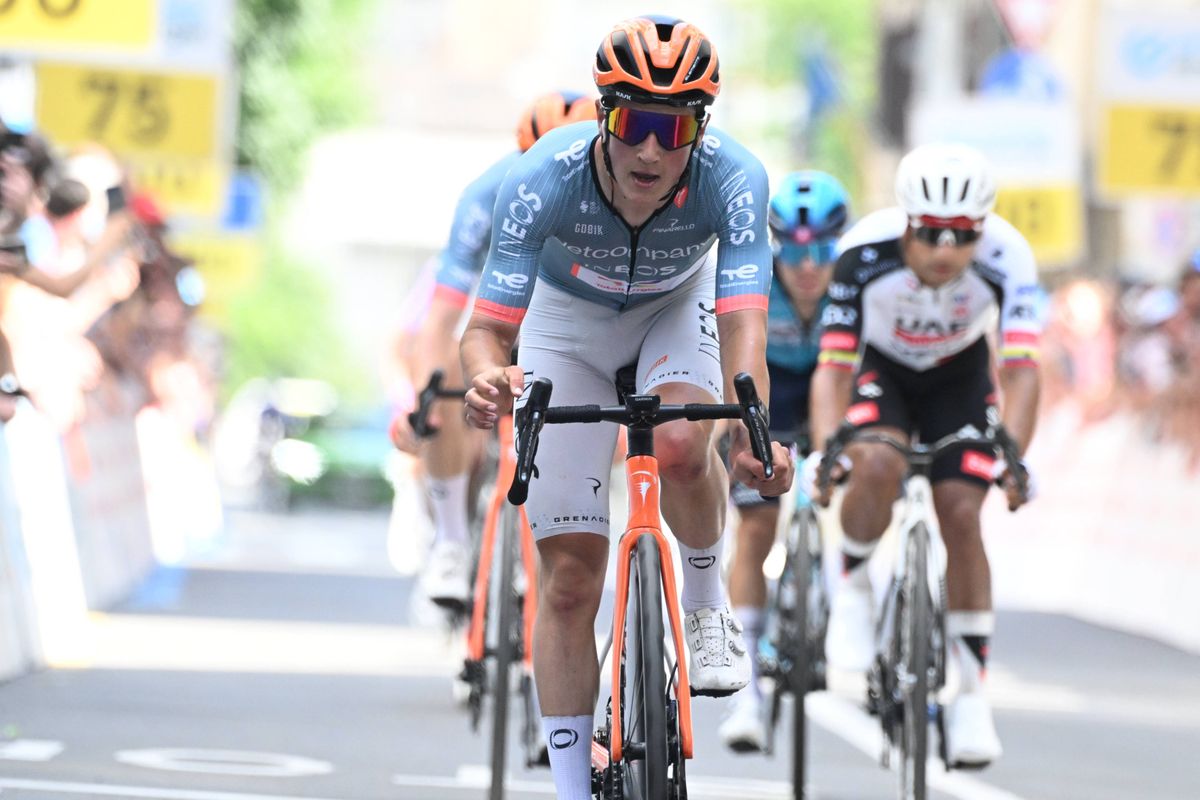
The Pidcock equation has no easy answer
A new team offers a new variable, but it doesn't solve the fundamental problem. You cannot be the best at everything, all at once.
The rumour is a move to Q36.5 Pro Cycling for 2026. For Tom Pidcock, this is presented as a step toward uncompromised leadership, a team built entirely around his ambitions. The logic is seductive. It is also wrong.
This is not a strategic masterstroke. It is a lateral move, at best. It seeks to solve a problem of team hierarchy when the fundamental limiter is one of physiology and time. Pidcock’s challenge isn’t the colour of his jersey or the names of his teammates. It’s the calendar, and the attempt to reconcile the irreconcilable demands of three different sports.
The Seductive Logic
The conventional wisdom is clear. At Ineos Grenadiers, Tom Pidcock is one of several leaders. He must fit his goals around the team’s broader Grand Tour ambitions, meaning resources are shared and the calendar is a compromise.
At a new entity like Q36.5, built for him, he would be the system's gravitational centre. Every rider, every staff member, every piece of equipment would be selected with one question in mind: does this help Tom Pidcock win? There would be no conflict for Tour de France leadership and no need to sacrifice a Classics campaign for another rider.
It is the promise of absolute authority, a blank canvas upon which to paint a masterpiece. This is the argument for the move, and on paper, it holds a certain appeal. But racing is not decided on paper.
Follow the Resources
The romance of the lone leader fades under the harsh light of logistics. Ineos Grenadiers is one of the most resource-rich organisations in the history of the sport. It possesses a depth of staff, sport science, and institutional knowledge built over more than a decade of dominance.
Can Q36.5, a team aiming to step up to the WorldTour, replicate that infrastructure by 2026? It's a monumental task. Building a team capable of supporting a Tour de France podium contender or a Monument winner takes years, not one transfer window.
Support riders who can navigate the peloton for 200 kilometres, set a punishing tempo on a final climb, and deliver their leader to the decisive moment are not commodities you simply purchase. They are part of a system. A rider with Pidcock’s scattered ambitions needs that deep support structure more, not less.
A smaller, focused team needs its star performer delivering on the road, consistently, to justify its entire existence. The pressure doesn't dissipate; it concentrates.
The Three-Body Problem
This brings us to the core of the issue. The single greatest variable limiting Tom Pidcock’s ultimate potential on the road is not his team. It is his own laudable, but ultimately self-defeating, ambition.
His career is a classic three-body problem, trying to solve for road, mountain bike, and cyclocross simultaneously. The result is a system of chaotic, unpredictable compromises. The peak required to win at the highest level of mountain biking is physiologically different from the endurance base required to contend for three weeks at the Tour de France.
Changing teams does not add more weeks to the year. It does not alter the fundamental principles of training and adaptation. To be the absolute best in the world at one of these disciplines requires a level of singular focus that, by definition, he cannot have while pursuing all three. This is not a failure of talent. It is a reality of mathematics.
A new contract with Q36.5 doesn't solve this equation. It only changes one of the constants. The unsolvable variable remains.
What Is the Ultimate Goal?
The only way this move makes sense is if it signals a fundamental re-evaluation of his goals. If the objective is no longer to become a Grand Tour champion, but to be a multi-disciplinary icon who hunts Monuments and championships, the logic shifts. Slightly.
But even then, is a nascent WorldTour team the best platform from which to win Paris-Roubaix or Liège-Bastogne-Liège? Those races are won with team strength, with tactical options, with riders who can sacrifice themselves to neutralise attacks and position their leader. Building that unit from scratch is a gamble.
The calculation seems to be that total freedom will unlock a new level. The data suggests that deep institutional support is what allows unique talents to flourish. He is betting on the former; the evidence points to the latter.
He isn't solving the problem. He is displacing it. The hard choice isn't which team to ride for. It's which rider he truly wants to become. Until he answers that, the jersey is irrelevant.
Changing teams does not add more weeks to the year. It does not alter the fundamental principles of training and adaptation.
The hard choice isn't which team to ride for. It's which rider he truly wants to become. Until he answers that, the jersey is irrelevant.