
An old story, told anew
The modern peloton is a machine built to calculate and nullify chance. But every so often, the road reminds us that it has its own arithmetic.
There was a time, not so long ago, when the sight of a lone rider or a small band of them toiling against the horizon was the very soul of this sport. The baroudeur, the man of courage and foolishness in equal measure, was a protagonist in his own right.
His victory was not measured solely by whether the peloton caught him, but by the audacity of the attempt. The gesture was the thing.
One is reminded of those long, sun-drenched afternoons watching a doomed escape – a day-long advertisement for a mattress company or a regional tourist board – that every once in a while, against all logic, would hold on to the line.
That time, we are told, has passed. The modern race is a different creature, a thing of precise calculation.
It is managed by directeur sportifs with spreadsheets, ridden by athletes who watch their power meters more than the faces of their rivals. Race radios crackle with instructions, chases are organised with cold efficiency, and the breakaway has been relegated to a piece of moving scenery.
It is a necessary fiction, we are told, to fill the television hours before the real race begins in the final kilometres. The gesture has been replaced by the equation.
And then, a day like we saw at the Tour de France 2026 arrives. On the roads of France, the sport’s oldest story was written again, not as a nostalgic throwback, but as a sharp retort to the modern consensus.
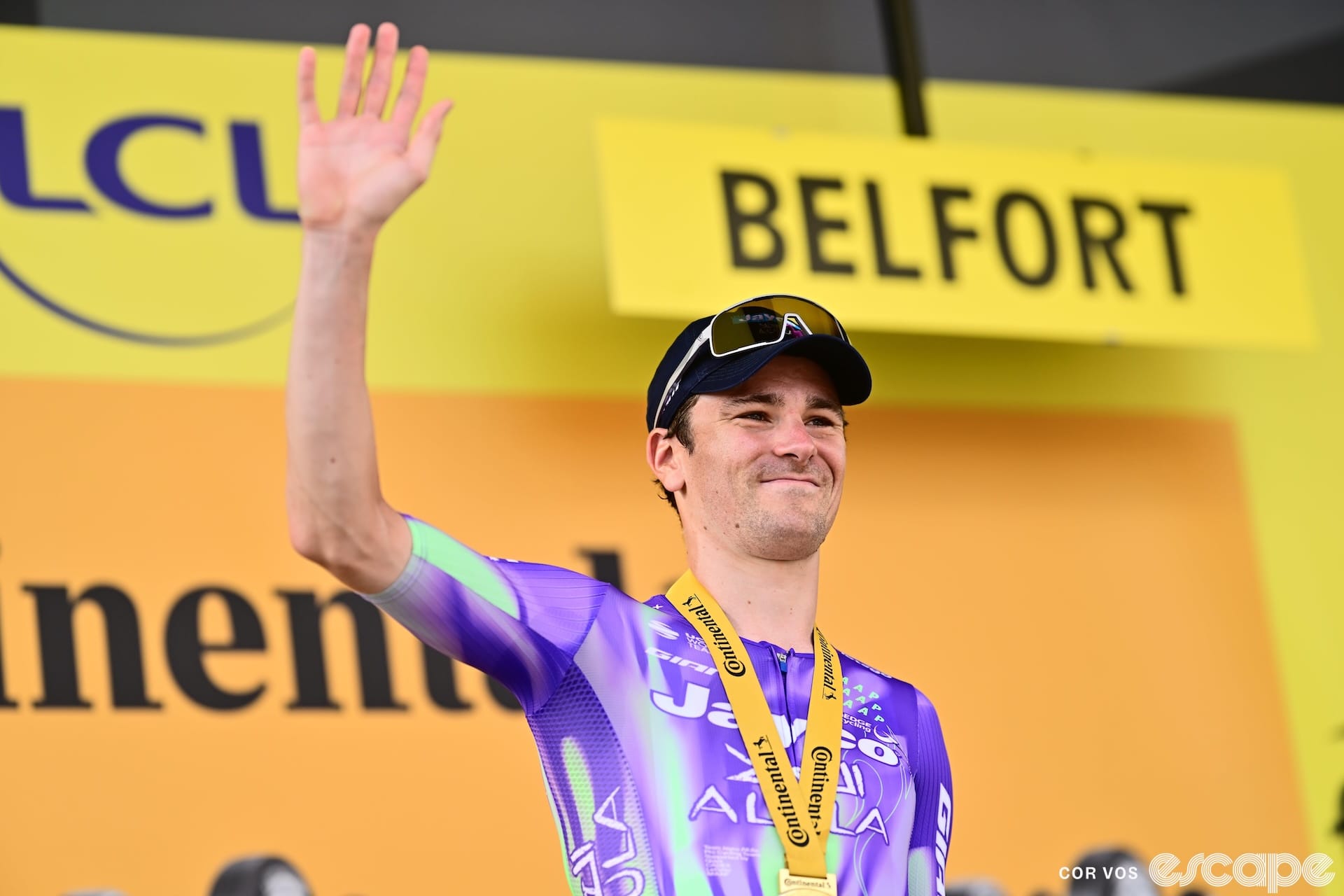
When riders like Mauro Schmid (Team Jayco-AlUla) and Harold Tejada animate a finish from a breakaway, it is more than just another stage win. It is a confirmation that the soul of the race, the unpredictable spirit of the breakaway, refuses to be extinguished.
The Logic of Chaos
The conventional wisdom will dismiss this. It will say the peloton gifted the stage, that with the general classification riders marking one another, a day was simply set aside for the opportunists. This view is both cynical and incorrect.
The escape that can form on such a stage, a sprawling and chaotic mass of riders, is not something the peloton could control, even if it had wanted to. It is a race within the race, too large and with too many interests at play to be governed by the simple mathematics of a chase.
This was not a gift from the peloton; it was a bill presented for its own single-mindedness. The obsession with the general classification, the laser focus of the major teams on a handful of contenders, creates the very conditions for such a move to succeed.
By placing all their resources into a singular battle, they create a vacuum elsewhere. The riders who break free do not simply ride away; they exploit the rigid, stratified logic of the modern Tour. They used the system's own nature against it.
In an earlier era, a breakaway was a test of power against the pack. Today, it is a test of tactics against a predictable and risk-averse machine.
The Human Equation
Within that breakaway group, another, older drama can play out. From a large group, the day’s narrative can slowly distill itself to two men, like Schmid and Tejada.
Their final duel is not about watts per kilogram, but about nerve, timing, and the exhaustion of a long day out front. It is a reminder that for all the sport’s technological advancements, it remains a profoundly human endeavour.
A victory from the break can be a redemption for a difficult start to a Tour – a small, personal story nested inside the day's grander tactical lesson.
This is what the hyper-controlled race so often threatens to erase: the idea that a Grand Tour is a tapestry of 184 individual stories, not just the chronicle of its eventual winner. The breakaway, when it succeeds, throws these other stories into the light. It reminds us that a career can be defined, a season saved, or a dream realized far from the glare of the yellow jersey.
The breakaway is the sport's oldest question: who is willing to risk certain exhaustion for a slim chance of glory? On the roads of France, it received a modern answer. The new baroudeur does not merely ride on courage; he rides on the understanding that the modern peloton's greatest strength—its rigid control—is also its most exploitable weakness.
What a rider like Mauro Schmid can demonstrate is that the grand escape is not dead. It has simply adapted. It waits for the moment when the machine becomes so focused on its own internal workings that it forgets about the men slipping away up the road.
Control is an ambition; freedom, on a bicycle, is a tactic. And it is a tactic as old as the race itself.
The gesture has been replaced by the equation.
This was not a gift from the peloton; it was a bill presented for its own single-mindedness.
Control is an ambition; freedom, on a bicycle, is a tactic.