
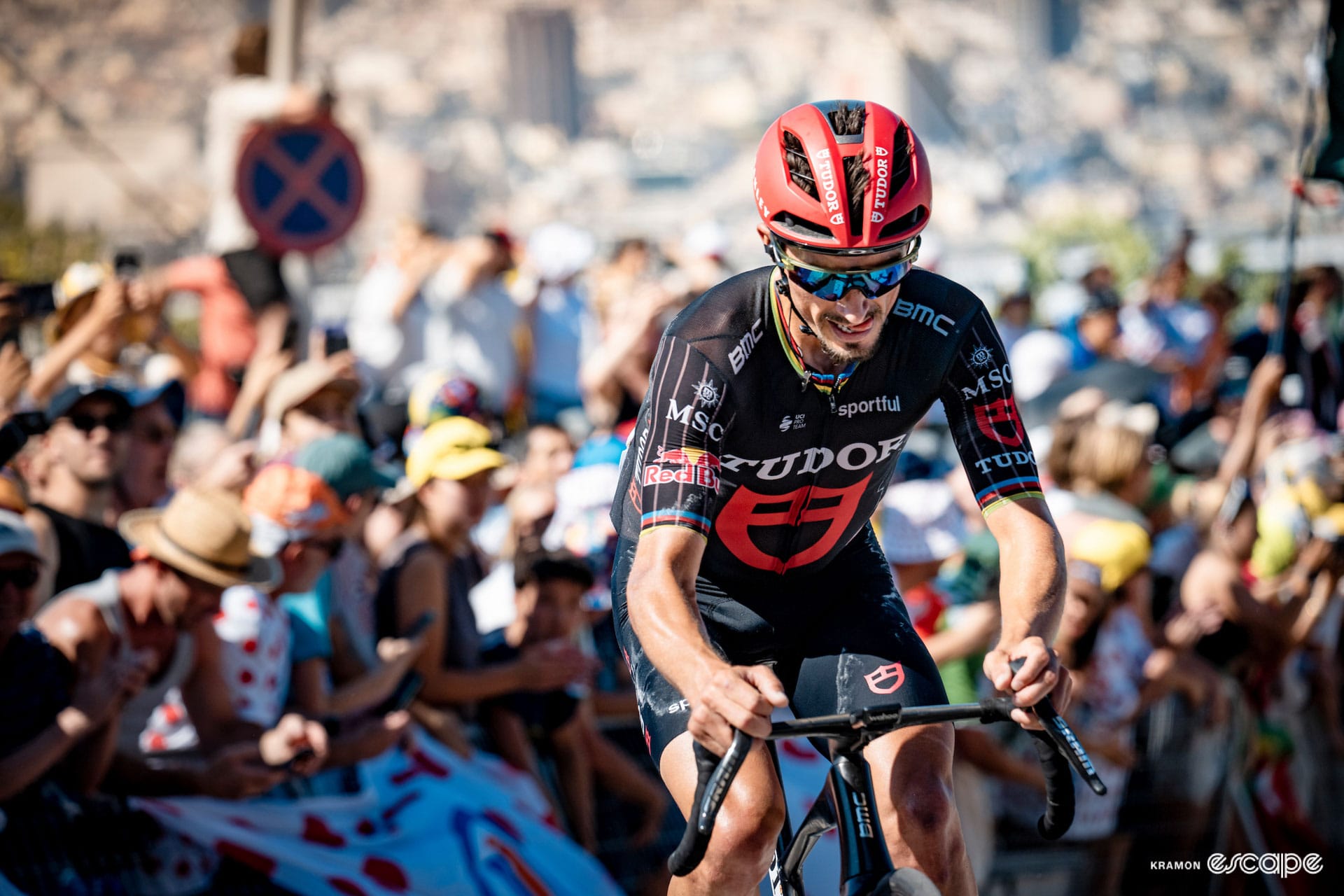
The Ghost at the Feast
He is hours from victory and a lifetime from yellow. And yet, Julian Alaphilippe is riding the only Tour de France that truly matters.
There are two ways to measure a bike race. You can use a clock, or you can use a heart rate monitor. One gives you a winner, a neat column of numbers descending from first to last, the official history of things. The other gives you the truth.
By the cold, hard logic of the clock, Julian Alaphilippe is a ghost at the Tour de France 2026. He haunts the peloton, a flicker of a Tudor Pro Cycling jersey hours in arrears.
He is a statistical anomaly, a footnote in the grand, algorithmic pursuit of the yellow jersey. To the men whittling away seconds at the top of the general classification, he is scenery. He does not matter.
And yet. Who are you watching?
When the road ramps up and the race sheds its inhibitions, whose is the shoulder-rocking dance you search for? When a lone figure defies the crushing momentum of a peloton hunting him down, who do you hope it is?
The men playing for the podium are engaged in a kind of high-stakes accounting, a passionless audit of watts and seconds. Alaphilippe is engaged in something else entirely. He is writing a poem in the margins of their spreadsheet.
The conventional wisdom, of course, will tell you this is romantic nonsense. It will say that the only prize is Paris, the only jersey is yellow, and everything else is a consolation prize for those who couldn't hack it.
It will point to the grim-faced GC captains, insulated by their teams, moving with the glacial certainty of a winning strategy. That, it will say, is professional cycling. Winning is the point.
But what if it isn’t? What if the point is the trying? What if the entire soul of the sport isn't contained in the final result, but in the glorious, doomed, beautiful effort?
The Tour is a grand stage, and the main plot—the slow, inexorable march to victory—is often the least interesting part of the play. The real drama is in the subplots, the brief, brilliant tragedies of the stage hunters.
This is the theatre of Julian Alaphilippe. His race is a series of one-act plays.
Each morning he wakes up, pins on a number, and chooses to forget he is hours behind. He chooses to believe that today is the only day that has ever existed.
He attacks not with the calculated fury of a man trying to gain 30 seconds, but with the explosive abandon of a man trying to win the entire world between this corner and the next.
His efforts are a kind of beautiful futility. He is building sandcastles against the tide.
He knows the waves of the GC battle will wash them away, that by evening the classification sheet will look almost identical to how it did in the morning, save for a few shifted seconds at the very top. But he builds them anyway.
He builds them because the act of creation is the point. The shape of the thing, however brief its existence, is what matters.
What would you do, if that was you? If you knew the war was lost, would you still fight the battle?
There is a special kind of courage in it, a defiance that is more compelling than any victory. It is a refusal to be defined by what you cannot win.
It is the decision to define yourself, instead, by how you choose to lose.
In five years, you will struggle to remember who finished third in the Tour de France 2026. The name will be a trivia question, a line in a record book.
But you will remember the feeling of watching a lone man rage against the dying of the light, grimacing into the wind, fighting for something as intangible and as vital as pride. You’ll remember the flash of panache that lit up an otherwise forgettable Alpine afternoon.
The clock gives us a record. The rider gives us a memory.
One is history. The other is a story.
And Julian Alaphilippe, hours down, is telling the best story of all.
The men playing for the podium are engaged in a passionless audit of watts and seconds. Alaphilippe is writing a poem in the margins of their spreadsheet.