
The Ghost in the Machine
A Tour de France is not won by one man’s strength, but by two men’s health. On the roads of the 2026 Tour, Tadej Pogačar is learning this old lesson the hard way.
History does not repeat, but it does rhyme. There is a particular silence that descends upon a general classification contender when he looks over his shoulder deep in the third week of a Tour de France and finds only the jerseys of his rivals. The face he is looking for, the one he has trusted for thousands of kilometres, is not there.
It is a moment of profound and terrifying isolation, a feeling that has unmade more potential champions than any mountain pass. The specifics change, but the story remains. In 1986, it was a crash that sundered a partnership; in 1996, a poorly timed day of hunger; and deep into the Tour de France 2026, it was the oldest adversary of all—illness—that threatened to rewrite the race.
The modern super-team, with its legion of specialists and nine-figure budget, is built on an illusion of control. It purports to have solved for every variable: aerodynamics, nutrition, recovery, strategy. It builds a fortress of strength around its leader, a phalanx of riders so strong that the loss of one ought to be a minor inconvenience.
UAE Team Emirates-XRG, the squad built around the prodigious talents of Tadej Pogačar, is the very model of this modern empire. Yet the edifice rests, as it always has, on the fragile biology of men.
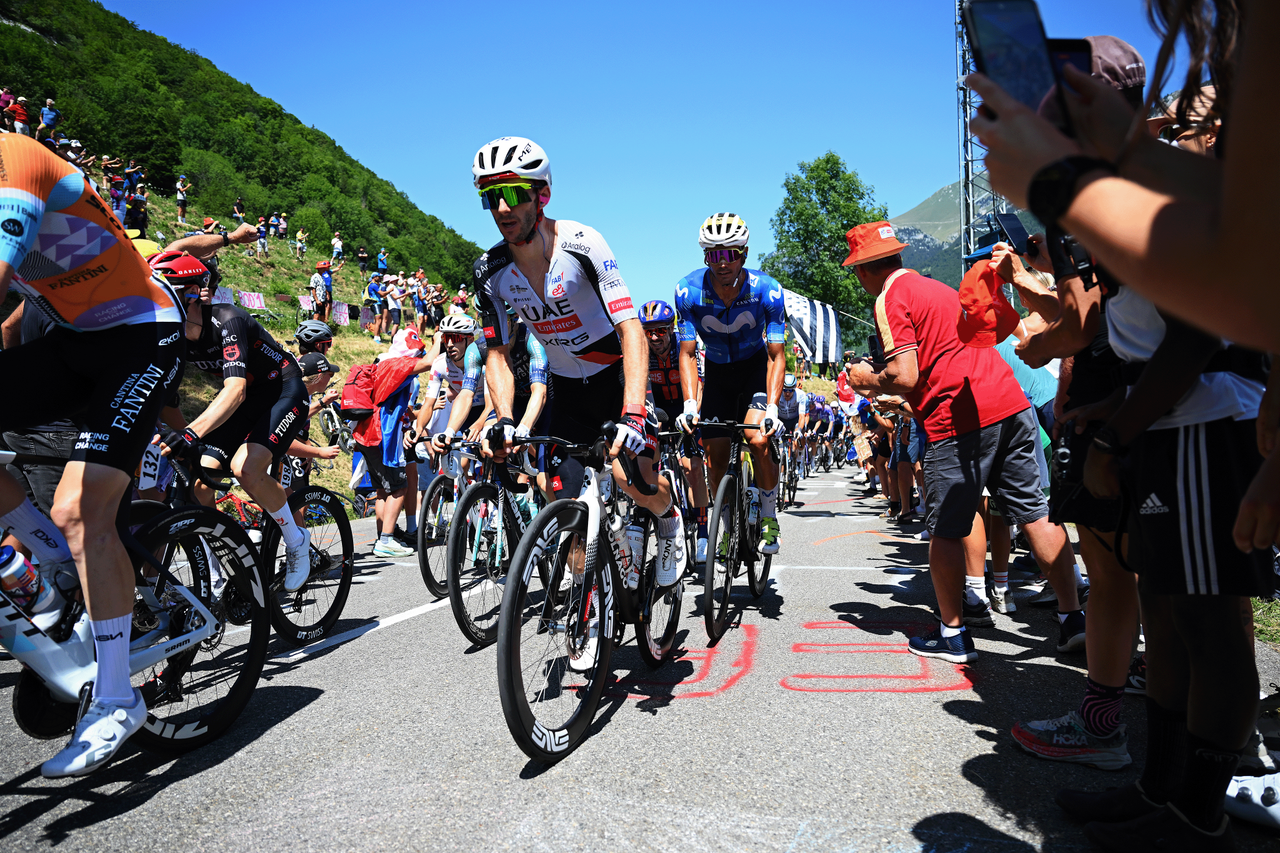
Adam Yates is not merely another rider in this formation. He is the final bulkhead, the last and most trusted lieutenant, tasked with neutralizing attacks and setting a pace so severe it extinguishes the ambitions of lesser challengers.
The role of the super-domestique is one of the great evolutions of modern cycling: a rider who could lead another team, sacrificing his own ambitions for his captain’s. When that rider is removed from the equation, the entire geometry of the race changes. It is not one less piece on the board; it is that the king is suddenly forced to defend himself.
The Fallacy of Singular Genius
The conventional wisdom, of course, will hold that a rider of Pogačar’s calibre is beyond such concerns. It will point to his reputation and argue that he is a singular force, capable of winning alone, unburdened by the frailties of his teammates.
This is a romantic notion, but it misunderstands the attritional nature of a three-week race. The Tour is not won in a single, explosive attack. It is won in the thousands of small moments where energy is conserved, where a wheel is followed, where a gap is closed by another man’s legs.
Every kilometre Yates paced the front, every gust of wind he shielded Pogačar from, every early attack he calmly neutralized—these were deposits in an energy account from which his leader could draw in the decisive moments. Without him, Pogačar must make withdrawals with every pedal stroke.
He must answer the questions of his rivals himself. He is no longer insulated from the race; he is immersed in its chaos. His rivals, who saw a fortress, now see an opening. The illness of one man becomes the opportunity of many.
One can only imagine the quiet despair for Yates himself. To train for months, to sacrifice one’s own chances, to perform flawlessly for two weeks, only to be laid low by an internal revolt of one’s own body.
The peloton is a uniquely unsentimental organism. It does not wait for illness or injury. The race continues, and a rider’s absence is felt only as a vacuum for others to exploit. His suffering is the brutal, unseen cost of this sport’s grand ambitions.
So the Tour de France 2026 moves towards its endgame, its narrative suddenly and irrevocably altered. It has become a test not just of Pogačar’s strength, but of his resilience in the face of an old, familiar foe: solitude. The story is no longer about the strongest team, but about how the strongest rider fares when his most important support is stripped away.
This is the lesson the Tour teaches anew to every generation. A leader is an idea, but a team is a physical reality.
When that reality falters, the idea is left exposed to the wind. On the roads of France, Tadej Pogačar learned a truth that every great champion must eventually confront: the yellow jersey is woven not just from strength, but from the good health of other men.
It is a moment of profound and terrifying isolation, a feeling that has unmade more potential champions than any mountain pass.
The illness of one man becomes the opportunity of many.
The yellow jersey is woven not just from strength, but from the good health of other men.