
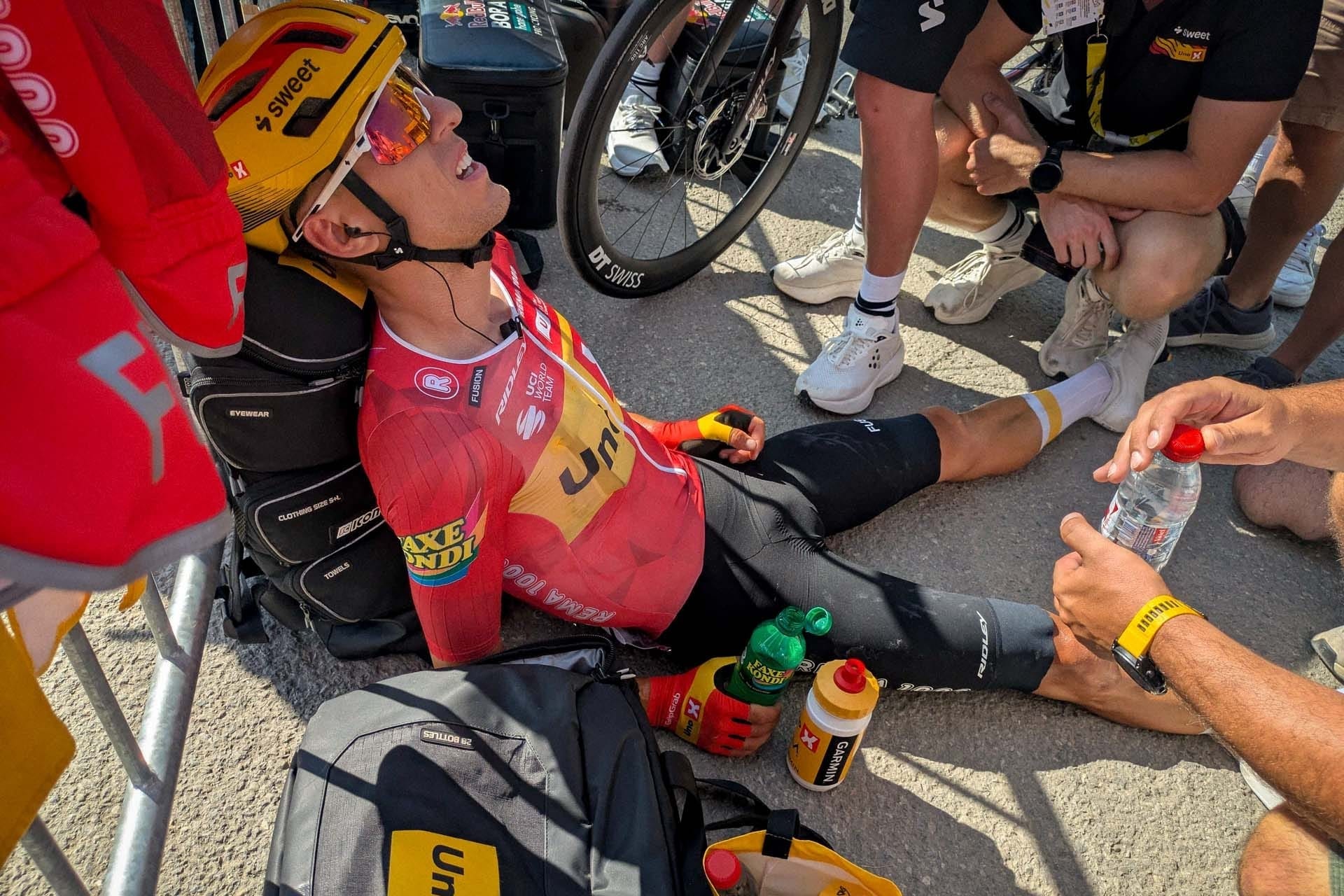
The ghost ship sails for Paris
The race for the yellow jersey is a fiction for most of the peloton. For the battered remains of one particular team, the real victory is simply surviving the storm.
There are two races inside every Tour de France. The first is the one you see on television: a glittering, kinetic blur of power and tactics, a contest for glory played out on the sport’s grandest stage. It is a race for jerseys, for stages, for a legacy carved in seconds.
Then there is the other one. The invisible race. It is fought in the gruppetto, a hundred kilometres from the finish, held together with bandages and stubbornness. Its only prize is the next sunrise, its only podium the finish line in Paris.
This year, the keepers of that second race – its quiet, suffering protagonists – are the men of one team. They are a team whittled down by the casual cruelty of the road, a squad reduced from its full strength, a skeleton crew sailing a battered ship through the final, violent squalls of the Alps.
They will not win the Tour de France 2026. They will not win a stage. But to watch them is to understand the race on a more profound level.
The Cold Arithmetic of Defeat
The conventional wisdom of professional cycling has a name for this: failure. Sport is a binary pursuit, and the results sheet is an unforgiving ledger. In a race defined by winning, a team not in contention is a team that is losing.
The cameras follow the attacks, the commentators praise the victors, and the sponsors pay for exposure at the front. The rest is just scenery, the slow-moving backdrop against which the real drama unfolds.
From this perspective, the story of this team is a sad one. It’s a tale of attrition, of what might have been, of a campaign devolved into a simple exercise in damage limitation. They are ghosts at the feast, a reminder of the Tour’s brutal filtration process.
But that is to mistake the vessel for the voyage. It is to read the story without understanding its language. The Tour de France is not merely a race; it is an ordeal.
Its primary function is not to find a winner, but to find the limits of human endurance and then, day after day, to push past them. The true character of the sport isn’t revealed in an explosive, 30-second sprint, but in the long, silent hours of a body screaming for it all to stop, and the will that tells it to keep going.
A Victory Unseen
What does victory look like when the podium is a thousand kilometres and a mountain range away? It looks like a rider, his knees taped into a crude approximation of working joints, pushing his teammate up the first ramp of the final climb.
It looks like a shared water bottle in the last 10 kilometres, a quiet word of encouragement passed between two faces etched with exhaustion. It looks like the grim, defiant act of finishing a stage an hour after the winner, cheered on by a handful of die-hards on a deserted roadside, and then getting up to do it all again the next day.
This is the unglamorous heroism of the peloton, a truth that gets lost in the clamour for results. For every rider celebrating with champagne on the Champs-Élysées, there are a hundred others for whom the greatest triumph was simply making it there.
Their victory is not a place on a spreadsheet but a private, hard-won peace. It is the knowledge that the road threw its worst at them, and they were not broken.
Watching the remaining riders of this team is to witness this principle in its purest form. They are a rolling testament to the idea that there is meaning in the struggle itself.
They are no longer racing against the race leaders; they are racing against the Tour itself, against the abstract, malevolent force of the Grand Tour in its third week. Their competition is gravity, pain, and the seductive whisper of abandon.
They will reach Paris. They will roll onto the cobbles of the Champs-Élysées, their bodies scarred and spent, their place in the general classification an afterthought. There will be no headlines for them.
But they will have finished. They will have honoured the race by enduring it. And in that quiet, unseen accomplishment, they will have won something more valuable than a yellow jersey. They will have won the invisible Tour.
Their victory is not a place on a spreadsheet but a private, hard-won peace. It is the knowledge that the road threw its worst at them, and they were not broken.