
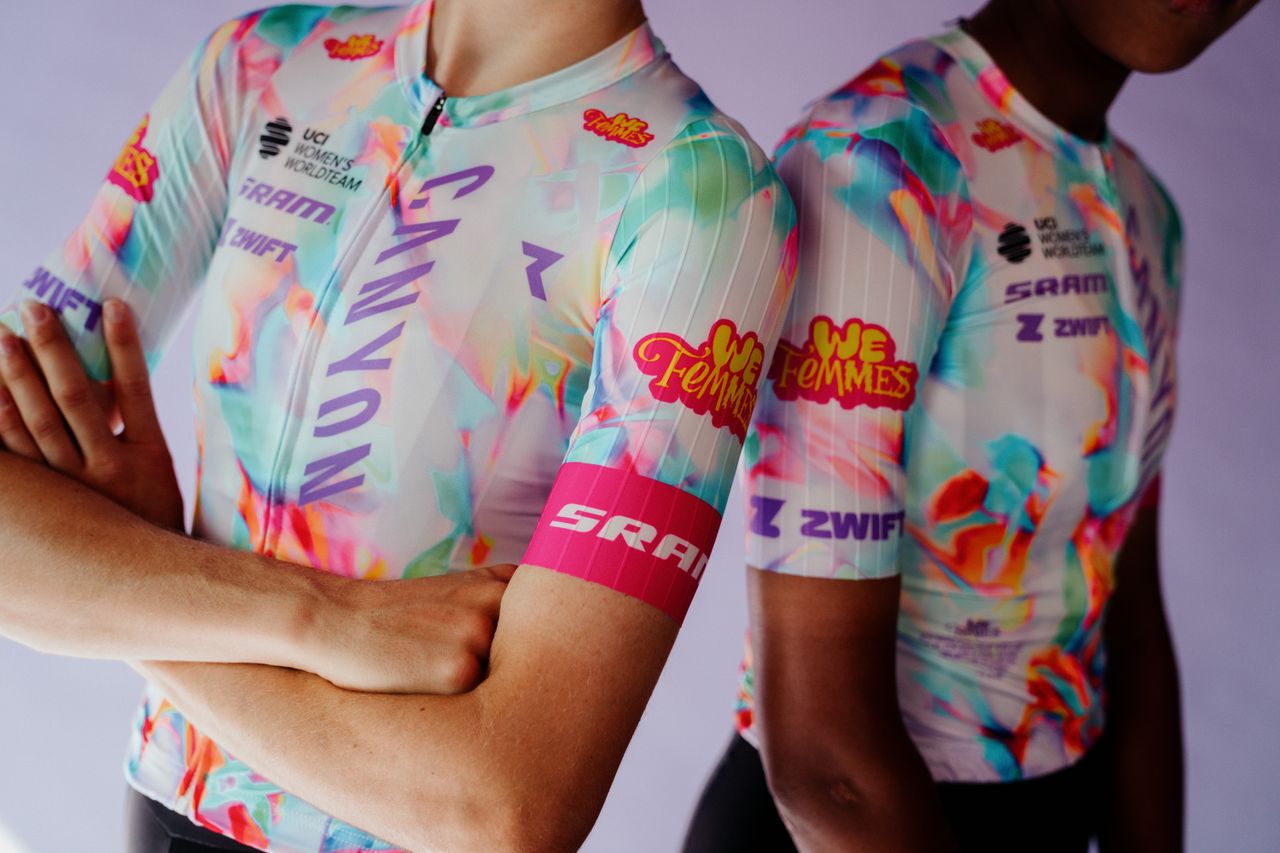
The uniform of a revolution that hasn’t happened yet
Canyon-SRAM’s new campaign gives women a banner to ride under. But a banner is not a barricade against the problems they still face on the road.
There is a particular magic to a new piece of kit. It’s the crispness of the fabric, the clean snap of the zipper, the promise held in the empty pockets. It’s a uniform, and a uniform does two things: it tells you who you are, and it tells you where you belong.
For the riders of Canyon-SRAM at the Tour de France Femmes 2026, their new kit does both, loudly and beautifully. It announces them as part of ‘We Femmes,’ an initiative with a stated goal of bringing a thousand new women into cycling every year over the next decade.
And who could argue with that? It is a noble, necessary, and photogenic gesture. But a gesture is what it remains for now.
The success of this campaign won’t be measured in jersey sales or Instagram impressions from its launch at the sport’s biggest race. It will be measured in the cold, hard, often unglamorous work of retention. It’s one thing to invite someone to the party; it’s another to make them want to stay after the music stops.
To understand why this is the right argument, and not just the cynical one, you have to look past the beautiful design and see the road it will be ridden on.
The Welcome Mat at the Cliff's Edge
The conventional wisdom, and it’s a powerful one, will say this is exactly what women’s cycling needs. It will point to the project's major backers, reported to be Canyon and Zwift, and the long-term commitment. It will celebrate the visibility of a top-tier team using its platform for something more than brand exposure.
It is, in the parlance of corporate social responsibility, a benchmark. It sets a standard for other teams: what are you doing to grow the sport you profit from?
All of this is true. Providing organised rides, a pathway, a literal group to belong to, is a crucial first step. It removes the initial, paralysing question faced by so many would-be cyclists: where do I even start?
It offers a neatly packaged answer. For this, the team and its sponsors deserve genuine applause. They’ve laid down a welcome mat.
The problem is that the welcome mat lies at the edge of a cliff. The campaign addresses the barrier to entry, but it can’t, in its current form, do much about the barriers to continuation. And those are the barriers that truly matter.
What happens the week after the organised ride? What about the woman who wants to ride to work, or train for a gran fondo, or simply go for a solo spin to clear her head? She still has to face the road as it is, not as we wish it were.
She has to face the driver who passes with a hand-span to spare, perhaps with a shouted commentary on her appearance. She has to face the condescension at the bike shop, the assumption that she couldn’t possibly know her way around a derailleur. She has to face the testosterone-fuelled club run, the so-called “no-drop” ride that prides itself on shattering the group within the first ten kilometres, leaving novices scattered and demoralised.
And she has to face the tyranny of time. Cycling is a greedy sport. It demands hours. For many women, disproportionately burdened with domestic and emotional labour, those hours are the hardest currency to find. A two-hour group ride is a start, but a sustainable life in the sport requires a fundamental shift in the structures around it.
A Map Is Not the Territory
The ‘We Femmes’ campaign is a beautiful map. It shows a route into the sport, clearly marked and inviting. But a map doesn’t flatten the mountains or fill in the potholes.
A map is not the territory. The territory of modern cycling culture remains, in too many places, hostile to women.
True, lasting change isn’t a marketing campaign. It’s a road-building project. It’s fighting for protected infrastructure so a woman doesn’t have to weigh her physical safety against her desire for a ride. It’s fostering club and shop cultures that are genuinely inclusive, not just tolerant. It’s creating media that treats female athletes as athletes, full stop. It is, in short, the slow, difficult, and deeply unmarketable work of dismantling a culture.
This isn't to say 'We Femmes' will fail. It is to say its success depends entirely on what happens next. Will it evolve? Will it partner with advocacy groups fighting for safer streets? Will it create mentorship programs that pair new riders with experienced ones to navigate the sport’s arcane cultural codes? Will it use its platform to call out the ugliness, not just celebrate the beauty?
So yes, let’s admire the jersey. Let’s celebrate the ambition. A team is using its power at the Tour de France Femmes 2026 to look beyond the finish line, and that is a rare and wonderful thing.
But let’s not mistake a banner for a barricade. A banner is a symbol of intent. A barricade is what you build when you are serious about changing the world.
A jersey can start a conversation. It cannot, by itself, win the argument.
It’s one thing to invite someone to the party; it’s another to make them want to stay after the music stops.
A map doesn’t flatten the mountains or fill in the potholes. A map is not the territory.
Let’s not mistake a banner for a barricade. A banner is a symbol of intent. A barricade is what you build when you are serious about changing the world.