
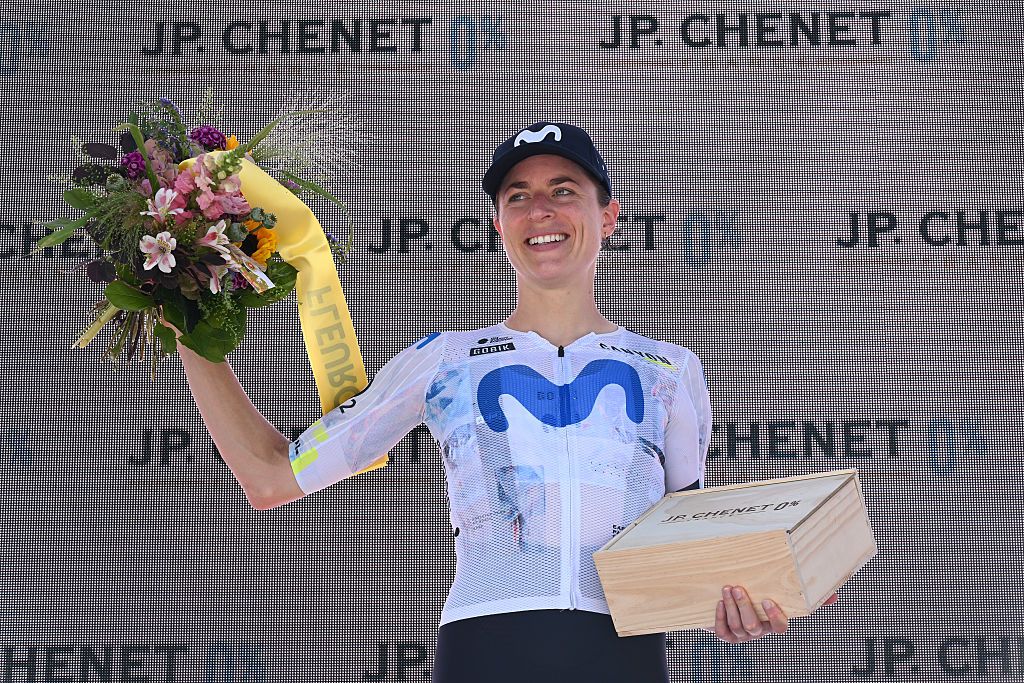
The Weight of the Armband
Marlen Reusser’s leadership at Movistar is more than a team selection. It is the moment the Tour de France Femmes inherits one of the oldest and heaviest burdens of the men's sport.
There is a particular quiet that settles over a team bus once the decision has been made. It is the quiet of settled purpose, when a team of riders becomes secondary to the ambitions of one, and the chaotic possibilities of a bike race are distilled into a single objective. For decades, this was the defining atmosphere of the men’s Tour de France. Now, with Marlen Reusser named as explicit leader for Movistar at the Tour de France Femmes 2026, that same quiet, that same weight, is settling into the heart of the women’s peloton.
This is not merely a roster announcement. It is a signpost marking a profound evolution in the tactical landscape of women’s Grand Tour racing. The designation of a sole leader, a capitana in the most traditional sense, signals a move away from the more fluid, opportunistic racing that has often characterized the sport and toward the formalized, high-pressure systems of the men’s race for the yellow jersey. Reusser’s appointment is confirmation that the women’s Tour is maturing into a race where the burdens of leadership are as concentrated, and as unforgiving, as they have ever been.
To understand the significance, one must look back. The history of the Tour de France is the history of teams built around a singular talent, a tradition stretching back through generations of champions.
The logic was, and remains, brutal in its simplicity: find the strongest rider and sacrifice everything for them. Domestiques exist to fetch bottles, close gaps, and shatter themselves on the front of the peloton so their leader might be spared a single unnecessary effort. The team becomes a fortress on wheels, its purpose not to win stages, but to protect the queen.
This is the model Movistar now formally adopts. In doing so, they embrace a doctrine that changes everything. Every decision, from breakfast to the final kilometre, will be filtered through a single question: what is best for Marlen Reusser?
A breakaway will be judged not on its own merits, but on whether it poses a threat. A teammate’s chance for a stage win will be weighed against the energy expended. It is a demanding, and often thankless, way to race, but it is the price of admission for any team with serious general classification intent.
Conventional wisdom will push back. It will say that teams have always had leaders, that a hierarchy naturally forms on the road. This is true, but it misses the distinction between an emergent leader and an appointed one.
To name a leader publicly, before a pedal has been turned, is to invite a level of scrutiny that changes the race itself. Every rival team now knows precisely who to watch, who to isolate, and who to attack. The leader’s face will be studied on every climb for the slightest flicker of weakness; her every mechanical or poorly timed stop becomes a potential crisis.
This is the double-edged sword of absolute leadership. It provides a team with immense clarity but removes all room for error. There is no Plan B.
Should the leader falter—through illness, a crash, or simply a bad day—the team’s entire campaign can unravel. This is the unforgiving calculus of the Grand Tour, a formula the men’s peloton has understood for a century.
For Reusser, the honour of leadership comes inextricably bound to this immense pressure. It is, in its own way, a form of progress. The stakes are higher because the race itself has grown in stature to command them.
And so, Marlen Reusser will ride to the start of the Tour de France Femmes 2026 carrying not just her own ambitions, but the accumulated weight of a tactical doctrine refined over generations. Her challenge is not only to prove herself against her rivals on the road, but to manage the expectations of a team that has placed its entire Tour in her hands. It is a familiar story, one of the oldest in cycling.
That it is now being written so clearly in the women’s peloton is the surest sign of all that the race has truly arrived.
It is a demanding, and often thankless, way to race, but it is the price of admission for any team with serious general classification intent.