
The Ghost in the Jersey
A strong ride in a small French stage race is a private joy for most young riders. For Markel Beloki, it is a public reckoning with a name that shaped an era.
There are names in cycling that function less as identifiers and more as echoes. They carry with them the ghosts of mountain passes, the memory of rain-slicked cobbles, the faint sting of old controversies. To hear the name 'Beloki' called out alone at the front of a professional bicycle race is to feel a ghost pass through the press room, a collective, unspoken memory of a different time.
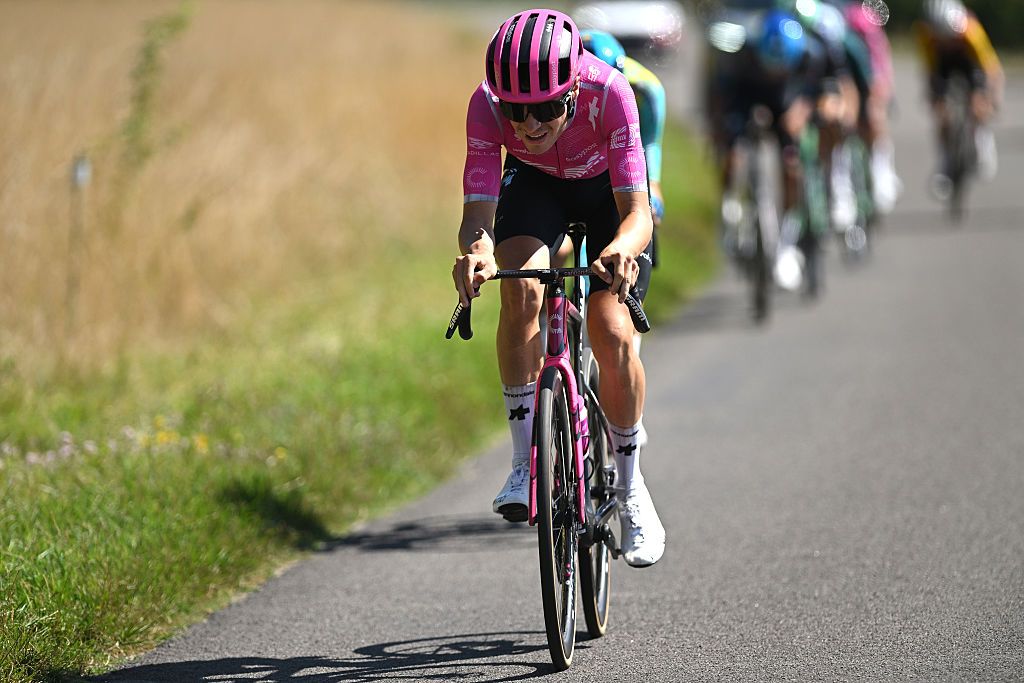
On the second stage of the Tour de l'Ain 2026, Markel Beloki (EF Education-EasyPost) put in a ride that turned heads, animating the race with a powerful move that marked a significant moment in his young career.
It was the kind of performance that announces a young rider's arrival with clean, unambiguous authority. For any other rider of his generation, this would be a story of a promising future. For Beloki, it is a story inextricably bound to the past.
To understand the weight on the son, one must remember the father. The name Joseba Beloki was a fixture in one of the sport's most turbulent and operatic eras, a name that resonates with fans from the turn of the millennium.
His career became defined as much by what might have been as by what was. It was a name associated with Spanish cycling in a period of giants, a story remembered not just in results, but in grit, drama, and resilience.
That name does not simply fade. In cycling, lineage is both a currency and a curse.
It can open doors to teams and sponsors, but it also paints a target on a young rider's back. Every pedal stroke is measured against a reputation built on different roads, in a different sport, two decades earlier.
The Necessary Reckoning
The modern, sensible view is to insist that the son be allowed his own career, free from the crushing weight of comparison. It is a kind and correct impulse. It is also, in the world of professional cycling, an impossible one.
The sport's memory is too long, its love of dynasty too deep. The story is too good: the son, riding for a modern, defiantly different American team, seeking to write a new chapter for a name synonymous with a past the sport has a complicated relationship with.
His performance was not a flamboyant attack mimicking the champions of old. It was a calculated, powerful move, the mark of a rider who understands the demands of today's racing.
It was his own performance, earned with his own legs. And yet, the moment his ride was over, the questions began. The comparison was not a choice; it was the frame through which the achievement was instantly viewed.
This is the burden Markel Beloki carries. He cannot simply be a young rider finding his way; he is, and always will be, Joseba Beloki's son.
His successes will be seen as a continuation, his failures as a falling short. He races not only against the peloton, but against a formidable and unshakeable ghost.
A New Signature
What, then, does this performance mean? It is not the passing of a torch; that is too simple a narrative.
It is something more complex: a claim of ownership. With this ride, Markel Beloki has served notice that the name on his jersey can have a new meaning.
He will never escape his father's shadow—no rider of his lineage ever truly does. But he can define its shape.
His father's career was a narrative of high-stakes contention on a grand stage. The son's career takes a step forward here, on a smaller road in eastern France, with a performance that is significant precisely because it is his alone.
The ride does not settle the question of his father’s legacy. It simply gives him, for the first time, the standing to answer it.
This performance at the Tour de l'Ain 2026 is the first line of a new chapter. It does not erase what came before.
Instead, it begins a conversation between past and present, a dialogue that will play out on the roads of Europe for years to come. For one afternoon, the echo sounded a new note.
He races not only against the peloton, but against a formidable and unshakeable ghost.
By winning, and winning alone, Markel Beloki has served notice that the name on his jersey can have a new meaning.