
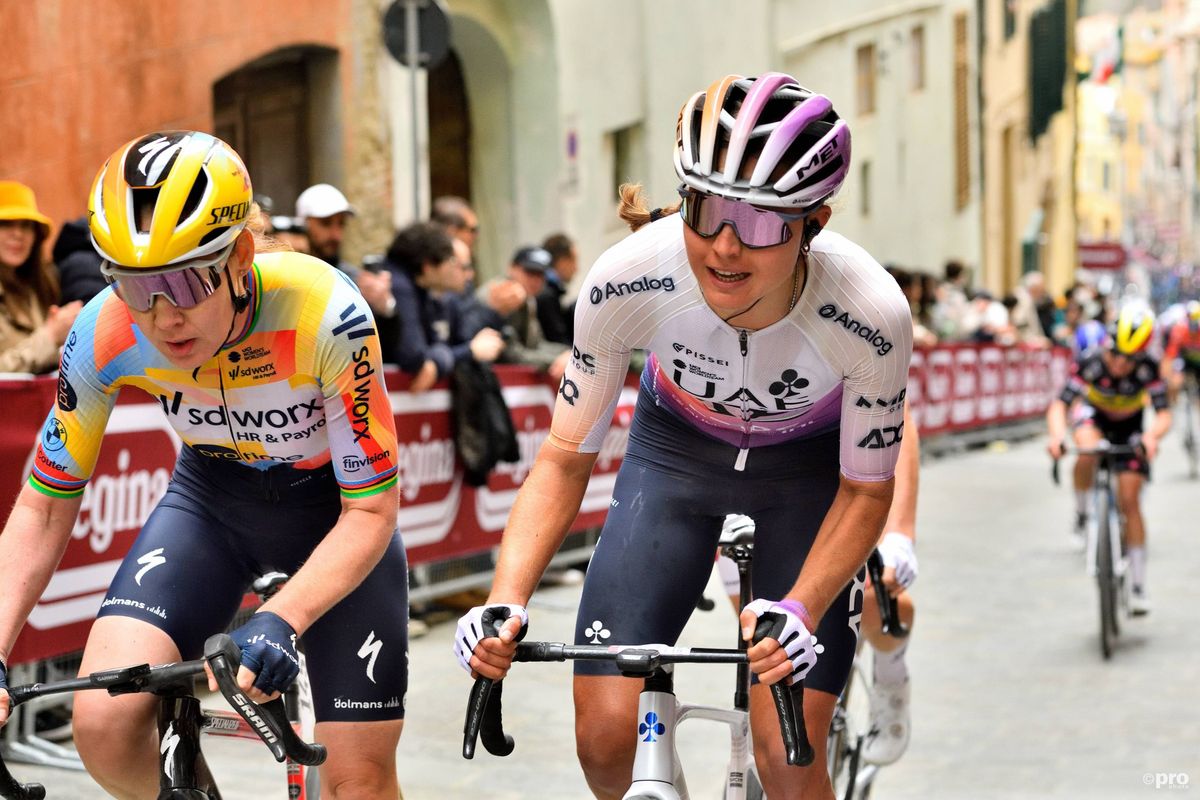
The champion in the back seat
A rider wins a Grand Tour. So why would she be sidelined for the Tour de France Femmes? Sometimes, the biggest prize in cycling is a lesson in politics.
Let's play a little game. Imagine a rider, say, 23 years old. She's just won a Grand Tour. She's stood on the top step, sprayed the cava, and proven she's one of the best stage racers on the planet.
The biggest race in the sport, the Tour de France Femmes 2026, is next on the calendar. What's her role?
If you said 'team leader,' congratulations, you have a functioning sense of logic. If you said 'not a designated leader,' well, you understand the baffling situation that can face a rider like Paula Blasi.
You already know how this ends, but stay with me, because the how is the good bit. A rider, fresh off the biggest win of her young career, might find herself taking a backseat at the Tour.
This isn't just a curious tactical choice; it's a glaring reminder that in the cold, hard business of professional cycling, even a Grand Tour trophy doesn't make you the boss. You can still be a pawn in someone else's game.
The Official Story (and why you shouldn't buy it)
The press release version of this story is, of course, very sensible. It's full of talk about 'team strategy,' 'managing expectations,' and 'sharing leadership' – the kind of corporate-speak designed to smooth over the fact that something deeply weird is happening.
A Grand Tour winner doesn't accidentally become a super-domestique a few weeks later. That’s a decision. A very loud, very political decision.
The conventional wisdom will tell you there could be good reasons. Perhaps the Tour de France Femmes parcours doesn't suit our hypothetical winner as well as the previous race did. Maybe the team has another, more established star they've built the whole season around.
They're not about to rip up the playbook just because the understudy stole the show. Or maybe they're 'protecting' their young champion from the pressure cooker of the Tour.
And sure, on paper, those arguments almost hold water. For about five seconds.
Then you remember that winning a Grand Tour proves you can handle pressure. It proves you can climb, time trial, and suffer for weeks on end. You don't fluke a win like that.
It suggests you're probably the best bet the team has, regardless of the route. To sideline that kind of form, that kind of momentum, isn't protecting a rider. It's undermining her.
Reading Between the Lines
If you want to know what's really going on, ignore the carefully curated quotes and look at a hypothetical detail: imagine our rider reveals her future is 'undecided,' despite having another year left on her contract.
Now, in the real world, having a contract means your future is, well, decided for the next 12 months. In pro cycling? That little nugget is not a throwaway line. That's a flare gun being fired into the transfer market.
It’s the polite, on-the-record way of saying, 'My agent is taking calls, and if you think a Grand Tour champion should actually lead a team at the Tour, let's talk.'
It tells you everything you need to know. This isn't a happy, unified camp making a purely tactical call. This is a rider who understands her value has just skyrocketed, and a team that is either unable or unwilling to recognise it.
It points to a pre-existing hierarchy, one where a big win was an inconvenient plot twist. The team had a script for the season, and the rider went and ad-libbed a masterpiece. Now, they're trying to wrestle the narrative back to their preferred protagonist for the Tour.
This isn't new, of course. Cycling history is littered with stories of co-leaders who despise each other and domestiques who were clearly stronger than the rider they were paid to protect. But to see it play out so starkly, where a rider's reward for a career-defining victory is to be put back in her box, feels particularly ruthless.
For a rider in this position, this must be a strange and bitter pill. She did the hardest thing in the sport, and in doing so, may have made her position inside her own team untenable. She won the war, and her prize is to be a foot soldier in the next battle.
But at 23, she's learning the game's second lesson much faster than most learn the first. Lesson one is how to win a bike race. Lesson two is knowing when the team you're winning for is no longer the right one.
Judging by her hypothetical comments, she's acing that test. Don't be surprised if the next jersey a rider like this pulls on has her name at the very top of the call sheet.
She won the war, and her prize is to be a foot soldier in the next battle.