
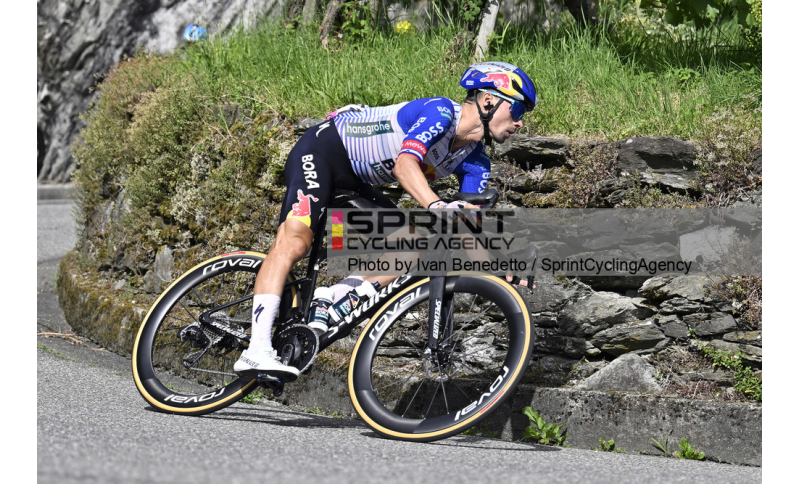
The thousand-and-first pain of Primož Roglič
He trains to master every variable in a Grand Tour. But his career is a brutal reminder that the one that truly matters is always the one you never see coming.
A professional cyclist prepares for a thousand different kinds of pain. There is the burn in the legs on a 20% gradient, the sting of hail on an alpine pass, the dull ache of a three-week effort settling into the bones.
Primož Roglič knows them all intimately. He has studied them, mastered them. But his career has become a monument to the thousand-and-first pain: the one you can’t train for.
His preparation for the Vuelta a España 2026, a race that has often defined his season, is now underway as he takes on the Vuelta a Burgos 2026. But for Roglič, any meticulous plan is always provisional.
And yet, is anyone truly surprised when things go awry? This isn't just bad luck; for Roglič, it often seems like a pattern, a ghost in the machine of a spectacular career.
To follow Primož Roglič is to understand that his greatest adversary is often not another rider. It is chaos itself. It is the stray variable, the unseen obstacle, the capricious whim of fate that seems to take a particular interest in him just as the biggest prizes loom.
The Vuelta's tragic hero
The Vuelta a España, more than any other race, is Roglič’s story. It is a Grand Tour that has suited his explosive power and grim tenacity.
It is on the Spanish roads that his narrative so often finds its most dramatic, and sometimes cruel, turning points. His campaigns there are not just athletic endeavours; they are morality plays about the limits of control.
The conventional wisdom will tell you he is simply “crash-prone,” a nervous rider who attracts misfortune. This is a simplistic reading that mistakes the symptom for the disease.
It’s not a flaw in his bike handling so much as a flaw in his stars. Other riders fall, of course. Cycling is a sport of broken collarbones and road rash. But with Roglič, the falls feel different; they feel scripted, arriving with an almost literary sense of timing to inflict maximum narrative damage.
What do you do when your greatest rival isn't another rider, but the simple, dumb physics of a world that keeps getting in your way? How do you build a strategy to defeat a spectator’s outstretched arm or a poorly placed piece of road furniture? You can’t. You can only endure.
The unbreakable vs. the unavoidable
The run-in to the Vuelta a España 2026 is a familiar kind of race for him. It is not just about sharpening form but about navigating the unpredictable. It’s about executing a schedule that is always at risk of being blown apart.
For his new Red Bull-Bora-Hansgrohe team, it is a test of their ability to support a rider for whom nothing is ever simple. But for Roglič, it is depressingly familiar territory.
We have learned by now that to bet against his resilience is a fool’s game. The man is made of some sterner stuff than the rest of us. But resilience is a finite resource.
Each comeback, each recovery, must take its toll. The deeper question is not about any single physical wound, but the psychological one. How many times can you be struck by lightning before you become afraid of the sky?
Grand Tours are not won by the strongest rider. They are won by the rider the road breaks the least. For three weeks, hundreds of men throw themselves at the mercy of the elements, of fortune, of the sheer statistical probability that something will go wrong.
Roglič has the engine to win. But the road, it seems, always has a plan of its own for him.
The thousand-and-first pain is the one that reminds you that for all the watts and the wind tunnels, you are ultimately not in control. Primož Roglič knows this better than anyone. And that is the entire story.
To follow Primož Roglič is to understand that his greatest adversary is not Jonas Vingegaard or Tadej Pogačar. It is chaos itself.
How many times can you be struck by lightning before you become afraid of the sky?
Grand Tours are not won by the strongest rider. They are won by the rider the road breaks the least.