
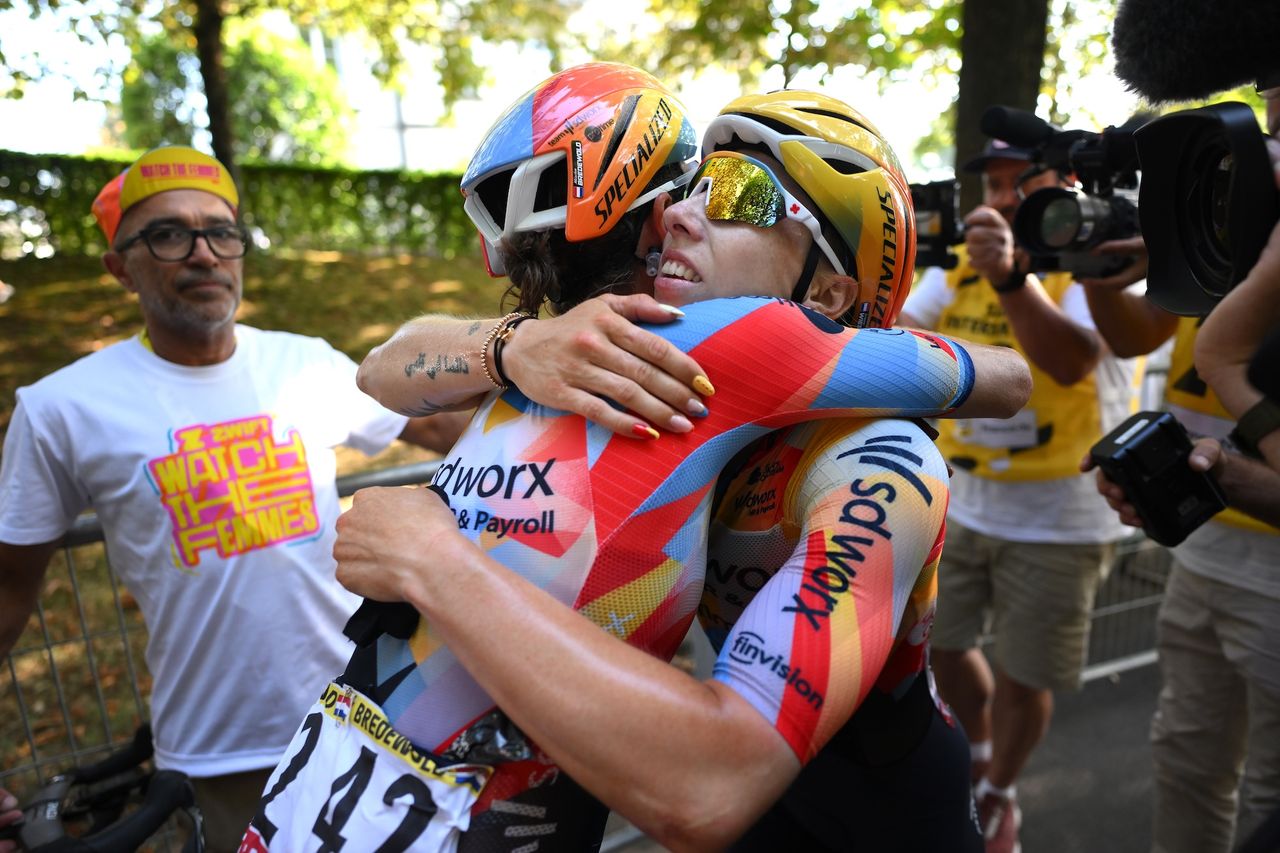
One rider, 146 spectators
Lorena Wiebes is the fastest sprinter in the world. That isn't the story. The story is why the peloton consistently allows her to prove it.
146 riders watched Lorena Wiebes win a sprint at the Tour de France Femmes 2026. They had the best seats in the house. They were in the race.
This is not another celebration of an inevitable victory. It is an inquest into tactical complacency. The result was pre-written, not because Lorena Wiebes (SD Worx-Protime) possesses some supernatural force, but because the peloton accepts her terms of engagement without a fight.
They delivered the world's best sprinter to the final 200 metres, then acted surprised when she won. It was a failure of imagination played out in real-time.
Power is a constant. Tactics are a variable. The peloton consistently fails to manipulate the variable.
The Definition of Insanity
Every team manager, every directeur sportif, every rider in the 147-strong field knew the most likely outcome of a bunch sprint. They knew Wiebes, backed by the formidable SD Worx-Protime train, was the single fastest finisher.
The entire tactical playbook for every other team should have been built around a single premise: do not let this finish happen.
Instead, we saw a slow capitulation. We saw teams burn matches chasing down doomed breakaways, only to dutifully reassemble the peloton for the SD Worx-Protime lead-out to take over.
They participated in their own execution. They set the stage for the one rider they could not beat on that stage.
The conventional wisdom will tell you her train is too strong, that her kick is too explosive. This is lazy thinking. It mistakes a difficult problem for an impossible one. It absolves teams of their responsibility to race, not just to follow.
Refuse the Premise
Beating Lorena Wiebes does not mean out-sprinting her. It means ensuring the sprint, in its purest form, never occurs. The blueprint is not complicated, but it requires courage and coordination—two qualities in short supply.
First, you force her team to work. Not just in the final 10 kilometres, but from 100 kilometres out. Send riders up the road in waves.
Make SD Worx-Protime burn their climbers and rouleurs controlling a chaotic race, leaving Wiebes isolated when it matters. One coordinated attack from three different teams with 50 km to go changes the entire energy equation of the final.
Second, you weaponize the terrain. An uphill drag to the line is not enough of a variable if the pace is controlled. The attacks need to come on the preceding climbs, forcing Wiebes into the red long before she can see the finish banner.
The goal isn't to drop her, necessarily. It's to blunt her top-end speed by forcing her to burn through anaerobic capacity just to stay in contention. Make her sprint with legs full of lactate.
This is not revolutionary doctrine. It is basic tactical theory. Yet team after team lines up, hoping to somehow surf the SD Worx-Protime wheel and get lucky. Luck is not a strategy.
The Prisoner's Dilemma on Wheels
The peloton's failure is a classic case of the prisoner's dilemma. Every team, acting in its own perceived short-term interest—a top-five placing, perhaps—chooses not to risk everything in a long-range attack.
The collective result of this individual risk-aversion is the guarantee of a loss. By refusing to collaborate to create a scenario where Wiebes could lose, they create the exact scenario where she is guaranteed to win.
Nobody wants to be the team that sacrifices its chances for another. So everyone sacrifices their chances together. It is a perfect tragedy of self-interest.
Lorena Wiebes is a phenomenal athlete. Her power is undeniable. But her greatest weapon is not her sprint.
It is the peloton's predictability. She wins because she knows exactly what her rivals are going to do. They are going to let her.
The victory was not won by watts alone. It was conceded by a peloton that chose to spectate.
They delivered the world's best sprinter to the final 200 metres, then acted surprised when she won.
Her greatest weapon is not her sprint. It is the peloton's predictability.