
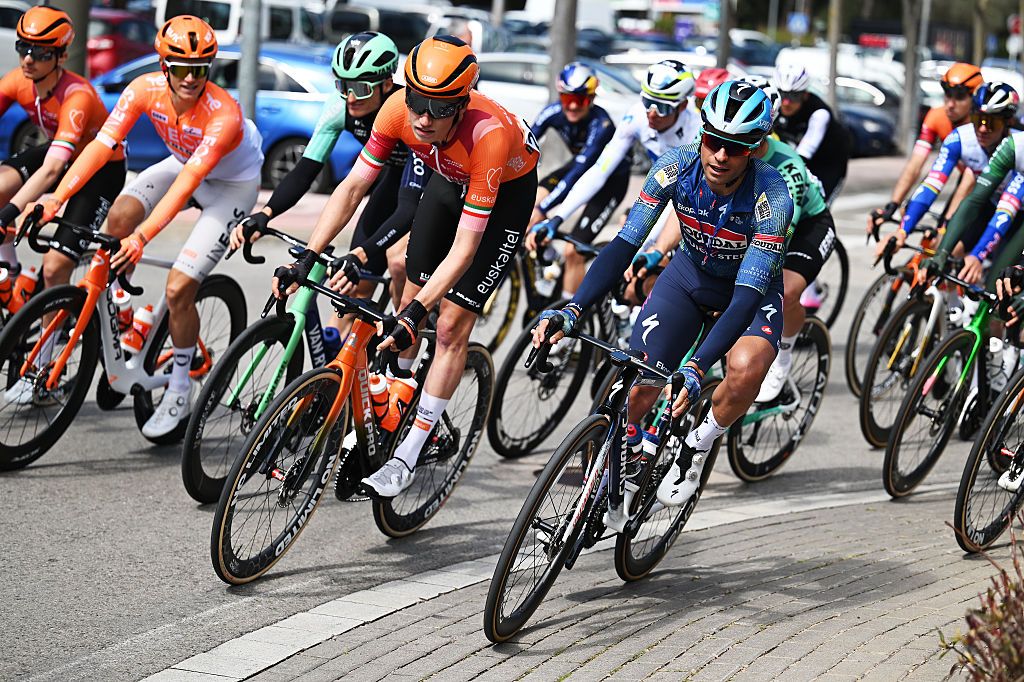
The roads always lead home
A rider's journey through cycling's superteams could end where it began. It's a familiar story, a reminder that ambition is often just a long detour on the way back to oneself.
There is a pattern to certain careers, a rhythm as old as the sport itself. A young rider of immense promise emerges from one of cycling’s heartlands, burns brightly for a time, and is drawn away by the gravitational pull of larger teams and grander budgets.
He chases victories in France, in Italy, in the employ of international superteams. And then, one day, he comes home. The prospect of Mikel Landa’s return to the orange jersey of Euskaltel-Euskadi is not a new story; it is merely the latest telling of an old one.
To understand such a move, from the WorldTour back to a team with deep roots in his home region, is to understand that some jerseys are more than just woven polyester. They are emblems of identity.
This would not simply be a late-career transfer for a rider seeking familiar roads on which to fade into retirement. It would be a profound statement about the enduring power of place in a globalised sport, and a reminder that a career’s arc is not always measured by its peak, but by the meaning found in its completion.
The Logic of the Head, The Pull of the Heart
Conventional wisdom might see this as an admission of defeat. It could be framed as a step down, a quiet retreat from the sharp end of Grand Tour contention.
The argument is simple: a rider leaves a team built to win the world’s biggest races for a smaller, ProTeam outfit. In the cold calculus of points and power meters, this is a move backward.
Landa, the perennial contender, the man of tantalising but unrealised potential, would be accepting his station. It is, from this perspective, a comfortable pension plan, a victory lap before the lights go down.
This view is not entirely without merit, but it is entirely without soul. It mistakes the map for the territory and presumes every rider’s ambition is a straight line toward the Tour de France podium.
It fails to account for the unique, almost spiritual significance of Euskaltel-Euskadi. This was never just a cycling team; for decades, it was a Basque institution, a rolling embassy for a region with a fierce and distinct identity.
The legions of fans in orange who flooded the Pyrenees were not there to cheer for a sponsor. They were there to cheer for themselves, for their home, represented by riders who were their own.
To wear that jersey is to carry a weight of history and expectation that no superteam budget can replicate. It is a cultural act as much as an athletic one.
Landa’s journey through the sport’s wealthiest teams has given him a perspective few possess. He has seen how the modern WorldTour works from the inside.
A decision to return would therefore not be one of ignorance, but of experience. He knows what he would be leaving, and he knows what he would be returning to. He would not be settling; he would be choosing.
A Bulwark Against the Modern Tide
We have seen this narrative before. We have seen the Flandrien who feels the pull of the cobbles more strongly than any foreign mountain, or the Breton who finds more meaning in a stage of the Tour de Bretagne than a classic far from home.
These attachments are the bedrock of the sport, the deep roots that prevent it from becoming a placeless, corporate spectacle.
In an age where teams change names with every new sponsor and riders switch allegiances frequently, a move like Landa’s would feel like an anchor. It would be a quiet insistence that geography still matters.
It would insist that a connection to the roads you first learned to ride on, to the people who first chanted your name, holds a value that cannot be quantified in a contract.
The modern superteam is an exercise in multinational efficiency; Euskaltel-Euskadi is an exercise in Basque identity. Landa would be trading the former for the latter.
His career may be remembered for its thrilling attacks and its near misses, for the rider he almost was. But this final chapter would re-contextualise the entire story.
The years away would no longer be a series of frustrated attempts to reach a singular goal. They would become the necessary journey of a man who had to see the world to understand the value of his own small corner of it.
Some careers are a straight line to victory. Others are a circle, drawn perfectly, back to the place they began.
This view is not entirely without merit, but it is entirely without soul. It mistakes the map for the territory.
The modern superteam is an exercise in multinational efficiency; Euskaltel-Euskadi is an exercise in Basque identity. Landa has traded the former for the latter.
Some careers are a straight line to victory. Others are a circle, drawn perfectly, back to the place they began.