
The space between the curb and the code
When a rider hops a curb, they aren't just breaking a rule. They are asking a question about what a road race really is, and whether the rulebook has an answer.
There is the road, and then there is everything else. The road is the race, the agreed-upon theatre of suffering. Everything else – the gravel shoulder, the grassy verge, the invitingly smooth arc of a concrete sidewalk – is the real world, where different rules apply.
For a professional cyclist, that boundary is supposed to be sacred. And for a few fleeting moments at the Tour de France Femmes 2026, it wasn't.
When a rider like Pauline Ferrand-Prévot takes to the pavement, they aren't blazing a new trail. They are following a well-worn desire path, the one carved by every rider who has ever seen a metre of free space in a moment of chaos and thought, mine.
A little later, when another, like Alison Jackson, is noted for a non-compliant position, they are doing the same thing in a different dimension: seeking an advantage not on the map, but on the machine itself. Often, such infractions result in little more than warnings.
And in these gentle, almost polite, admonishments lies a fundamental tension in modern cycling: the spirit of the race versus the letter of the law.
The rules, as written, are an attempt to impose order on chaos. They are a social contract for a 147-rider society moving at 50 kilometres an hour. They exist for fairness and, more importantly, for safety.
Rule 2.3.026 is not ambiguous. You race on the road. You do not race on the bits that are not the road. Simple.
But a bike race is not simple. It is a fluid, violent, unpredictable thing.
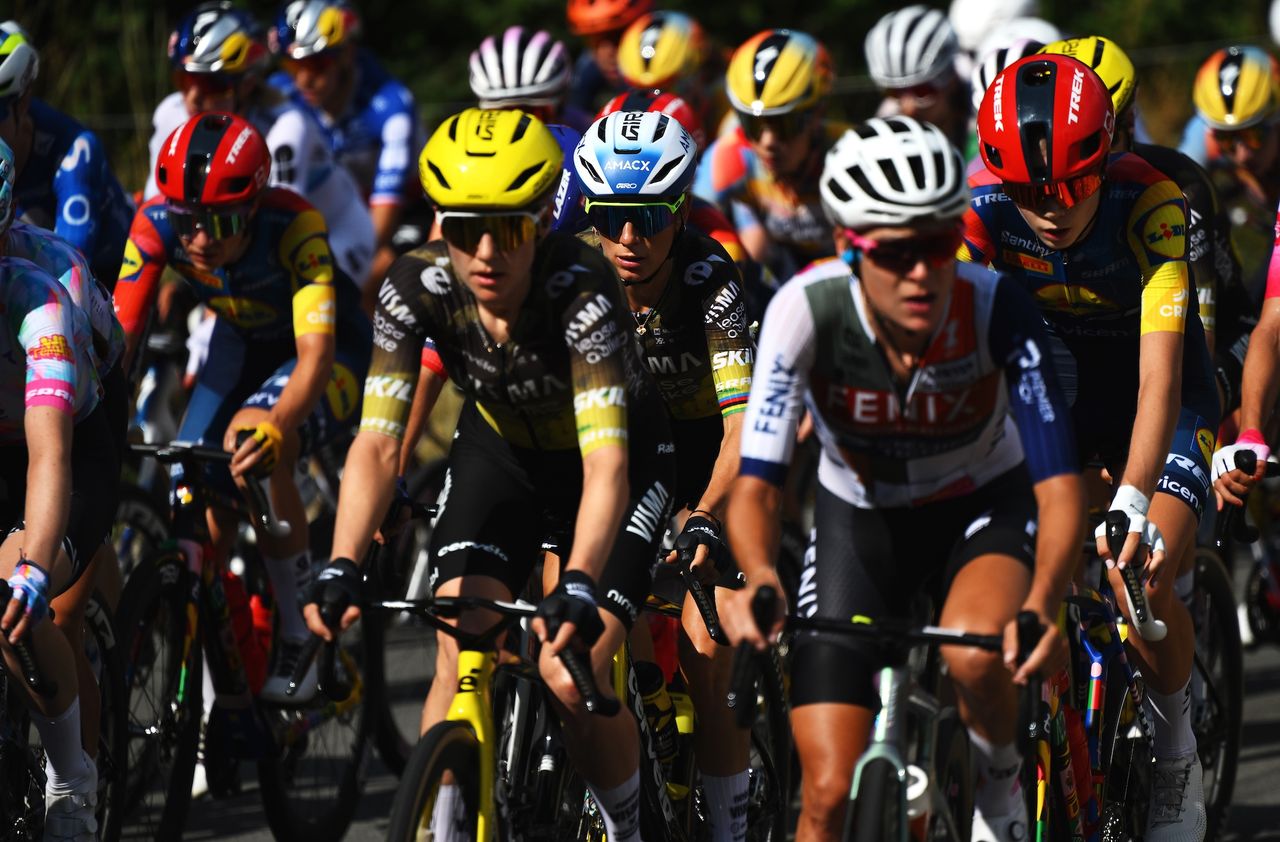
Put yourself in the wheels. You are deep in the peloton, the air thick with the smell of hot brakes and nervous sweat. The road narrows, street furniture looms, and the elastic of the bunch is snapping.
To your left is a wall of riders, a tangle of carbon and bone. To your right is a curb and, beyond it, a pristine, empty ribbon of sidewalk. It is an escape hatch, a way to hold the wheel of the teammate you are paid to protect. It is survival.
What do you see? A paragraph in the UCI regulations, or a way through?
This is the dilemma. We ask riders to be inhumanly powerful, to push their bodies to the precipice, to read a race with the tactical genius of a field marshal. We celebrate them for their aggression, their cunning, their willingness to gamble everything for a sliver of an advantage.
And then we expect them to turn off that instinct the moment their tyre hits a painted white line. It’s a paradox. The very instincts that make a rider great are the ones that lead them to the sidewalk.
The Rulebook's Answer to a Question Nobody Asked
The conventional wisdom will push back, of course. It will say, and not without reason, that rules are rules. That without them, we have anarchy.
If one rider uses the sidewalk, soon everyone will, and a bike race becomes a city-wide demolition derby. It will say that a forbidden posture is part of a necessary crackdown on dangerous riding styles. A line must be drawn.
And it’s true, a line must be drawn. But the problem is that the current system draws it in chalk, then smudges it with a wet finger.
A warning is a strange penalty. It is a formal acknowledgement of a transgression that carries no immediate consequence. It is the governing body saying, “We saw that. Don’t do it again, please.” It’s a parent counting to three.
For a professional athlete, whose entire career is a calculation of risk and reward, a warning is just another variable to factor in. The implicit message is not 'never do this', but 'don't get caught doing this too often'. It turns a clear boundary into a fuzzy suggestion.
This is where the spirit of the thing frays. The unwritten rule, the one understood in the bones of the peloton, is that you take what the road gives you. You don’t attack in a feed zone; you wait for the yellow jersey if he has a mechanical.
But that shared understanding becomes strained when the official rules seem so disconnected from the physical reality of the race. The race is fought in the margins, and the sidewalk, for a moment, becomes just another margin.
What we see at races like the Tour de France Femmes 2026 is not a scandal. It is a symptom. It is the frantic, messy, brilliant sport of cycling bumping up against its own rigid container.
It is the primal urge for advantage meeting the cold text of a rulebook. It isn't a crime, but a question. And often the answer isn't a disqualification or a time penalty, but a quiet note in a commissaire's book. A warning.
Perhaps that’s the most honest answer the sport has. An admission that it doesn’t quite know what to do with the space between the curb and the code. It’s a space where instinct lives, and for now, the rules can only stand on the edge and watch.
The very instincts that make a rider great are the ones that lead them to the sidewalk.