
Tour de France 2026 Stage 2: A Catalan Classic on Montjuïc
- Date
- Sun, Jul 5, 2026
- Distance
- 182 km
- Start
- Tarragona
- Finish
- Barcelona
- Type
- Rolling Hills
- Finish type
- Short Climb
After the collective, high-speed discipline of the opening team time trial, the 2026 Tour de France turns to individual ambition. Stage 2 is the first road stage of the race, a journey through Catalonia that swaps the smooth tarmac of the time trial course for a far more unpredictable and explosive challenge. The maillot jaune sits on the shoulders of Tadej Pogačar (UAE Team Emirates-XRG) after his team's success in Barcelona, but today is not for him or his GC rivals to win; it is a day for the puncheurs, the classics specialists who thrive on short, sharp climbs and chaotic finales.
Date: Sunday, 5 July 2026 Distance: 182 km Start location: Tarragona Finish location: Barcelona Stage type / profile: Rolling Hills
Route & context
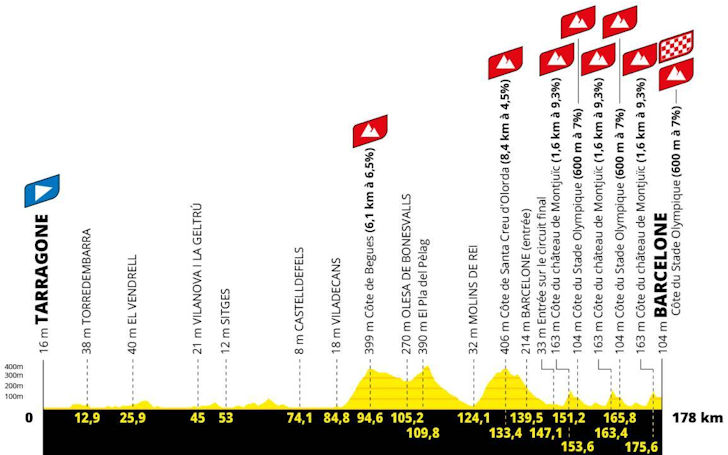
The peloton rolls out from Tarragona, a city where Roman history is etched into the very coastline. Once the capital of Hispania Citerior, its magnificent amphitheatre still watches over the Mediterranean, a silent witness to centuries of spectacle. It provides a grand backdrop for the Grand Départ Réel, as the race heads north-east along the celebrated Costa Daurada, the 'Golden Coast'. The opening 85 kilometres are almost entirely flat, hugging the shoreline through seaside towns like Sitges and Vilanova i la Geltrú. While seemingly benign, this coastal run is exposed to the sea breeze, and any crosswinds could inject early tension into the peloton.
The character of the stage changes abruptly as the route turns inland and begins to climb. The first categorised test is the Côte de Begues, a significant 6.1-kilometre ascent at an average of 6.5%. This is where the day's breakaway will look to solidify its advantage and where the pure sprinters will begin to feel the strain. After a rolling plateau, the road rises again towards the day's longest climb, the Côte de Santa Creu d'Olorda. At 8.4 kilometres, its 4.5% average gradient is more steady than severe, but its summit comes with just 48 kilometres remaining, serving as the perfect launchpad for teams to increase the pace and begin positioning their leaders for the finale.
From there, the race descends into the vibrant, sprawling metropolis of Barcelona, a city of art, architecture, and sporting ghosts. The finish is a nod to the city's Olympic heritage, a brutal finishing circuit centred on Montjuïc, the 'Hill of the Jews', which was the heart of the 1992 Olympic Games. The sting is truly in the tail: the peloton will twice tackle the punishingly steep Côte du château de Montjuïc, a 1.6-kilometre wall with a gradient of 9.3%. The final kilometre features one last ramp to the finish line at the Olympic Stadium, a 600-metre drag at 7%. It is on these slopes, with the roars of the Catalan crowd echoing around them, that the stage winner will be decided.
What to expect
This stage is perfectly designed for a puncheur. An early breakaway is guaranteed to form on the flat coastal roads, but with such a prestigious stage win and a potential yellow jersey on the line, they will likely be kept on a tight leash. Teams like Alpecin-Premier Tech, Tudor Pro Cycling Team, and Lidl-Trek have riders perfectly suited to this terrain and will have a vested interest in controlling the race for a reduced group finish.
The real race will ignite on the finishing circuit in Barcelona. The narrow, twisting roads and the repeated ascents of Montjuïc will create a war of attrition. Expect a series of attacks on each passage of the climb, shedding riders from the back and isolating the main contenders. The winner will need impeccable positioning, explosive power for the steep gradients, and the nerve to time their final move to perfection on the last ramp to the Olympic Stadium. For the GC contenders, it's a day to stay vigilant, avoid crashes in the technical finale, and not get caught out by any splits in the bunch.
Contenders
Favourites
- Mathieu van der PoelAlpecin-Premier Tech
The steep, punchy climbs of the Montjuïc circuit are perfectly suited to his explosive, classics-winning style.
- Julian AlaphilippeTudor Pro Cycling Team
A two-time World Champion on similar terrain, the Frenchman lives for these kinds of explosive, uphill finishes.
- Ben HealyEF Education-EasyPost
An aggressive rider who excels on hilly courses and has already shown great form by placing in the top 10 in the opening TTT.
- Mads PedersenLidl-Trek
A powerful rider who can survive the climbs and unleash a formidable sprint from a reduced group.
- Michael MatthewsTeam Jayco-AlUla
A classic puncheur with a fast finish, 'Bling' is a perennial contender on stages that are too tough for pure sprinters.
Outsiders
- Biniam GirmayNSN Cycling Team
Possesses the perfect combination of climbing ability and sprinting speed to conquer a hilly finish like this.
- Matej MohoricBahrain Victorious
An opportunist and a brilliant bike handler, the chaotic and technical Barcelona circuit is ideal for his attacking instincts.
- Maxim Van GilsRed Bull-BORA-hansgrohe
A proven puncheur who thrives on steep gradients and has the kick to finish off a tough stage.
- Alex AranburuCofidis
A punchy rider who is strong on home roads and excels in uphill sprints from a small group.
- Marc HirschiTudor Pro Cycling Team
Another excellent option for Tudor, Hirschi has the explosive attack needed to win on the Montjuïc slopes.
Prediction
We think Mathieu van der Poel will take the victory. The short, savagely steep slopes of Montjuïc are perfectly suited to his immense power, and after a controlled race by his Alpecin-Premier Tech team, he will have the final kick to distance his rivals and potentially take the race leader's yellow jersey.