
Tour de France Stage 11: A Sprinter's Truce on the Road to Nevers
- Date
- Wed, Jul 15, 2026
- Distance
- 161 km
- Start
- Vichy
- Finish
- Nevers
- Type
- Flat
- Finish type
- Flat
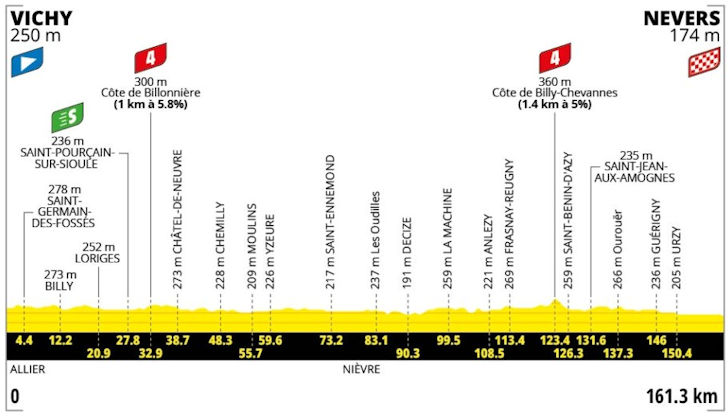
Date: Wednesday, 15 July 2026 Distance: 161 km Start location: Vichy Finish location: Nevers Stage type: Flat
After the explosive GC exchanges on the road to Le Lioran, which saw Tadej Pogačar further stamp his authority on this Tour de France, the race offers a day of détente for the overall contenders. Stage 11 is a transitional journey north, a classic mid-Tour stage designed to give the sprinters, who have patiently bided their time through the hills, their much-anticipated opportunity for glory.
From the celebrated spa town of Vichy to the ducal city of Nevers on the Loire, the parcours is almost entirely flat. For the GC teams, it is a day for active recovery, for staying upright and out of trouble. For the teams of the fast men, it is the most important day of the second week, a chance to execute a perfect lead-out and contest one of the purest bunch sprints of the race.
Route & context
The stage begins in Vichy, the ‘Queen of Spa Towns’, a place synonymous with restoration and healing. Its grand Art Nouveau and Belle Époque architecture, built around its famous thermal springs, speaks of a history catering to health-seekers, including Napoleon III himself. For a peloton nursing the wounds of a punishing first ten days, the symbolism is apt. But Vichy also holds a more sombre place in French history as the seat of Marshal Pétain's collaborationist government during the Second World War, a complex legacy that adds a layer of gravity to the day's Grand Départ.
Leaving the department of Allier, the route heads north on roads that are unlikely to trouble the peloton. An early intermediate sprint comes after just 20.9 km in Saint-Pourçain-sur-Sioule, ensuring the battle for the green jersey, currently led by Mads Pedersen, will ignite from the outset. Shortly after, the day's first categorised climb, the Côte de Billonnière (1 km at 5.8%), offers a single point for the King of the Mountains classification, a prize destined for the day's breakaway.
The heart of the stage is a long passage through the rolling agricultural landscapes of central France, a tranquil setting for the day's main drama: the careful calculation of the chase. The sprinter's teams will keep the escapees on a tight leash, measuring the kilometres and the seconds as they pass through towns like Moulins on their way towards the Nièvre department.
The final climb, the Côte de Billy-Chevannes (1.4 km at 5%), arrives with 35 km remaining to the finish. Its gentle gradient is not severe enough to trouble the main sprinters, and its distance from the line means any attacks are almost certain to be neutralised by the organised chase. From its summit, the run-in to Nevers is straightforward, setting the stage for a high-speed finale.
The finish line awaits in Nevers, a city with a rich history as the seat of the Dukes of Nevers. Its Ducal Palace is considered one of the first of the great Loire châteaux, and the city is famed for its distinctive tin-glazed earthenware, or faïence. As the peloton sweeps into the city, the fight for position will be fierce, with lead-out trains battling for control on the flat, fast roads leading to the finish line.
What to expect
This stage has all the hallmarks of a classic cat-and-mouse game between a hopeful breakaway and a determined peloton. A small group of riders from the wildcard teams will likely escape in the opening kilometres, building a lead that the sprinter's teams will meticulously control. Teams like Alpecin-Premier Tech, Soudal Quick-Step, and Lidl-Trek will share the responsibility of pacemaking, ensuring the gap never becomes insurmountable.
The GC teams will be content to sit behind the chase, their primary objective being to keep their leaders safe and conserve energy for the battles to come. The day's two minor climbs will do little to disrupt the rhythm. The real race will begin inside the final 20 kilometres, as the pace skyrockets, the breakaway is inevitably caught, and the lead-out trains begin to form and jostle for supremacy at the head of the bunch. The final few kilometres into Nevers will be a chaotic, high-stakes battle of speed and positioning, culminating in a pure bunch sprint.
Contenders
Favourites
- Tim MerlierSoudal Quick-Step
Possessing arguably the highest top-end speed in the peloton, he is a prime candidate for any pure, flat sprint.
- Jasper PhilipsenAlpecin-Premier Tech
Backed by the formidable lead-out talent of Mathieu van der Poel, he is the benchmark for consistency in Grand Tour sprints.
- Mads PedersenLidl-Trek
The current green jersey holder is in excellent form and has the power to win from a chaotic or a well-drilled sprint.
- Biniam GirmayNSN Cycling Team
Sitting second in the points classification, the versatile Eritrean has the speed to challenge the very best on a flat finish.
Outsiders
- Olav KooijDecathlon CMA CGM Team
The young Dutch sprinter is one of the fastest of the new generation and is capable of a breakthrough stage win.
- Phil BauhausBahrain Victorious
A powerful and consistent sprinter who is rarely far from the front in a bunch gallop.
- Max KanterXDS Astana Team
His position in the top five of the points classification demonstrates his consistency in reaching the finale of sprint stages.
- Michael MatthewsTeam Jayco-AlUla
While better suited to tougher finishes, his experience and bike-handling skills make him a threat in any bunch sprint.
Prediction
We think Jasper Philipsen will take the victory. While Tim Merlier's raw speed is a huge threat, the well-drilled Alpecin-Premier Tech lead-out, with Mathieu van der Poel as the final pilot, provides an advantage in positioning that is often the decisive factor in frantic Tour de France sprints.