
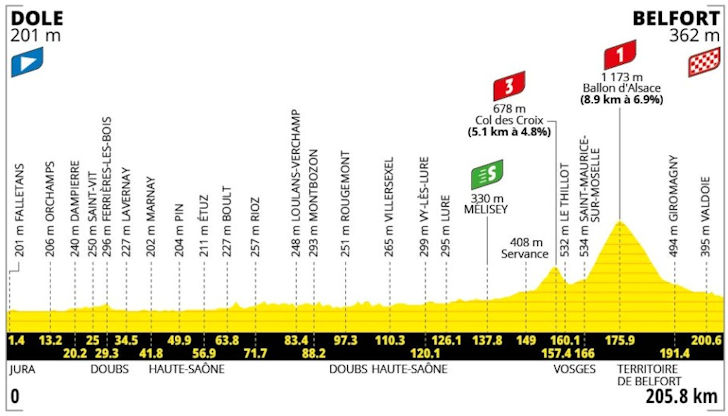
The longest day and the Lion of Belfort
- Date
- Fri, Jul 17, 2026
- Distance
- 205 km
- Start
- Dole
- Finish
- Belfort
- Type
- Rolling Hills
- Finish type
- Descent
There is a certain rhythm to a Grand Tour, a cadence that builds through the opening week and finds its crescendo in the high mountains. But between the frantic sprints and the epic GC battles lie the transition stages, the long roads that carry the race from one mountain range to another. Stage 13 is the epitome of such a day, and at 205.8 kilometres, it is the longest of the 2026 Tour de France, a marathon test of attrition that connects the Jura with the Vosges.
On paper, the route from Dole to Belfort is a classic breakaway day, a chance for the opportunists to escape the clutches of the peloton and fight for glory. But its sheer length, combined with a final, decisive act in the mountains, makes it a far more complex challenge. This is not a day for the pure sprinters, nor is it likely to tempt the GC titans into action. Instead, it is a day for the baroudeur, the hardman, the rider with the engine for a five-hour effort and the punch to finish it off. It is a slow burn that will explode into life on the slopes of one of the Tour's most historic climbs.
Route & context
The day begins in Dole, in the Jura department, a town of art and history best known as the birthplace of Louis Pasteur. The pioneering scientist’s methodical, patient approach to discovery is a fitting metaphor for the day ahead. As the peloton rolls out, they leave behind the canals of the 'Little Venice' of Franche-Comté for a long journey east. For the first 140 kilometres, the race traverses the departments of Doubs and Haute-Saône, a landscape of gentle hills, lush forests, and quiet villages that will offer little respite from the distance. This is the territory where the day’s primary narrative will be written, as a determined breakaway fights to establish an advantage. The peloton, led by the sprinters' teams initially and then the GC contenders' outfits, will be content to let them go, playing a long game of cat and mouse across the rolling countryside.
The race’s character shifts dramatically after the intermediate sprint in Melisey at kilometre 137.8. The route turns south-east and begins to climb, entering the Parc Naturel Régional des Ballons des Vosges. The air cools, the roads narrow, and the fatigue of the long day begins to bite. The first test is the Category 3 Col des Croix, a 5.1-kilometre climb at a gentle 4.8%. It is merely an aperitif for the main course: the Ballon d'Alsace. First introduced to the Tour de France in 1905, it was one of the first true mountain passes the race ever tackled, a climb that cemented the legend of René Pottier. While it may lack the fearsome gradients of modern Alpine ascents, its history and placement make it the day’s decisive feature. The Category 1 climb stretches for 8.9 kilometres at an average of 6.9%, more than enough to shatter the remnants of the breakaway and force a final, brutal selection.
From the summit, a challenging 30-kilometre run to the finish awaits. A long, technical descent, likely made treacherous by forecast rain, gives way to a fast, rolling finale into Belfort. The city itself is defined by its history of resistance, symbolised by the colossal Lion of Belfort statue, carved by Frédéric Auguste Bartholdi to commemorate the city's heroic defence during the Franco-Prussian War. It is a fitting backdrop for a stage finish that will demand courage and commitment. The rider who triumphs beneath the gaze of the lion will have earned it on a day that is far tougher than its profile might suggest.
What to expect
Everything about Stage 13 screams 'breakaway'. The length of the stage, the mostly flat opening two-thirds, and the lack of a summit finish all point to the GC teams allowing a group of non-threatening riders to contest the victory. The battle to get into the move will be fierce, and once established, the escapees will need to work together to build a sufficient buffer before the final climbs.
The race will ignite on the Ballon d'Alsace. This is where the strongest rider in the break will look to make their move, hoping to crest the summit alone or in a very select group. However, with nearly 30 kilometres remaining to the finish, a solo move is a huge gamble. The technical descent and fast run-in favour a small, powerful group of skilled bike handlers who can collaborate to hold off any chasers. With rain forecast, descending skills will be at a premium, and nerve could be as important as leg strength. For the GC contenders, it will be a day of vigilance. While they are unlikely to contest the stage win, they must navigate the final climb and treacherous descent safely, as a moment of inattention could prove costly.
Contenders
Favourites
- Alex AranburuCofidis
A strong puncheur and excellent descender in great form, perfectly suited to the stage finale.
- Ben HealyEF Education-EasyPost
The quintessential breakaway specialist whose aggressive style is made for a long, hard day like this.
- Tom PidcockPinarello-Q36.5 Pro Cycling Team
One of the world's best descenders, the technical run-in to Belfort is ideal for him if he makes the break.
- Maxim Van GilsRed Bull-BORA-hansgrohe
An explosive rider who can handle the climbs and has the versatility to win from a small group.
- Mads PedersenLidl-Trek
The green jersey has the power to survive the climbs and is lethal in a reduced group sprint.
Outsiders
- Toms SkujinsLidl-Trek
A powerful and intelligent breakaway artist who thrives on hilly, attritional stages.
- Fred WrightPinarello-Q36.5 Pro Cycling Team
A strong puncheur who is consistently active in breakaways and has the engine for a long day.
- Tim WellensUAE Team Emirates-XRG
A classic puncheur who may be granted freedom to hunt a stage win on terrain that suits him perfectly.
- Magnus CortUno-X Mobility
A renowned stage hunter who excels on rolling terrain and knows how to win from a breakaway.
- Ion IzagirreCofidis
An experienced Grand Tour stage winner and a strong descender who thrives in tough conditions.
- Biniam GirmayNSN Cycling Team
If he can limit his losses on the Ballon d'Alsace, he is one of the fastest finishers for this type of stage.
Prediction
The long run-in from the top of the Ballon d'Alsace makes this a difficult stage to predict. It requires a rider who can climb, descend with confidence, and still have a kick after more than 200 kilometres of racing. We think Alex Aranburu (Cofidis) has the perfect combination of climbing legs, descending nerve, and a fast finish to tame the Ballon d'Alsace and conquer Belfort.