
Forget the aero frame: your t-shirt is costing you minutes
We all know aero kit makes you faster at 50 km/h, but what about at an everyday 150 watts? GCN Tech's test results are a wake-up call for anyone who thinks clothing doesn't matter.
There’s a persistent idea in cycling that aerodynamic clothing is the preserve of the elite. It’s for racers, time triallists, and people who use words like ‘optimisation’ without a hint of irony. For the rest of us, the thinking goes, it’s all a bit pointless.
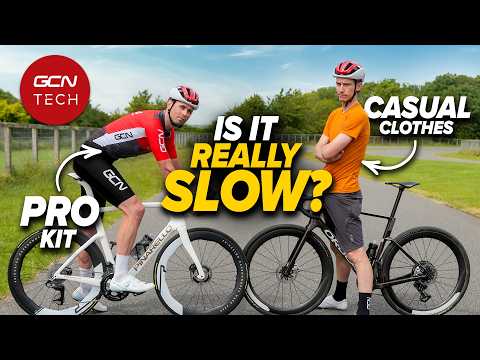
But what if that casual approach is costing you more than you think, not just in speed, but in effort? The crew at GCN Tech recently put this to the test, asking if swapping a t-shirt for a proper jersey makes a difference for an everyday cyclist. As they put it, "Is it yet another cycling myth that's ready to get busted?"
The principle is simple physics. On a flat road, most of your energy goes into overcoming aerodynamic drag. While body position is the single most important factor, what you wrap that body in also has an outsized effect.
GCN’s hypothesis was that clothing choice could be a "greater upgrade than getting an aero wheelset, or even an aero frame." They went to a closed track to find out.
The test setup
This wasn't a wind tunnel test with lasers and smoke. It was a real-world experiment designed to measure a tangible outcome: time. Presenters Simon and Alex rode a 1.5 km circuit under controlled conditions.
The first variable was clothing. 'Casual Kit' meant a t-shirt and shorts for Simon and, absurdly, a full business suit for Alex. The control was 'Aero Kit' – standard, close-fitting cycling lycra.
The second was effort. They held two power outputs constant using a power meter: 150 W, an achievable endurance pace, and 200 W, a brisker effort. By fixing the power and measuring lap time, they could isolate the clothing's effect on speed for the exact same work.
It’s a simple, effective protocol: same bike, same rider, same track, same power. The only significant variable was the clothing flapping in the wind.
The results: a drag-racing drag act
The numbers GCN recorded are staggering. They don't represent marginal gains; they represent a fundamental difference in efficiency.
At the more relatable effort of 150 W, Simon completed a 1.5 km lap in 3 minutes and 28 seconds in his t-shirt and shorts. Switching to proper cycling kit, his time for the same effort dropped to 3 minutes and 6 seconds – a 22-second saving on a single lap. Alex, in his office suit, was 30 seconds slower per lap than in lycra.
Extrapolate that over a modest 30 km ride, and you’re looking at a seven-minute difference for the same energy expenditure. You haven't gotten any fitter; you've just stopped acting like a parachute.
When the effort increased to 200 W, the time gaps narrowed but remained immense. Simon's casual kit was 10 seconds slower per lap (3:01 vs 2:51), while Alex's suit still cost him 23 seconds per lap. Even the presenters were taken aback, with one noting the gap at 200 W was "a result that most certainly surprised me."
These findings echo a previous GCN test measuring the power required to hold 40 km/h. In casual gym kit, it took 382.3 W; in performance cycling kit, just 307.4 W. That’s a 75-watt penalty – a 20% increase in power – for wearing loose clothing at speed.
The verdict: cheaper than carbon
The data shows that for any rider, at any speed, clothing choice has a dramatic impact on performance. The key insight from the GCN test isn't just about going faster, but about efficiency. As they put it, with better kit, "You will go further for the same effort, or you will go the same speed and the same distance for less effort."
For someone trying to hang on during a group ride or simply make a long day in the saddle more pleasant, that's a huge advantage.
The final piece of the puzzle is cost. While top-tier performance clothing can run to £500, GCN notes that savvy shopping can assemble an effective kit for around £150.
Compare that £150 to other aerodynamic upgrades. A set of deep-section carbon wheels costs £1,000 or more for a saving often measured in single-digit watts. A new aero frame can be thousands. The return on investment from a decent jersey and bib shorts is off the charts.
This isn't to say equipment doesn't matter. But the evidence is clear: before you spend four figures on a new frameset, check your wardrobe. That flappy t-shirt isn't just a style choice; it’s a handbrake.
You haven't gotten any fitter; you've just stopped acting like a parachute.
The return on investment from a decent jersey and bib shorts is off the charts.