
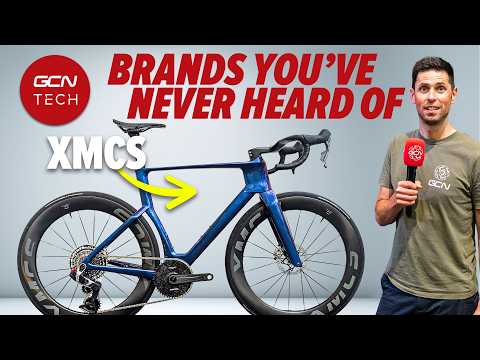
Beyond the Big Brands: The real tech trends hiding at Eurobike
The household names might be staying away, but Eurobike's halls are still packed with genuine innovation. Inside, we find fast-charging e-bikes, ultra-light carbon, and boutique hubs that show what's really next.
Eurobike isn't the show it used to be. As GCN Tech noted in a recent tour of the halls, if you walk the floor expecting to see all the marquee brands from five years ago, you'll be disappointed.
But that absence creates a vacuum, and it's being filled by the engine room of the industry: specialist component makers, OEM factories, and emerging brands, many from the Far East.
What you get is a less polished but arguably more interesting view of where cycling tech is heading. This is where you see the raw engineering, often from the same factories that produce parts for the household names. It’s a showcase of blistering-paced evolution, from the hyper-specific to the mass-market.
The Niche, Perfected
Take Rohloff. Not a new name, but one that represents a deep, focused niche. Their 14-speed internally geared hub is, as the presenter put it, "exquisite." Seen on the show floor in an anodised purple finish and hooked up to TRP levers for electronic shifting, it's a reminder that the derailleur isn't the only way.
For tourists, commuters, or anyone who values robustness over the last gram, an internally geared hub is a compelling proposition. Everything is sealed from the elements, maintenance is minimal, and you can shift at a standstill.
Adding precise electronic control just modernises the package. It's a "work of art," yes, but it’s a functional one, representing the steady refinement of a proven alternative.
Solving Problems That Actually Exist
While a Rohloff hub is a beautiful piece of engineering, it's not solving a problem most riders complain about daily. E-bike charging times, however, are. At the Hepha stand, GCN highlighted an award-winning e-bike with a standout feature: a claimed charge time of "empty to almost full in around 20 minutes."
For many e-bike users, charging is an overnight affair. A 20-minute top-up is transformative, turning a limitation into a coffee-break inconvenience. This is practical engineering that genuinely makes a difference, and it’s coming from a brand you've likely never heard of.
This e-bike ecosystem was visible elsewhere, too. The Digiwise booth was full of digital displays, and one large-screen model was flagged as not being UCI-legal under new rules—a perfect illustration of how the utility-focused e-bike world is diverging from the constraints of professional road racing.
The Gram-Shaving Game
Of course, it wouldn't be a bike show without a healthy dose of weight-weenie obsession. The Apex stand delivered, with a spread of carbon fibre components and their claimed weights proudly displayed. This is where the numbers do the talking.
A claimed weight of just 295 g for a complete carbon crankset assembly. A one-piece carbon spoke wheelset quoted at 1,200 g. A carbon rim at a claimed 380 g. These figures are seriously competitive.
Brands like Apex and wheel-maker Farsports, with its carbon-spoked wheels and flashy polished chrome hubs, are demonstrating that high-performance, low-weight componentry is not the exclusive domain of a few big players. They offer compelling options for builders and upgraders who know what they're looking for.
When Does Bespoke Become Bizarre?
And then you see something that makes you stop and ask... why? At one booth, a smart trainer, handmade from polished wood, was on display with a price tag of €13,000. GCN’s presenter suggested it could be the "centerpiece of a room," and he's not wrong. It's beautiful.
But is a €13,000 handmade wooden smart trainer a serious training tool, or is it functional art? The answer is probably 'yes'. It's a statement piece for someone for whom cost is no object and aesthetics are paramount.
It’s a fascinating, if extreme, example of cycling tech crossing over into luxury furniture design. Don't expect to see one at your next Zwift race.
The Verdict
Walking the virtual halls of Eurobike via GCN's camera reveals a simple truth: the heart of the cycling industry is still beating strong, but the rhythm is coming from different places.
The sheer scale of manufacturing was on display at stands like Dynem Mobility, an Indian manufacturer with a claimed capacity of 500,000 bikes from its 240,000 sq. ft. factory. That’s the muscle that builds the bikes we all ride.
So while the show may feel different, it's more transparent. You see the innovators, the specialists, and the manufacturing giants without the layer of marketing from the big Western brands.
The key takeaway is that technology continues to march forward, solving real problems and pushing performance boundaries. You just might not recognize the name on the down tube—yet.
A 20-minute top-up is transformative, turning a limitation into a coffee-break inconvenience.
Is a €13,000 handmade wooden smart trainer a serious training tool, or is it functional art? The answer is probably 'yes'.
The key takeaway is that technology continues to march forward, solving real problems and pushing performance boundaries. You just might not recognize the name on the down tube—yet.